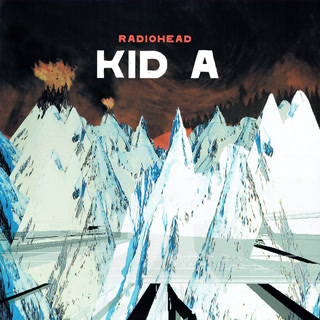
Radiohead · 2000 · Studio album
Kid A tuning.
E Standard at concert pitch (A 440), measured on the LP. 5 of 10 songs are tuned differently.
Album tuning
E Standard
At concert pitch (A 440), measured on the LP.
MeasuredFrom tabs
Measured by TuneLit
At concert pitch
| Source | Offset | Equivalent A | Songs | Spread | Confidence |
|---|---|---|---|---|---|
| 2LP, XL Recordings XLLP782B (2016 reissue) | +2.2 ¢ | A 440.6 | 10 | +1.9 to +2.5 ¢ | High |
Before we measured, sources said: E Standard, with no pitch given (community).
Built largely on synthesisers, samples and processed sound, with guitar on a few songs: How to Disappear Completely with a capo, Optimistic in Drop D, the rest in standard tuning. The 2016 XL LP sits at concert pitch (A ≈ 440.6). The electronic pieces sit lower: Everything in Its Right Place about 19 ¢ flat, Idioteque 23 and Treefingers 25. Optimistic is about 12 ¢ sharp.
10 songs · 5 tuned differently
Every song, ready to tune
Tune opens the tuner in that song's tuning, pitch included. Play along opens the song player set to that tuning, so the track plays in yours. What the labels mean
-
1. Everything in Its Right Place
Different pitch
E Standard −19 ¢Measured
Notes
No guitar: Thom Yorke's chords on a Prophet-5 synthesiser and his digitally cut-up voice (Wikipedia). About 19 ¢ flat (A ≈ 435).
Built on keyboards, samples or loops, so the album's standard tuning stands for any guitar you add; TuneLit measured the song on its own because its pitch differs from the album's.
-
2. Kid A
E StandardMeasured
Notes
Built on keyboards and a heavily processed vocal; there is little guitar to follow.
-
3. The National Anthem
E StandardMeasured
Notes
Built on a looping bass riff, with a brass section; the tabs keep the bass in standard tuning. The King of Gear notes Thom Yorke used Drop D for it on stage in 2012.
-
4. How to Disappear Completely
Different pitch
E Standard −6 ¢Measured
Notes
Thom Yorke's acoustic in standard tuning with a capo at the 2nd fret, under strings and ondes Martenot. About 6 ¢ flat.
The King of Gear lists Thom Yorke's acoustic with a capo at the 2nd fret, and an Ultimate Guitar transcription has the same capo. Wikipedia describes the strummed chord as a D with an added ninth.
-
5. Treefingers
Different pitch
E Standard −25 ¢Measured
Notes
An ambient instrumental made by digitally processing Ed O'Brien's guitar loops (Wikipedia); nothing to tune along to. About 25 ¢ flat.
Built on keyboards, samples or loops, so the album's standard tuning stands for any guitar you add; TuneLit measured the song on its own because its pitch differs from the album's.
-
6. Optimistic
Different tuning
Drop D +12 ¢Measured
Notes
How to get there from the album's E Standard: String 6 down a whole step (E → D); the other strings stay.
Drop D on the guitars and on the bass, about 12 ¢ sharp (A ≈ 443).
The Songsterr tab has Thom Yorke's and Ed O'Brien's guitars in Drop D and the bass dropped to D too; The King of Gear lists Thom in Drop D (or D A D G B D), and Jonny Greenwood live in D A D A♯ C D.
Bass: Bass Drop D +12 ¢ Tune bass
-
7. In Limbo
E StandardMeasured
-
8. Idioteque
Different pitch
E Standard −23 ¢Measured
Notes
No guitar: a drum machine Jonny Greenwood built from synthesiser modules and a chord phrase sampled from Paul Lansky's computer piece Mild und leise (Wikipedia). About 23 ¢ flat (A ≈ 434).
Built on keyboards, samples or loops, so the album's standard tuning stands for any guitar you add; TuneLit measured the song on its own because its pitch differs from the album's.
-
9. Morning Bell
E StandardMeasured
-
10. Motion Picture Soundtrack
E StandardMeasured
Notes
An old song (written before Creep) recast for organ, harp and strings.
What the labels mean
- Measured
- TuneLit measured the pitch on an original CD or LP. The tuning name still comes from the sources.
- Official
- The band, a member, their producer or their guitar tech said it.
- Widely reported
- Trusted outlets, guides and tabs agree, but the band did not say it directly.
- From tabs
- From community tabs, or from players who tune along with the record.
- Disputed
- Sources disagree. The likeliest setting is shown; the notes name the other one.
Each song shows one label, the strongest it has, in this order. How we measure recordings →
Questions
What tuning is Kid A in?
Radiohead recorded Kid A (2000) in E Standard at concert pitch (A 440), measured by TuneLit on the LP. 5 songs use other tunings or pitches, listed song by song on this page.
Why does Kid A sound out of tune with my guitar?
Everything in Its Right Place sits about 19 cents flat (A ≈ 435), so a guitar tuned to A 440 clashes with it. The Tune buttons on this page set the tuner's reference to match the record, song by song, so you only tune the strings.