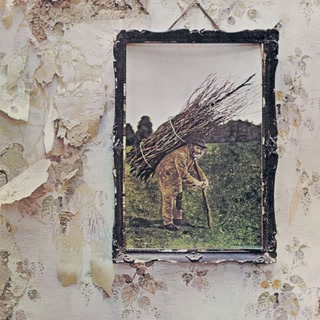
Led Zeppelin · 1971 · Studio album
Led Zeppelin IV tuning.
E Standard, about 11 cents flat (A ≈ 437), measured on the CD. 5 of 8 songs are tuned differently.
Album tuning
E Standard −11 ¢
About 11 cents flat (A ≈ 437), measured on the CD.
MeasuredCommunity
Measured by TuneLit
11 ¢ flat
| Source | Offset | Equivalent A | Songs | Spread | Confidence |
|---|---|---|---|---|---|
| CD, Atlantic, original 1980s mastering | −11.0 ¢ | A 437.2 | 8 | Too few songs | Low |
Before we measured, sources said: E Standard, with no pitch given (community).
E Standard, about 11 ¢ flat (A ≈ 437) on the original 1980s CD, with three tunings beside it: double drop D for Going to California, open F for When the Levee Breaks, and Page on Jones's mandolin for The Battle of Evermore. The songs spread more than on any other album: Stairway to Heaven is 8 ¢ sharp, Misty Mountain Hop 25 ¢ flat, The Battle of Evermore 29 ¢ flat.
8 songs · 5 tuned differently
Every song, ready to tune
Tune opens the tuner in that song's tuning, pitch included. Play along opens the song player set to that tuning, so the track plays in yours. What the labels mean
-
1. Black Dog
E Standard −11 ¢Measured
Notes
The riff is in E Standard; the song sets the album value with Four Sticks (about 10 ¢ flat).
-
2. Rock and Roll
E Standard −11 ¢Measured
Notes
Doubtful pitch: TuneLit found no steady reading anywhere in the track, so the Tune button uses the album's −11 ¢. Its rough reading points about 40 ¢ flat, like Boogie with Stu, which was recorded at the same Headley Grange session with Ian Stewart on piano. If the guitar sounds sharp, try A ≈ 430.
-
3. The Battle of Evermore
Different pitch
E Standard −29 ¢Measured
Notes
For the mandolin, tune G D A E as usual; for the guitar arrangement, E Standard. TuneLit measured about 29 ¢ flat (A ≈ 432.6) all the way through.
Page plays Jones's mandolin (tuned G D A E as usual) and Jones plays acoustic guitar in standard tuning; the tab also arranges the mandolin part for a guitar in E Standard.
-
4. Stairway to Heaven
Different pitch
E Standard +8 ¢Measured
Notes
Acoustic, 12-string and electric parts, all in E Standard. TuneLit measured about 8 ¢ sharp (A ≈ 442), some 19 ¢ above the songs around it.
The acoustic, 12-string and electric parts are all tabbed in E Standard.
-
5. Misty Mountain Hop
Different pitch
E Standard −25 ¢Measured
Notes
TuneLit measured about 25 ¢ flat (A ≈ 433.6), steady over the whole track.
Tabbed in E Standard; Jones plays the electric piano riff.
-
6. Four Sticks
E Standard −11 ¢Measured
-
7. Going to California
Different tuning
Double Drop D −11 ¢Measured
Notes
How to get there from the album's E Standard: String 6 down a whole step (E → D), String 1 down a whole step (E → D); the other strings stay.
Double drop D. TuneLit measured about 6 ¢ flat, close to its album, so the button uses the album's −11 ¢.
Page's acoustic is in double drop D (D A D G B D); John Paul Jones plays the mandolin parts.
-
8. When the Levee Breaks
Different tuning
C2 F2 C3 F3 A3 C4 −11 ¢Measured
Notes
How to get there from the album's E Standard: String 6 down 4 half steps (E → C), String 5 down 4 half steps (A → F), String 4 down a whole step (D → C), String 3 down a whole step (G → F), String 2 down a whole step (B → A), String 1 down 4 half steps (E → C).
Open F. Parts were recorded at another speed and slowed down. TuneLit reads most of the track 16 to 20 ¢ flat, and the end lower still, but the main reading fell just short of the confidence needed for its own value, so the button uses the album's −11 ¢. Lower the reference toward A 435 if the slide sounds sharp.
Tabbed in open F (C F C F A C) for the slide and 12-string parts. Parts of the track were recorded at a different speed and slowed down in the mix.
On its own, this song measures flatter: CD −19.6 ¢ (medium confidence). Tune uses the album's −11 ¢.
What the labels mean
- Measured
- TuneLit measured the pitch on an original CD or LP. The tuning name still comes from the sources.
- Official
- The band, a member, their producer or their guitar tech said it.
- Widely reported
- Trusted outlets, guides and tabs agree, but the band did not say it directly.
- Community
- From community tabs, or from players who tune along with the record.
- Disputed
- Sources disagree. The likeliest setting is shown; the notes name the other one.
Each song shows one label, the strongest it has, in this order. How we measure recordings →
Questions
What tuning is Led Zeppelin IV in?
Led Zeppelin recorded Led Zeppelin IV (1971) in E Standard, about 11 cents flat (A ≈ 437), measured by TuneLit on the CD. 5 songs use other tunings or pitches, listed song by song on this page.
Why does Led Zeppelin IV sound out of tune with my guitar?
The record sits about 11 cents flat (A ≈ 437), so a guitar tuned to A 440 clashes with it. The Tune buttons on this page set the tuner's reference to match the record, song by song, so you only tune the strings.