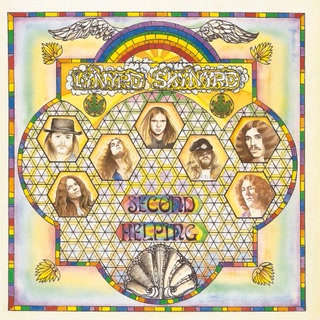
Lynyrd Skynyrd · 1974 · Studio album
Second Helping tuning.
E Standard, about 11 cents flat (A ≈ 437), measured on the CD. 3 of 8 songs are tuned differently.
Album tuning
E Standard −11 ¢
About 11 cents flat (A ≈ 437), measured on the CD.
MeasuredFrom tabs
Measured by TuneLit
11 ¢ flat
| Source | Offset | Equivalent A | Songs | Spread | Confidence |
|---|---|---|---|---|---|
| CD, expanded edition, AAC copy | −10.6 ¢ | A 437.3 | 8 | −11.1 to −7.7 ¢ | High |
Before we measured, sources said: E Standard, with no pitch given (community).
From April 1974. Normal tuning by the record. TuneLit measured an expanded CD edition about 11 ¢ flat (A ≈ 437.2), with Sweet Home Alabama exactly on that value.
8 songs · 3 tuned differently
Every song, ready to tune
Tune opens the tuner in that song's tuning, pitch included. Play along opens the song player set to that tuning, so the track plays in yours. What the labels mean
-
1. Sweet Home Alabama
E Standard −11 ¢Measured
Notes
E Standard; the reading for Sweet Home Alabama is −10.6 ¢, a sure reading, the same as the album's.
-
2. I Need You
E Standard −11 ¢Measured
Notes
I Need You: E Standard. Its own reading, −7.7 ¢, is within a few cents of the album's.
-
3. Don't Ask Me No Questions
E Standard −11 ¢Measured
Notes
Don't Ask Me No Questions: E Standard. Its own reading is −3.8 ¢, a little above the album's; nudge the tuner if string 6 sounds flat against the record.
-
4. Working for MCA
Different pitch
E Standard −23 ¢Measured
Notes
E Standard, and about 23 ¢ flat (A ≈ 434.2): Working for MCA was measured 12 ¢ apart from the songs around it, so its Tune button differs from the album's.
Normal tuning, by the record: the bass sits on its low E and does not go below it.
-
5. The Ballad of Curtis Loew
Different pitch
E Standard +5 ¢Measured
Notes
The Ballad of Curtis Loew has a setting of its own: E Standard, about 5 ¢ sharp (A ≈ 441.3). That is 16 ¢ from the album's pitch, too far to share one setting.
Normal tuning, by the record: the bass sits on its low E and does not go below it.
-
6. Swamp Music
Different pitch
E StandardMeasured
Notes
E Standard. Swamp Music sits at concert pitch by TuneLit's measurement (a fair reading, +1.4 ¢), 11 ¢ away from its album, and carries its own setting.
Normal tuning, by the record: the bass sits on its low E and does not go below it.
-
7. The Needle and the Spoon
E Standard −11 ¢Measured
Notes
E Standard; the reading for The Needle and the Spoon is −11.1 ¢, a sure reading, the same as the album's.
-
8. Call Me the Breeze
E Standard −11 ¢Measured
Notes
Call Me the Breeze sits exactly where its album does: E Standard, −12.6 ¢ by TuneLit's measurement.
What the labels mean
- Measured
- TuneLit measured the pitch on an original CD or LP. The tuning name still comes from the sources.
- Official
- The band, a member, their producer or their guitar tech said it.
- Widely reported
- Trusted outlets, guides and tabs agree, but the band did not say it directly.
- From tabs
- From community tabs, or from players who tune along with the record.
- Disputed
- Sources disagree. The likeliest setting is shown; the notes name the other one.
Each song shows one label, the strongest it has, in this order. How we measure recordings →
Questions
What tuning is Second Helping in?
Lynyrd Skynyrd recorded Second Helping (1974) in E Standard, about 11 cents flat (A ≈ 437), measured by TuneLit on the CD. Working for MCA uses E Standard −23 ¢; The Ballad of Curtis Loew uses E Standard +5 ¢; Swamp Music uses E Standard.
Why does Second Helping sound out of tune with my guitar?
The record sits about 11 cents flat (A ≈ 437), so a guitar tuned to A 440 clashes with it. The Tune buttons on this page set the tuner's reference to match the record, song by song, so you only tune the strings.