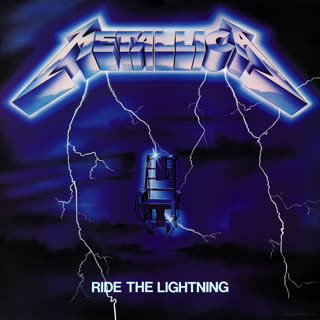
Metallica · 1984 · Studio album
Ride the Lightning tuning.
E Standard, about 8 cents sharp (A ≈ 442), measured on the CD and the original LP. 3 of 8 songs are tuned differently.
Album tuning
E Standard +8 ¢
About 8 cents sharp (A ≈ 442), measured on the CD and the original LP.
MeasuredCommunity
Measured by TuneLit
8 ¢ sharp
| Source | Offset | Equivalent A | Songs | Spread | Confidence |
|---|---|---|---|---|---|
| CD edition Used for the Tune buttons | +7.9 ¢ | A 442 | 8 | +7.9 to +13.8 ¢ | Medium |
| Original LP, Megaforce MRI 769 | +2.8 ¢ | A 440.7 | 8 | +2.8 to +5.7 ¢ | Medium |
Before we measured, sources said: E Standard, about 20 cents sharp (community).
The album is in E Standard, but it plays sharp of A440 by an amount that changes from song to song. Players quote A=444 to A=445; TuneLit measured about +8 ¢ for the album as a whole (A ≈ 442), +22 ¢ for Fade to Black and Creeping Death and +46 ¢ for For Whom the Bell Tolls, and the original LP shows the same pattern. One guide blames a mastering mistake, and fan forums say producer Flemming Rasmussen sped the tape up during the mix, but no original interview confirming that could be traced. In concert since the Load era these songs are played half a step down in E♭, so tune to E♭ for modern live recordings.
8 songs · 3 tuned differently
Every song, ready to tune
Tune opens the tuner in that song's tuning, pitch included. Play along opens the song player set to that tuning, so the track plays in yours. What the labels mean
-
1. Fight Fire with Fire
E Standard +8 ¢Measured
-
2. Ride the Lightning
E Standard +8 ¢Measured
-
3. For Whom the Bell Tolls
Different pitch
E Standard +46 ¢Measured
Notes
TuneLit measured the studio version at +46 ¢ (A ≈ 451.7), close to a quarter step above E Standard and far more than the rest of Ride the Lightning. One explanation is a sped-up tape; the other is that the guitars were pitched to the opening bell sound, which Lars Ulrich created by hitting an anvil, combined with a bell from a sound-effects recording. Live, the song is played in E♭ with the rest of the set.
Sources put it about a quarter step (≈ +50 ¢) above E Standard; TuneLit measured +46 ¢ on the CD and +40 ¢ on the LP, far sharper than the rest of the album. Tab sites carry separate versions retuned to A440.
-
4. Fade to Black
Different pitch
E Standard +22 ¢Measured
Notes
Measured +22 ¢ (A ≈ 445.5), about 14 ¢ sharper than the rest of the album.
Players quote about +15 to +20 ¢ for the album. TuneLit measured this song at +22 ¢ on the CD and +18 ¢ on the LP, about 14 to 16 ¢ above the rest of the album on both.
-
5. Trapped Under Ice
E Standard +8 ¢Measured
-
6. Escape
E Standard +8 ¢Measured
-
7. Creeping Death
Different pitch
E Standard +22 ¢Measured
Notes
Measured +22 ¢ (A ≈ 445.7), sharper than the rest of the album.
Players quote about +15 to +20 ¢ for the album. TuneLit measured this song at +22 ¢ on the CD and +16 ¢ on the LP, above the rest of the album on both.
-
8. The Call of Ktulu
E Standard +8 ¢Measured
What the labels mean
- Measured
- TuneLit measured the pitch on an original CD or LP. The tuning name still comes from the sources.
- Official
- The band, a member, their producer or their guitar tech said it.
- Widely reported
- Trusted outlets, guides and tabs agree, but the band did not say it directly.
- Community
- From community tabs, or from players who tune along with the record.
- Disputed
- Sources disagree. The likeliest setting is shown; the notes name the other one.
Each song shows one label, the strongest it has, in this order. How we measure recordings →
Questions
What tuning is Ride the Lightning in?
Metallica recorded Ride the Lightning (1984) in E Standard, about 8 cents sharp (A ≈ 442), measured by TuneLit on the CD and the original LP. For Whom the Bell Tolls uses E Standard +46 ¢; Fade to Black and Creeping Death use E Standard +22 ¢.
Why does Ride the Lightning sound out of tune with my guitar?
For Whom the Bell Tolls sits about 46 cents sharp (A ≈ 452), so a guitar tuned to A 440 clashes with it. The Tune buttons on this page set the tuner's reference to match the record, song by song, so you only tune the strings.