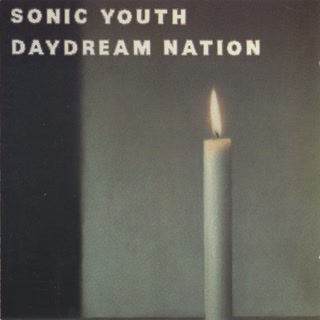
Sonic Youth · 1988 · Studio album
Daydream Nation tuning.
A2 C3 C3 G3 G♯3 C4 at concert pitch (A 440), measured on the CD. 9 of 12 songs are tuned differently.
Album tuning
A2 C3 C3 G3 G♯3 C4
At concert pitch (A 440), measured on the CD.
MeasuredWidely reported
Measured by TuneLit
At concert pitch
| Source | Offset | Equivalent A | Songs | Spread | Confidence |
|---|---|---|---|---|---|
| CD, Blast First BFFP 34 CD (1988) | +2.8 ¢ | A 440.7 | 12 | Too few songs | High |
Before we measured, sources said: A2 C3 C3 G3 G♯3 C4, with no pitch given (widely reported).
The double album that made the tunings famous: Guitar Player printed most of them in 1989 and 1991, and nearly every song pairs two different ones, one per guitar. TuneLit measured the Blast First CD at concert pitch (+3 ¢) with the songs tightly grouped, except Rain King, about 46 ¢ flat (A ≈ 428.4): almost halfway between two notes. When the band relearned the album for its 2007 concerts, Rain King's tuning was the hardest one to reconstruct. Providence (piano and amplifier hum) reads 16 ¢ sharp.
12 songs · 9 tuned differently
Every song, ready to tune
Tune opens the tuner in that song's tuning, pitch included. Play along opens the song player set to that tuning, so the track plays in yours. What the labels mean
-
Notes
How to get there from E Standard: String 6 up 3 half steps (E → G), String 4 down 3 half steps (D → B), String 3 down 5 half steps (G → D), String 2 down 7 half steps (B → E), String 1 down 9 half steps (E → G); the other strings stay.
String 1 sits 9 half steps below its standard E4. On a normal set (.010) it keeps only about 35 % of its usual tension and flaps. For the usual feel use about a .017 string, or a baritone guitar.
The main riff is Thurston's G A B D E G guitar; Lee doubles and drones on G G D D G G.
Thurston's guitar: G A B D E G, a pentatonic tuning with no two strings alike. Lee Ranaldo's guitar: G G D D G G. Both published in Guitar Player (1989 and 1991).
On its own, this song measures sharper: CD +10.7 ¢. Tune uses the album's A 440.
-
2. Silver Rocket
A2 C3 C3 G3 G♯3 C4Measured
Notes
Thurston in A C C G G♯ C, Lee in A A E E A A, both printed by Guitar Player and in the 1994 book Confusion Is Next.
On its own, this song measures sharper: CD +8.0 ¢. Tune uses the album's A 440.
-
3. The Sprawl
Different tuning
C3 C3 E3 B3 G3 D4Measured
Notes
How to get there from the album's A2 C3 C3 G3 G♯3 C4: String 6 up 3 half steps (A → C), String 4 up 4 half steps (C → E), String 3 up 4 half steps (G → B), String 2 down a half step (G♯ → G), String 1 up a whole step (C → D); the other strings stay.
Thurston's guitar: C C E B G D, a high-pitched tuning with its lowest string on the C below middle C. Lee's guitar: G G D D G G. From a 1989 video.
-
4. 'Cross the Breeze
Different tuning
C3 C3 E3 B3 G3 D4Measured
Notes
How to get there from the album's A2 C3 C3 G3 G♯3 C4: String 6 up 3 half steps (A → C), String 4 up 4 half steps (C → E), String 3 up 4 half steps (G → B), String 2 down a half step (G♯ → G), String 1 up a whole step (C → D); the other strings stay.
Thurston's guitar: C C E B G D; Lee's guitar: E E E E F♯ F♯. Both in Guitar Player, February 1989.
-
5. Eric's Trip
Different tuning
E2 B2 E3 E3 A3 B3Measured
Notes
How to get there from E Standard: String 5 up a whole step (A → B), String 4 up a whole step (D → E), String 3 down 3 half steps (G → E), String 2 down a whole step (B → A), String 1 down 5 half steps (E → B); the other strings stay.
String 1 sits 5 half steps below its standard E4. On a normal set (.010) it keeps only about 55 % of its usual tension and feels loose. For the usual feel use about a .013 string, or a baritone guitar.
Lee sings and plays the lead part.
Lee Ranaldo's guitar, the song's lead voice: E B E E A B (Guitar Player 1989 and 1991). Thurston plays an old four-string "Drifter" guitar strung with bass strings, two on B and two on F♯, fretted with a drumstick.
-
6. Total Trash
Different tuning
G2 G2 D3 D3 D♯3 D♯3Measured
Notes
How to get there from E Standard: String 6 up 3 half steps (E → G), String 5 down a whole step (A → G), String 3 down 5 half steps (G → D), String 2 down 8 half steps (B → E♭), String 1 down 13 half steps (E → E♭); the other strings stay.
String 1 sits 13 half steps below its standard E4. On a normal set (.010) it keeps only about 20 % of its usual tension and flaps. For the usual feel use about a .021 string, or a baritone guitar.
Thurston's guitar: G G D D D♯ D♯ (Guitar Player, February 1989). Lee's guitar: G G D D G G, according to the band's techs.
-
7. Hey Joni
Different tuning
E2 B2 E3 E3 A3 B3Measured
Notes
How to get there from E Standard: String 5 up a whole step (A → B), String 4 up a whole step (D → E), String 3 down 3 half steps (G → E), String 2 down a whole step (B → A), String 1 down 5 half steps (E → B); the other strings stay.
String 1 sits 5 half steps below its standard E4. On a normal set (.010) it keeps only about 55 % of its usual tension and feels loose. For the usual feel use about a .013 string, or a baritone guitar.
Lee sings and leads.
Lee's guitar: E B E E A B (Guitar Player 1989 and 1991). Thurston's guitar: G A B D E G, the Teen Age Riot tuning.
-
8. Providence
Different pitch
A2 C3 C3 G3 G♯3 C4 +16 ¢Measured
Notes
No guitar to tune: Thurston's piano, the hum of an overheating amplifier and a phone message from Mike Watt.
No guitar on this track (piano, amplifier hum and a phone message from Mike Watt). Listed with the album's tuning only so the record's pitch can be set.
-
9. Candle
A2 C3 C3 G3 G♯3 C4Measured
Notes
Thurston in A C C G G♯ C (Guitar Player 1989 and 1991), Lee in A A E E A A.
-
10. Rain King
Different tuning
E2 B2 E3 E3 A3 A3 −46 ¢Measured
Notes
How to get there from E Standard: String 5 up a whole step (A → B), String 4 up a whole step (D → E), String 3 down 3 half steps (G → E), String 2 down a whole step (B → A), String 1 down 7 half steps (E → A); the other strings stay.
String 1 sits 7 half steps below its standard E4 (counting the record’s pitch). On a normal set (.010) it keeps only about 40 % of its usual tension and flaps. For the usual feel use about a .015 string, or a baritone guitar.
Lee sings. Even the band had trouble finding its way back to these tunings twenty years later. The record sits about 46 ¢ flat, almost halfway between two notes, and TuneLit's semitone check hears a note a half step under Lee's low E, which fits Thurston's D♯ strings. Check by ear which guitar you are matching.
Lee's guitar: E B E E A A, a variant of his E B E E A B that he settled on when the band relearned the album in 2007 and believes was the original. Thurston's D♯ D♯ A A E E had to be reconstructed by detective work at the same time.
-
11. Kissability
A2 C3 C3 G3 G♯3 C4Measured
Notes
Thurston in A C C G G♯ C (a 1989 video); Lee in E B E E A B (Guitar Player).
-
12. Trilogy: The Wonder, Hyperstation, Eliminator Jr.
Different tuning
G2 G2 D3 D3 D♯3 D♯3Measured
Notes
How to get there from E Standard: String 6 up 3 half steps (E → G), String 5 down a whole step (A → G), String 3 down 5 half steps (G → D), String 2 down 8 half steps (B → E♭), String 1 down 13 half steps (E → E♭); the other strings stay.
String 1 sits 13 half steps below its standard E4. On a normal set (.010) it keeps only about 20 % of its usual tension and flaps. For the usual feel use about a .021 string, or a baritone guitar.
One 14-minute track on the original CD: The Wonder, Hyperstation and Eliminator Jr.
Thurston's guitar: G G D D D♯ D♯ through all three parts (Guitar Player 1989 and 1992). Lee plays G G C♯ D G G on The Wonder and Hyperstation and G G D D G G on Eliminator Jr.
What the labels mean
- Measured
- TuneLit measured the pitch on an original CD or LP. The tuning name still comes from the sources.
- Official
- The band, a member, their producer or their guitar tech said it.
- Widely reported
- Trusted outlets, guides and tabs agree, but the band did not say it directly.
- From tabs
- From community tabs, or from players who tune along with the record.
- Disputed
- Sources disagree. The likeliest setting is shown; the notes name the other one.
Each song shows one label, the strongest it has, in this order. How we measure recordings →
Questions
What tuning is Daydream Nation in?
Sonic Youth recorded Daydream Nation (1988) in A2 C3 C3 G3 G♯3 C4 at concert pitch (A 440), measured by TuneLit on the CD. 9 songs use other tunings or pitches, listed song by song on this page.
Why does Daydream Nation sound out of tune with my guitar?
Providence sits about 16 cents sharp (A ≈ 444), so a guitar tuned to A 440 clashes with it. The Tune buttons on this page set the tuner's reference to match the record, song by song, so you only tune the strings.