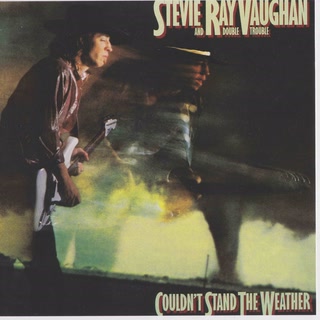
Stevie Ray Vaughan · Couldn't Stand the Weather · song 1
Scuttle Buttin' tuning.
Scuttle Buttin' (Stevie Ray Vaughan, 1984) is in E♭ Standard, about 13 cents sharp (A ≈ 443), measured by TuneLit from the record.
Song tuning
E♭ Standard +13 ¢
About 13 cents sharp (A ≈ 443).
Measured by TuneLit
13 ¢ sharp
Measured on this song itself: Tune moves every string +13 ¢.
Stevie Ray Vaughan · Couldn't Stand the Weather · 1984
About Scuttle Buttin'
The breakneck instrumental that opens Couldn't Stand the Weather (1984), under two minutes of pentatonic runs over a riff that keeps returning to the open low string. It is played in E shapes on a guitar tuned a half step down, so it sounds in E♭.
This is where the record departs from concert pitch. The album as a whole sits within about 2 ¢ of A 440, but Scuttle Buttin' measures about 13 ¢ sharp (A ≈ 443.4), steady across the whole track and confirmed on the 2010 remaster, so it has its own setting. Tune E♭ Standard 13 ¢ up, and the open-string hits will lock with the band.
At this tempo a few cents matter more than they seem: the fast runs blur, and the open-string stabs between them are what the ear compares. Players who learn it at A 440 often find the record slightly bright against them, which is that 13 ¢. A popular tab is labelled E Standard; against the CD, a guitar tuned that way sits a half step high. Practise slowly with the song's own setting, then bring the tempo up.
Tip: Use the song's own +13 ¢ button rather than the album's, and check it against the open low string at the end of each run.
Step by step
Tune your guitar like the record
- Tap Tune like this: the tuner switches to E♭ Standard, every string +13 ¢, the notes Scuttle Buttin' was recorded in.
- From E Standard: Every string down a half step. No tuner that knows E♭ Standard? Clamp a capo across fret 1, tune to E Standard as usual, then take it off: every string drops to E♭ Standard. Check each string again afterwards, since a capo pulls the strings a little sharp.
- Turn String 6 to String 1 until each shows ✓ in tune. Scuttle Buttin' sits 13 cents sharp on the record: at A 440 your guitar would sound that much flat against it, which Tune already corrects.
- Then play Scuttle Buttin' along with the record: its lowest open note and your String 6 should ring together without a wobble.
Or the other way round
Move the record into your tuning
Rather keep your guitar as it is? Let Play along move Scuttle Buttin' instead. Add your own copy, for example from your CD (it never leaves your device); the link already says the song is in E♭ Standard +13 ¢. Choose E Standard at A 440 and Scuttle Buttin' moves up 87 cents, at its own speed. Slow it down or loop a few bars to learn it, and save the result as a WAV file.
Questions
What tuning is Scuttle Buttin' in?
E♭ Standard +13 ¢: E♭ A♭ D♭ G♭ B♭ E♭, low to high, at the pitch TuneLit measured on the record.