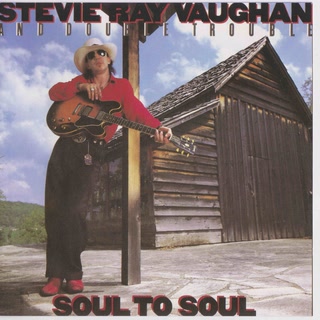
Stevie Ray Vaughan · 1985 · Studio album
Soul to Soul tuning.
E♭ Standard at concert pitch (A 440), measured on the CD. All 10 songs use it.
Album tuning
E♭ Standard
At concert pitch (A 440), measured on the CD.
MeasuredWidely reported
Measured by TuneLit
At concert pitch
| Source | Offset | Equivalent A | Songs | Spread | Confidence |
|---|---|---|---|---|---|
| CD, Epic 466330 2 (Austria, CBS issue, about 1990) | +1.7 ¢ | A 440.4 | 10 | −0.6 to +2.8 ¢ | High |
Before we measured, sources said: E♭ Standard, with no pitch given (widely reported).
E♭ Standard at concert pitch: every song reads within 6 ¢ of A 440, and a 2005 reissue agrees within a cent. The most-viewed tabs of Come On (Part III) and Say What! are in E Standard; the record is in E♭.
10 songs
Every song, ready to tune
Tune opens the tuner in that song's tuning, pitch included. Play along opens the song player set to that tuning, so the track plays in yours. What the labels mean
-
1. Say What!
E♭ StandardMeasured
Notes
Vaughan recorded it with two wah-wah pedals. The most-viewed tab is in E Standard, but its notes do not line up with the record, while a tab in E♭ fits it better. The audio check is not sure: the open low string hardly sounds.
-
2. Lookin' Out the Window
E♭ StandardMeasured
-
3. Look at Little Sister
E♭ StandardMeasured
Notes
Joe Sublett plays saxophone. E♭ Standard, about 6 ¢ sharp, close enough to share the album's setting.
-
4. Ain't Gone 'n' Give Up on Love
E♭ StandardMeasured
-
5. Gone Home
E♭ StandardMeasured
-
6. Change It
E♭ StandardMeasured
-
7. You'll Be Mine
E♭ StandardMeasured
-
8. Empty Arms
E♭ StandardMeasured
Notes
Vaughan plays the drums on this version too. A different, earlier take is on The Sky Is Crying.
-
9. Come On (Part III)
E♭ StandardMeasured
Notes
The most-viewed tab is in E Standard, a half step above the record; another tab and TuneLit's audio check both put it in E♭.
-
10. Life Without You
E♭ StandardMeasured
What the labels mean
- Measured
- TuneLit measured the pitch on an original CD or LP. The tuning name still comes from the sources.
- Official
- The band, a member, their producer or their guitar tech said it.
- Widely reported
- Trusted outlets, guides and tabs agree, but the band did not say it directly.
- From tabs
- From community tabs, or from players who tune along with the record.
- Disputed
- Sources disagree. The likeliest setting is shown; the notes name the other one.
Each song shows one label, the strongest it has, in this order. How we measure recordings →
Questions
What tuning is Soul to Soul in?
Stevie Ray Vaughan recorded Soul to Soul (1985) in E♭ Standard at concert pitch (A 440), measured by TuneLit on the CD. Every song uses it.