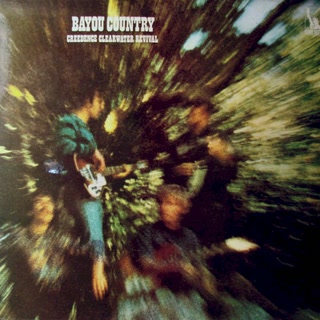
Creedence Clearwater Revival · Bayou Country · song 6
Proud Mary tuning.
Proud Mary (Creedence Clearwater Revival, 1969) is in D Standard, about 37 cents flat (A ≈ 431), measured by TuneLit from the record.
Measured by TuneLit
37 ¢ flat
Measured on this song itself: Tune moves every string −37 ¢.
Creedence Clearwater Revival · Bayou Country · 1969
About Proud Mary
Proud Mary is the sixth track on Bayou Country (1969) and the band's first great hit. The introduction is a run of descending chords, and the verse sits on one chord with a rolling strum. By the record it is in D Standard, every string a whole step down: a quarter of the low notes TuneLit hears are the bass's low D.
That is why the song is fingered with the shapes of C, A, G, F and D in tab but sounds a whole step lower than those names. TuneLit measured the album about 37 ¢ flat (A ≈ 430.7), and the song carries that setting: the Tune button gives D Standard at −37 ¢.
Thirty-seven cents is more than a third of a half step, and it is the least certain figure on this page: the song's own reading is about 32 ¢ flat. Tune with the button, then strum the first chord of the introduction against the record and adjust by ear if it wobbles.
If you only have a guitar in normal tuning, the song can be played with the same shapes two frets lower, as barre chords; you lose the open strings that give the strum its ring.
Tip: Strum the first chord of the introduction with the record and trim the fine-tune by ear.
Step by step
Tune your guitar like the record
- Tap Tune like this: the tuner switches to D Standard, every string −37 ¢, the notes Proud Mary was recorded in.
- From the album's E Standard: Every string down a whole step. No tuner that knows D Standard? Clamp a capo across fret 2, tune to E Standard as usual, then take it off: every string drops to D Standard. Check each string again afterwards, since a capo pulls the strings a little sharp.
- Turn string 6 to string 1 until each shows ✓ in tune. Proud Mary sits 37 cents flat on the record: at A 440 your guitar would sound that much sharp against it, which Tune already corrects.
- Then play Proud Mary along with the record: its lowest open note and your string 6 should ring together without a wobble.
Or the other way round
Move the record into your tuning
Rather keep your guitar as it is? Let Play along move Proud Mary instead. Add your own copy, for example from your CD (it never leaves your device); the link already says the song is in D Standard −37 ¢. Choose E Standard at A 440 and Proud Mary moves up 2 half steps and 37 cents, at its own speed. Slow it down or loop a few bars to learn it, and save the result as a WAV file.
Questions
What tuning is Proud Mary in?
D Standard −37 ¢: D G C F A D, low to high, at the pitch TuneLit measured on the record.