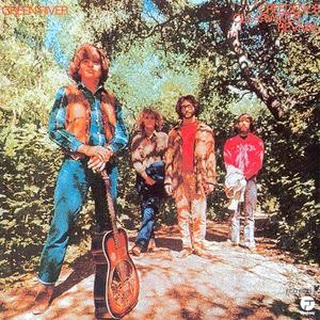
Creedence Clearwater Revival · 1969 · Studio album
Green River tuning.
E Standard at concert pitch (A 440), measured on the CD. 5 of 9 songs are tuned differently.
Album tuning
E Standard
At concert pitch (A 440), measured on the CD.
MeasuredFrom tabs
Measured by TuneLit
At concert pitch
| Source | Offset | Equivalent A | Songs | Spread | Confidence |
|---|---|---|---|---|---|
| CD, MP3 copy | +0.4 ¢ | A 440.1 | 9 | −0.7 to +2.2 ¢ | High |
Before we measured, sources said: E Standard, with no pitch given (community).
From August 1969. Normal tuning on six songs and D Standard on three, Bad Moon Rising among them, by the bass. TuneLit measured an MP3 copy of the CD at concert pitch as a whole, with Lodi and Wrote a Song for Everyone well below it.
9 songs · 5 tuned differently
Every song, ready to tune
Tune opens the tuner in that song's tuning, pitch included. Play along opens the song player set to that tuning, so the track plays in yours. What the labels mean
-
1. Green River
E StandardMeasured
Notes
Green River: E Standard, right at the album's pitch (+2.8 ¢, a fair reading).
-
2. Commotion
Different tuning
D Standard +18 ¢Measured
Notes
How to get there from the album's E Standard: Every string down a whole step.
D Standard, not the album's E Standard, and about 18 ¢ sharp (A ≈ 444.6): Commotion was measured 18 ¢ apart from the songs around it, so its Tune button differs from the album's.
By the record: TuneLit hears the bass on a low D, below the lowest note this album's usual tuning has, so the song is listed in D Standard. No tab or interview was read for it.
-
3. Tombstone Shadow
E StandardMeasured
Notes
E Standard, as on the rest of the album; Tombstone Shadow came out at −4.1 ¢, close to it.
-
4. Wrote a Song for Everyone
Different pitch
E Standard −26 ¢Measured
Notes
E Standard. Wrote a Song for Everyone sits about 26 ¢ flat (A ≈ 433.4) by TuneLit's measurement (a sure reading, −26.0 ¢), 26 ¢ away from its album, and carries its own setting.
The band used two tunings: normal tuning, and a whole step down for many of its best-known songs. Songs listed in normal tuning have the bass on its low E; songs where it goes down to D are listed in D Standard.
-
Notes
How to get there from the album's E Standard: Every string down a whole step.
Bad Moon Rising: D Standard, not the album's E Standard, right at the album's pitch (−0.1 ¢, a fair reading).
By the record: TuneLit hears the bass on a low D, below the lowest note this album's usual tuning has, so the song is listed in D Standard. No tab or interview was read for it.
-
6. Lodi
Different pitch
E Standard −19 ¢Measured
Notes
Lodi has a setting of its own: E Standard, about 19 ¢ flat (A ≈ 435.2). That is 19 ¢ from the album's pitch, too far to share one setting.
The band used two tunings: normal tuning, and a whole step down for many of its best-known songs. Songs listed in normal tuning have the bass on its low E; songs where it goes down to D are listed in D Standard.
-
7. Cross-Tie Walker
Different tuning
D Standard −24 ¢Measured
Notes
How to get there from the album's E Standard: Every string down a whole step.
D Standard, not the album's E Standard, and about 24 ¢ flat (A ≈ 433.9): Cross-Tie Walker was measured 24 ¢ apart from the songs around it, so its Tune button differs from the album's.
By the record: TuneLit hears the bass on a low D, below the lowest note this album's usual tuning has, so the song is listed in D Standard. No tab or interview was read for it.
-
8. Sinister Purpose
E StandardMeasured
Notes
Sinister Purpose: E Standard, right at the album's pitch (+0.4 ¢, a fair reading).
-
9. The Night Time Is the Right Time
E StandardMeasured
Notes
E Standard. The Night Time Is the Right Time reads +2.0 ¢, which is the album's own value.
What the labels mean
- Measured
- TuneLit measured the pitch on an original CD or LP. The tuning name still comes from the sources.
- Official
- The band, a member, their producer or their guitar tech said it.
- Widely reported
- Trusted outlets, guides and tabs agree, but the band did not say it directly.
- From tabs
- From community tabs, or from players who tune along with the record.
- Disputed
- Sources disagree. The likeliest setting is shown; the notes name the other one.
Each song shows one label, the strongest it has, in this order. How we measure recordings →
Questions
What tuning is Green River in?
Creedence Clearwater Revival recorded Green River (1969) in E Standard at concert pitch (A 440), measured by TuneLit on the CD. 5 songs use other tunings or pitches, listed song by song on this page.
Why does Green River sound out of tune with my guitar?
Commotion sits about 18 cents sharp (A ≈ 445), so a guitar tuned to A 440 clashes with it. The Tune buttons on this page set the tuner's reference to match the record, song by song, so you only tune the strings.