Jimi Hendrix · 1997 · Studio album
First Rays of the New Rising Sun tuning.
E♭ Standard, about 7 cents sharp (A ≈ 442), measured on the CD. 10 of 17 songs are tuned differently.
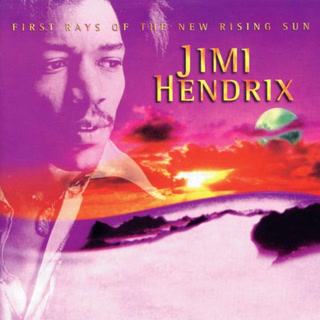
Album tuning
E♭ Standard +7 ¢
About 7 cents sharp (A ≈ 442), measured on the CD.
MeasuredWidely reported
Measured by TuneLit
7 ¢ sharp
| Source | Offset | Equivalent A | Songs | Spread | Confidence |
|---|---|---|---|---|---|
| CD, MCA/Experience Hendrix MCD 11599 (1997) | +6.6 ¢ | A 441.7 | 17 | +5.4 to +9.6 ¢ | High |
Before we measured, sources said: E♭ Standard, with no pitch given (widely reported).
Released in 1997, after Hendrix's death, as his planned fourth studio album: seventeen songs, most of them recorded at Electric Lady Studios in 1970, assembled by Eddie Kramer and Mitch Mitchell. Mostly E♭ Standard, with My Friend in D Standard and Astro Man and Room Full of Mirrors in E Standard. TuneLit measured the first 1997 CD at about 7 cents sharp (A ≈ 441.7); the later CDs agree within 3 cents.
17 songs · 10 tuned differently
Every song, ready to tune
Tune opens the tuner in that song's tuning, pitch included. Play along opens the song player set to that tuning, so the track plays in yours. What the labels mean
-
1. Freedom
Different pitch
E♭ StandardMeasured
Notes
Tabbed in E♭ Standard; the audio check agrees. The record sits at concert pitch, a little below the album value.
Hendrix's 1969–1970 sessions are tabbed a half step down, E♭ Standard, like his concerts of the time.
-
2. Izabella
Different pitch
E♭ Standard +37 ¢Measured
Notes
About 37 ¢ sharp of E♭ (A ≈ 449.5), near the middle between two notes; the audio check hears E♭.
Hendrix's 1969–1970 sessions are tabbed a half step down, E♭ Standard, like his concerts of the time.
-
3. Night Bird Flying
E♭ Standard +7 ¢Measured
Notes
Tabbed in E♭ Standard; the audio check agrees. Its own reading, about 5 ¢ flat, is uncertain, so it uses the album value; lower the reference a little if it sounds sharp.
-
4. Angel
E♭ Standard +7 ¢Measured
Notes
Tabbed in E♭ Standard (a second tab says E); the audio check agrees with E♭.
-
5. Room Full of Mirrors
Different tuning
E Standard +7 ¢Measured
Notes
How to get there from the album's E♭ Standard: Every string up a half step.
A slide-guitar song. The studio tab is in E Standard and the audio check agrees; tabs of live versions use E♭. Its own reading, about 22 ¢ sharp, is uncertain, so it uses the album value.
The tab of the studio recording is in E Standard; a tab of a live version is in E♭ Standard.
-
6. Dolly Dagger
E♭ Standard +7 ¢Measured
-
7. Ezy Ryder
Different pitch
E♭ Standard −8 ¢Measured
Notes
About 8 ¢ flat of E♭ (A ≈ 438); the audio check agrees.
Hendrix's 1969–1970 sessions are tabbed a half step down, E♭ Standard, like his concerts of the time.
-
8. Drifting
Different pitch
E♭ Standard −5 ¢Measured
Notes
Hendrix's 1969–1970 sessions are tabbed a half step down, E♭ Standard, like his concerts of the time.
-
9. Beginnings
Different pitch
E♭ Standard +16 ¢Measured
Notes
About 16 ¢ sharp of E♭ (A ≈ 444.2).
Hendrix's 1969–1970 sessions are tabbed a half step down, E♭ Standard, like his concerts of the time.
-
10. Stepping Stone
Different pitch
E♭ Standard −6 ¢Measured
Notes
Hendrix's 1969–1970 sessions are tabbed a half step down, E♭ Standard, like his concerts of the time.
-
11. My Friend
Different tuning
D Standard +16 ¢Measured
Notes
How to get there from the album's E♭ Standard: Every string down a half step.
From a session with Kenny Pine on 12-string guitar and Stephen Stills on piano. Tabbed in D Standard; the audio check agrees. About 16 ¢ sharp (A ≈ 444.2).
The tab (Hendrix and the 12-string part) is in D Standard.
-
12. Straight Ahead
Different pitch
E♭ Standard −5 ¢Measured
Notes
Hendrix's 1969–1970 sessions are tabbed a half step down, E♭ Standard, like his concerts of the time.
-
13. Hey Baby (New Rising Sun)
E♭ Standard +7 ¢Measured
Notes
Tabbed in E♭ Standard; the audio check agrees.
-
14. Earth Blues
E♭ Standard +7 ¢Measured
-
15. Astro Man
Different tuning
E Standard −33 ¢Measured
Notes
How to get there from the album's E♭ Standard: Every string up a half step.
Tabbed in E Standard; the audio check agrees with E. About 33 ¢ flat (A ≈ 431.8).
The community tab is in E Standard.
-
16. In from the Storm
E♭ Standard +7 ¢Measured
-
17. Belly Button Window
E♭ Standard +7 ¢Measured
Notes
Billy Cox and Mitch Mitchell do not play on it. Tabbed in E♭ Standard; the audio check agrees.
What the labels mean
- Measured
- TuneLit measured the pitch on an original CD or LP. The tuning name still comes from the sources.
- Official
- The band, a member, their producer or their guitar tech said it.
- Widely reported
- Trusted outlets, guides and tabs agree, but the band did not say it directly.
- From tabs
- From community tabs, or from players who tune along with the record.
- Disputed
- Sources disagree. The likeliest setting is shown; the notes name the other one.
Each song shows one label, the strongest it has, in this order. How we measure recordings →
Questions
What tuning is First Rays of the New Rising Sun in?
Jimi Hendrix recorded First Rays of the New Rising Sun (1997) in E♭ Standard, about 7 cents sharp (A ≈ 442), measured by TuneLit on the CD. 10 songs use other tunings or pitches, listed song by song on this page.
Why does First Rays of the New Rising Sun sound out of tune with my guitar?
Izabella sits about 37 cents sharp (A ≈ 450), so a guitar tuned to A 440 clashes with it. The Tune buttons on this page set the tuner's reference to match the record, song by song, so you only tune the strings.