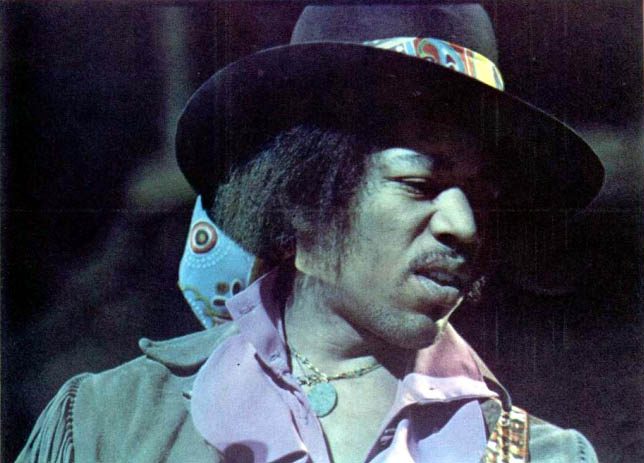
Jimi Hendrix in his wide-brimmed hat and fringed jacket, a colour photograph printed in the Argentine music magazine Pelo in 1971.
In short
How Jimi Hendrix tunes
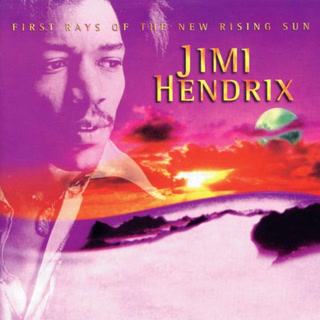
Jimi Hendrix recorded most of Are You Experienced in plain E Standard, then moved to E♭ Standard, a half step down, for nearly everything after it: Axis: Bold as Love, Electric Ladyland and the late songs collected on First Rays of the New Rising Sun. A few songs go lower still (Voodoo Chile and My Friend in D Standard) or stay in E (Come On, Burning of the Midnight Lamp, Astro Man).
Read more
TuneLit measured all four albums from CD, and the records rarely sit on A 440. The albums land 5 to 8 cents flat (First Rays 7 cents sharp), but single songs spread from about 43 cents flat (Love or Confusion) to 41 cents sharp (One Rainy Wish), and Castles Made of Sand sits right between two notes. Every Tune button carries the song's own measured offset.
Jimi Hendrix is the name most guitarists think of when they hear "tune down a half step". From 1967 on he tuned his guitar to E♭ Standard, every string a half step below concert pitch, and played the same chord shapes and riffs as in standard tuning. That alone would make his records easy to follow: drop all six strings a fret and go. The catch is that the records themselves do not sit still. TuneLit measured every song of his three studio albums and of First Rays of the New Rising Sun, and the pitch moves from song to song by as much as 40 cents, almost half a semitone, sometimes from one track to the next.
This page collects what is known about each album: the tuning of the guitar parts as the sources give them, the pitch TuneLit measured on the CDs, the songs that break the pattern, and how to set it all up in TuneLit. The album pages list every song with a Tune button that opens the tuner in exactly that tuning, measured offset included.
Popular songs
How to tune for Jimi Hendrix's best-known songs
Each song has its own page: the exact tuning, the record's pitch, how to get there string by string, and how to move the record into your own tuning.
The owner's library holds three or four CD editions of every album, so TuneLit measured all of them. Following our rule for every band, the values on the site come from the earliest CD pressing in the library; the later editions are a cross-check.
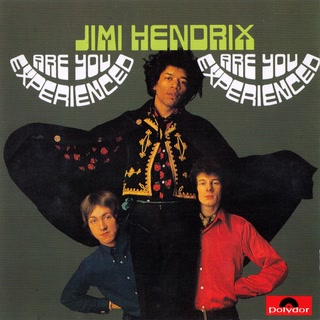
Are You Experienced: Polydor 847 234-2 (1991), a European CD with the American running order and the American cover. Cross-checks: the MCA CD of 1993 (MCAD-10893), the Experience Hendrix CD of 2010 and the Japanese Sony CD of 2013 (SICP 30001), which follows the original British running order.
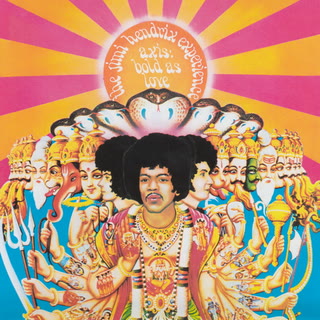
Axis: Bold as Love: MCA MCAD-10894 (1993). Cross-checks: Experience Hendrix (2010) and Sony Japan (2015).
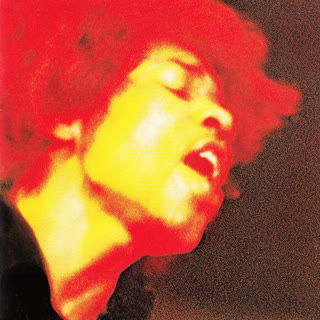
Electric Ladyland: MCA MCAD-10895 (1993). Cross-checks: Experience Hendrix (2010) and Sony Japan (2015).
First Rays of the New Rising Sun: the first MCA/Experience Hendrix CD, MCD 11599 (1997). Cross-checks: Experience Hendrix (2010) and Sony Japan (2013).
The editions do not all run at the same speed, and that matters when you play along:
Are You Experienced: the 1991 Polydor CD, the 2010 CD and the 2013 Japanese CD agree within 2 cents on every song they share. The 1993 MCA CD runs about 21 cents lower on every song (from 19 to 29 cents), close to a quarter of a semitone. If that is your copy, lower the reference A by about 5 Hz against the values on this page.
Axis: Bold as Love: the 2010 and 2015 CDs sit about 7 cents below the 1993 MCA CD, on every song (5 to 9 cents). Our values follow the 1993 CD; with one of the newer CDs, take about 7 cents off.
Electric Ladyland and First Rays of the New Rising Sun: all editions agree, by less than a cent on average and within a few cents on every song.
The method is the one behind every TuneLit band page. The estimator reads 90 seconds of each song, from 0:45, and compares the strongest notes with the equal-tempered grid. That gives the record's offset from A 440, known only within one semitone; which semitone the strings sit on comes from the tabs and sources, checked against TuneLit's semitone check from the audio. A song gets its own value when it differs from its album by 8 cents or more with good confidence; the rest share the album's value. Anything within ±4 cents is shown as concert pitch.
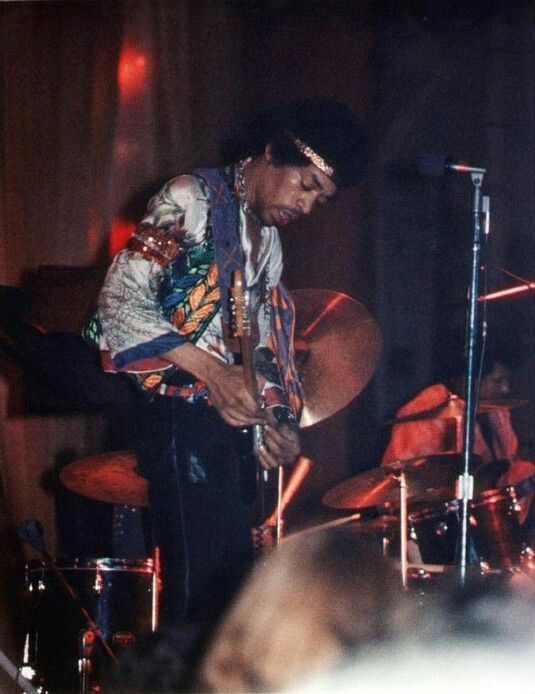
Jimi Hendrix bent over his guitar on stage on 20 June 1970, during his last American tour, photographed from the audience.
The story
Hendrix's tunings in one place
Tuning
Strings, low to high
Songs
E Standard
E A D G B E
most of Are You Experienced (Purple Haze, Hey Joe, The Wind Cries Mary, Fire, Foxey Lady, Third Stone from the Sun), Come On, Burning of the Midnight Lamp, Astro Man, Room Full of Mirrors
E♭ Standard
E♭ A♭ D♭ G♭ B♭ E♭
Manic Depression, May This Be Love, Are You Experienced?; almost all of Axis: Bold as Love, Electric Ladyland and First Rays of the New Rising Sun
D Standard
D G C F A D
Voodoo Chile, My Friend
E♭ Standard is the Hendrix tuning. Wikipedia's article on Little Wing puts it plainly: as with most Hendrix songs, the guitar is tuned down a half step. Its article on Red House adds that he usually tuned a half step down and sometimes a whole step. On stage he was tuning down by the summer of 1967: the community tabs of his Monterey Pop set in June 1967 (Hey Joe, The Wind Cries Mary, Foxy Lady) are all in E♭, although the studio versions of the same songs are tabbed in E.
E Standard belongs mostly to the first sessions, from late 1966 to spring 1967, when the Experience cut its first singles and most of Are You Experienced. A few later songs are tabbed in E too: Come On, Burning of the Midnight Lamp, Astro Man and the studio Room Full of Mirrors. TuneLit's audio check agrees with E on three of them.
D Standard, a whole step down, is rare. Wikipedia's article on Voodoo Chile, the fifteen-minute jam with Steve Winwood and Jack Casady, says Hendrix tuned a whole tone down for it, and the most-viewed tab agrees. My Friend, from an earlier session collected on First Rays, is tabbed in D Standard too.
Hendrix played a right-handed Fender Stratocaster turned over and restrung for his left hand, but nothing about the tuning changes for you: a right-handed guitar in the same tuning plays the same notes. The bass parts are tabbed in the same tunings as the guitars, whether Noel Redding, Billy Cox or, on several Electric Ladyland songs, Hendrix himself played them.
The story
A record that will not sit still
The usual advice, "tune down a half step and play along", gets you close to most of these songs, but rarely onto them. A measurement cannot tell a tape running fast from a guitar tuned sharp; it hears where the record ends up, and that is what you need to tune to.
Are You Experienced has a steady core: Purple Haze, Hey Joe, The Wind Cries Mary, Fire and Foxey Lady all sit 3 to 11 cents flat of E Standard. Around them the album wanders: I Don't Live Today 18 cents flat, Third Stone from the Sun 35 cents flat, Love or Confusion 43 cents flat. The three songs tabbed in E♭ sit at E♭ +18 (Manic Depression), E♭ −27 (Are You Experienced?) and E♭ −34 (May This Be Love).
Axis: Bold as Love spreads the widest. Bold as Love and Little Wing sit near the album value, about 8 cents flat of E♭. If 6 Was 9 is 30 cents flat, Up from the Skies 26, She's So Fine 22. On the other side, You Got Me Floatin' is 17 cents sharp, Ain't No Telling 33, Little Miss Lover 36 and One Rainy Wish 41.
Electric Ladyland holds closer to its value, 5 cents flat of E♭, apart from All Along the Watchtower (17 cents sharp) and the two songs in E Standard, Come On (35 cents flat) and Burning of the Midnight Lamp (28 cents flat).
First Rays of the New Rising Sun falls into two groups: one about 5 to 13 cents sharp (Angel, Dolly Dagger, Hey Baby, Earth Blues, In from the Storm, Belly Button Window) and one a few cents flat (Freedom, Ezy Ryder, Drifting, Stepping Stone, Straight Ahead). Izabella is 37 cents sharp and Astro Man 33 cents flat.
Some speed changes are documented. On Purple Haze, a guitar part recorded at half speed was played back at full speed for the outro, an octave up; on Third Stone from the Sun the spoken parts were slowed down. Those are effects inside a song. The offsets above apply to whole songs, so set them before you play.
Songs halfway between two notes
When a song sits 40 or more cents off its tuning, the next semitone is nearly as close. Love or Confusion, 43 cents flat of E Standard, plays exactly the same notes as E♭ Standard 57 cents sharp, which is why one tab names E and another E♭: both describe the same record. TuneLit's pages flag such songs as "between two notes" and give a Tune button for each reading:
Castles Made of Sand (Axis) sits right in the middle: E♭ Standard 54 cents flat, or the same guitar 46 cents sharp (which a tuner set to A 427 calls E Standard). The audio check cannot decide between the two. Its neighbours on the album lean to the sharp side: Ain't No Telling, Little Miss Lover and One Rainy Wish all sit 33 to 41 cents sharp of E♭, with the check agreeing. Try both buttons and keep the one where your open low string matches the record.
One Rainy Wish, Little Miss Lover (Axis) and Izabella (First Rays) sit 36 to 41 cents sharp of E♭. The audio check hears E♭ as their lowest open string, so the first button is the likely one.
Main tuning: E Standard −7 ¢ (A ≈ 438.1), measured on the Polydor CD of 1991.
The album came out twice in 1967 with two different track lists. The British edition (Track Records, May) opened with Foxy Lady and included Red House, Can You See Me and Remember. The American edition (Reprise, August) dropped those three for the singles Purple Haze, Hey Joe and The Wind Cries Mary, spelled Foxey Lady, and added a question mark to the title song. This page lists the American running order, the one the earliest CD in the library follows and the one the Experience Hendrix CDs open with (they add the British-only songs and the B-sides as extra tracks).
Every main community tab of Purple Haze, Hey Joe, The Wind Cries Mary, Fire, Foxey Lady and Third Stone from the Sun is in E Standard, and the measurement fits: those songs sit 3 to 11 cents flat, with the album value at 7 cents flat. TuneLit's audio check agrees with E as the lowest open string on Purple Haze, Hey Joe, Fire, Foxey Lady, I Don't Live Today and Third Stone from the Sun.
Three songs are tabbed a half step down: Manic Depression, May This Be Love and the title song. The check agrees with E♭ on May This Be Love; on the other two the low string is too rarely played for a sure answer. Manic Depression sits 18 cents sharp of E♭ (A ≈ 444.5), the only song on the album above A 440.
Three E Standard songs sit well below the rest: I Don't Live Today (18 cents flat, A ≈ 435.5), Third Stone from the Sun (35 cents flat, A ≈ 431.1) and Love or Confusion (43 cents flat, A ≈ 429.1). Love or Confusion is the one the tabs disagree on, E or E♭; as explained above, both name the same record.
On The Wind Cries Mary and Love or Confusion the audio check points a half step up, to F. That is the check's known blind spot, a song that seldom plays its open low string: the low notes TuneLit hears center on F in one and on G in the other. Both stay in E Standard.
The British-only songs are not on this list. Red House is tabbed in E♭ (Wikipedia notes Noel Redding played its bass line on a borrowed hollow-body guitar tuned down a half step); Can You See Me and Remember are tabbed in E Standard.
With TuneLit: E Standard for most songs, E♭ Standard for Manic Depression, May This Be Love and Are You Experienced?, and each song's own button for the flat ones.
Main tuning: E♭ Standard −8 ¢ (A ≈ 438), measured on the MCA CD of 1993.
Recorded at Olympic Studios in London from May to October 1967 and released in December, Axis is the first Hendrix album in E♭ Standard from start to finish. Every main community tab is in E♭, from Little Wing and Castles Made of Sand to Spanish Castle Magic and the title song. The one exception, a popular tab of One Rainy Wish in E Standard, does not hold up: TuneLit's audio check hears E♭ as its lowest open string and never E, a second tab says E♭, and so the song is listed in E♭ like the rest. The album was nearly late: Hendrix left the master tape of side one in a taxi, and side one was remixed in one night.
Pitch is where Axis gets difficult. Only Little Wing and Bold as Love sit near the album value. Up from the Skies (26 cents flat), If 6 Was 9 (30 cents flat) and She's So Fine (22 cents flat) sit low; Spanish Castle Magic (6 cents sharp), You Got Me Floatin' (17 cents sharp), Ain't No Telling (33), Little Miss Lover (36) and One Rainy Wish (41 cents sharp, A ≈ 450.6) sit high. The audio check agrees with E♭ on eleven of the thirteen songs, so the semitone is not in doubt; the offsets simply differ song to song.
Castles Made of Sand is the hardest song on the album to tune to: it sits exactly between two notes (see above). EXP, the opening sound collage of feedback and voices, has no reliable reading and uses the album value.
If you play along with the 2010 Experience Hendrix CD or the 2015 Japanese CD, every song sits about 7 cents lower than the values here.
With TuneLit: E♭ Standard, with each song's own button. Expect to retune between songs.
Main tuning: E♭ Standard −5 ¢ (A ≈ 438.7), measured on the MCA CD of 1993.
The double album was recorded mostly at the Record Plant in New York in 1968, with guests on several tracks. Most of it is tabbed in E♭, and TuneLit's check agrees on Have You Ever Been, Crosstown Traffic, Little Miss Strange, Gypsy Eyes, House Burning Down and Voodoo Child (Slight Return). Apart from a handful of songs, it holds closer to one value than Axis does.
The exceptions:
Voodoo Chile, the fifteen-minute jam with Steve Winwood on organ and Jack Casady on bass, is a whole step down, D Standard, according to Wikipedia and the most-viewed tab, and the audio check agrees with D. Its own reading is uncertain, so it uses the album value.
Come On (Let the Good Times Roll), Earl King's song, is in the key of E and tabbed in E Standard; the check agrees. It sits 35 cents flat (A ≈ 431.3).
Burning of the Midnight Lamp was begun at Olympic in London in May 1967 and released as a single that summer, a year before the album. It is tabbed in E Standard and sits 28 cents flat (A ≈ 432.8). The audio check points a half step up, its usual mistake on a song that seldom plays its open low string.
All Along the Watchtower sits 17 cents sharp of E♭ (A ≈ 444.4). Dave Mason added a 12-string guitar, and Hendrix played the final bass part himself.
Have You Ever Been (To Electric Ladyland) is 17 cents flat and 1983... (A Merman I Should Turn to Be) 14 cents flat.
Rainy Day, Dream Away and Still Raining, Still Dreaming are two halves of one jam, with Mike Finnigan on organ, Freddie Smith on saxophone and Buddy Miles on drums. The tab of Rainy Day is in E♭, the one tab of Still Raining in E; we list both in E♭, at the album value. No bass guitar is credited on them, and the organ's low notes confuse the audio check, so treat both as unconfirmed. ...And the Gods Made Love, a sound collage, and Moon, Turn the Tides, an instrumental full of tape effects, give no reliable reading.
With TuneLit: E♭ Standard, D Standard for Voodoo Chile, E Standard for Come On and Burning of the Midnight Lamp.
Main tuning: E♭ Standard +7 ¢ (A ≈ 441.7), measured on the first MCA/Experience Hendrix CD (1997).
Hendrix died in September 1970 while working on his fourth studio album; First Rays of the New Rising Sun was one of the titles he had proposed for it. In 1997 his engineer Eddie Kramer and drummer Mitch Mitchell assembled seventeen songs from those sessions, most of them recorded at Hendrix's new Electric Lady Studios in New York with Mitchell and Billy Cox, as one of the first releases of the family company Experience Hendrix. It is posthumous, and nobody knows exactly what Hendrix would have released, but it is the closest thing to his fourth album, so TuneLit lists it as a studio album.
The guitars are in E♭ Standard, like Hendrix's concerts of the time, and the audio check agrees on all fourteen songs listed in E♭. The album value, 7 cents sharp, is that of Angel, Dolly Dagger, Hey Baby (New Rising Sun), Earth Blues, In from the Storm and Belly Button Window, all between 5 and 13 cents sharp. Freedom, Ezy Ryder, Drifting, Stepping Stone and Straight Ahead sit a few cents flat instead, between concert pitch and 8 cents flat. Beginnings is 16 cents sharp and Izabella 37.
Three songs leave E♭:
My Friend comes from a session with a different line-up, with Kenny Pine on 12-string guitar and Stephen Stills on piano. It is tabbed in D Standard, and the audio check agrees. It sits 16 cents sharp (A ≈ 444.2).
Astro Man is tabbed in E Standard, and the check agrees with E. It sits 33 cents flat (A ≈ 431.8).
Room Full of Mirrors, a slide-guitar song, is tabbed in E Standard (tabs of live versions use E♭). The check agrees with E for the studio recording. Its own reading is uncertain, so it uses the album value.
With TuneLit: E♭ Standard, with D Standard for My Friend and E Standard for Astro Man and Room Full of Mirrors.
The story
Playing along
Start from E♭ Standard for everything after the first album, then use each song's Tune button rather than one setting for a whole album. On Axis in particular the offsets jump by 30 cents or more between neighbouring songs.
On Are You Experienced, switch tunings between the E Standard songs and the three in E♭.
For a song between two notes, tune with one button, play your open low string against the record, and switch to the other button if it clashes.
Know your edition. The values here follow the CDs listed above. With the 1993 MCA CD of Are You Experienced, every song sits about 21 cents lower; with the newer CDs of Axis, about 7 cents lower.
Basses tuned with the guitars: E♭ Standard on bass for the E♭ songs, D Standard for Voodoo Chile, and so on.
TuneLit's Play along can move a record into your own tuning instead: for example, shift Little Wing into E Standard at A 440 and play it with a guitar in standard tuning.
Questions
What tuning does Jimi Hendrix use?
Mostly E♭ Standard: 3 of 4 albums. Are You Experienced is in E Standard. Many albums also have songs in other tunings, and the album pages list them song by song.
How did TuneLit measure Jimi Hendrix's records?
We played original CDs and LPs through TuneLit's pitch analysis: the strongest notes of each song are compared with the A 440 grid, which gives the offset in cents. That cannot tell the semitone, so the tuning name comes from interviews, the press and tabs, and for 1 song from TuneLit's semitone check from the audio, backed by a tab or source. The audio is never stored or published.
Colors and font
Font
Colors
Menu
Install the app
Android (Chrome): menu ⋮ → Install app or Add to Home screen.
Computer (Chrome, Edge): the install icon at the right end of the address bar.
iPhone: Safari → Share → Add to Home Screen.
It opens full screen and keeps tuning with no connection.