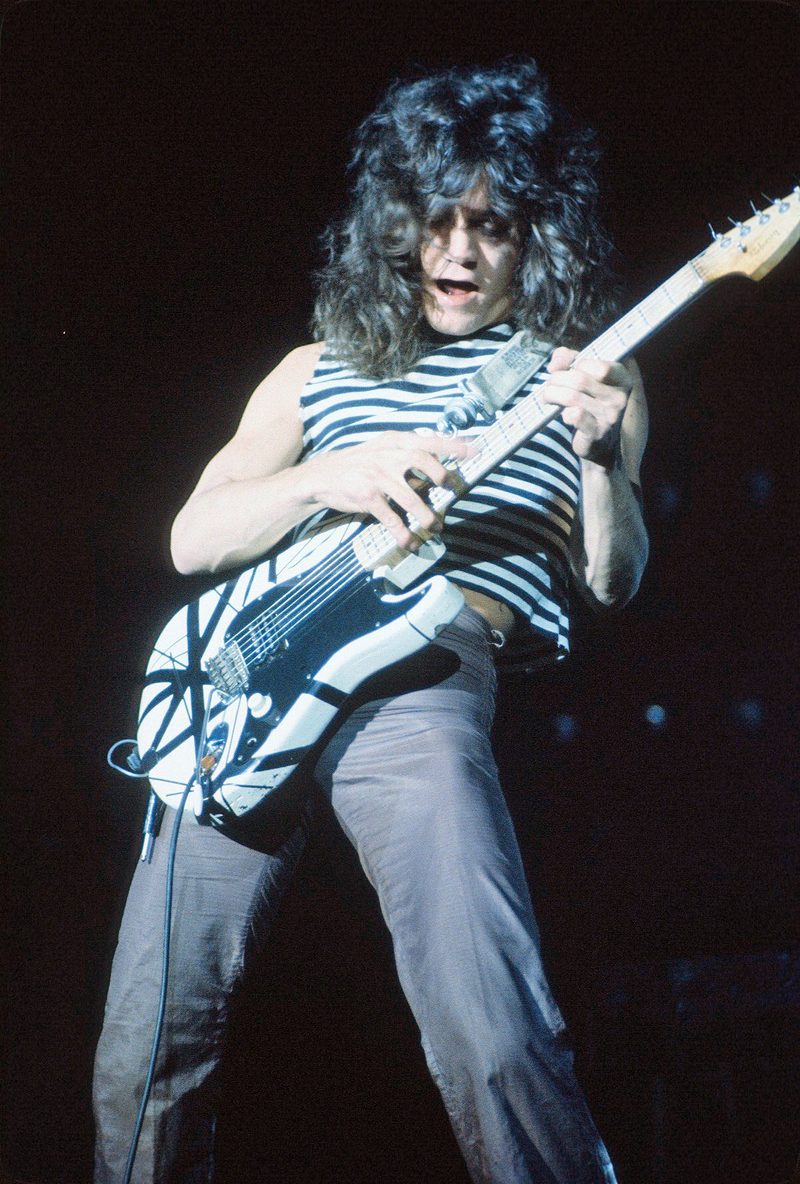
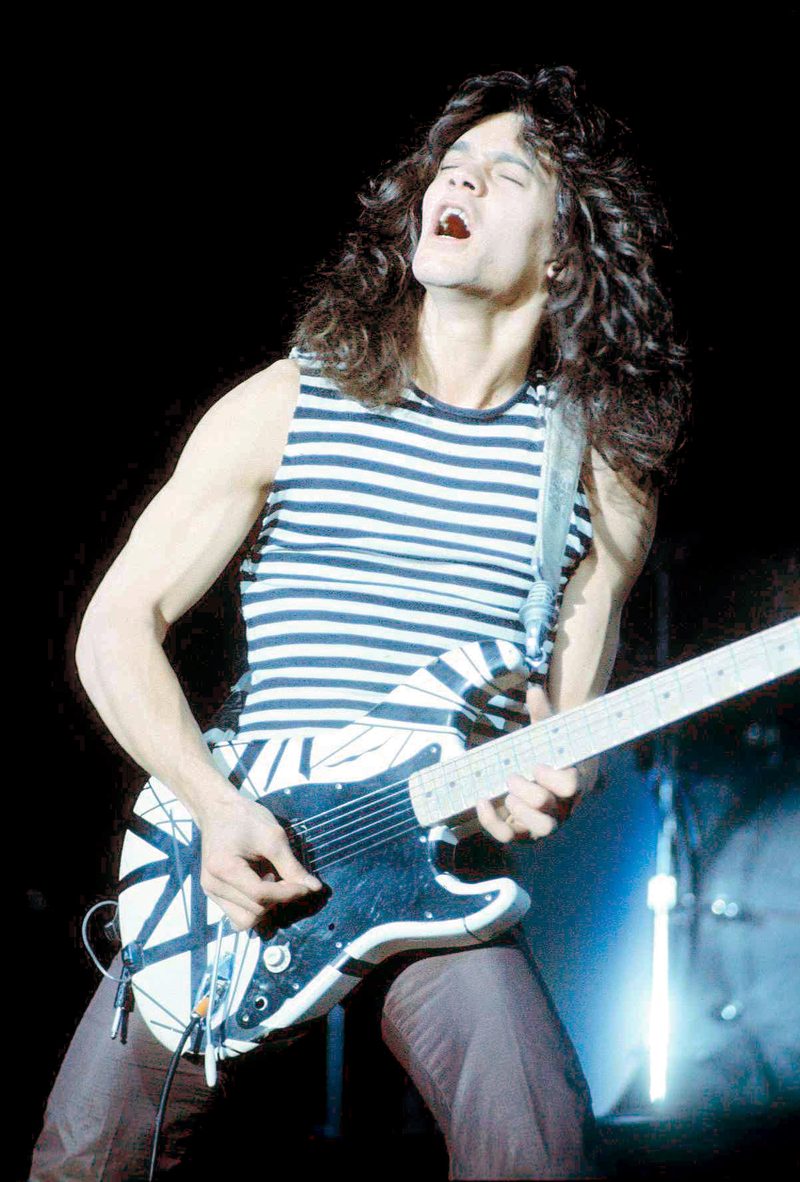
Eddie Van Halen playing at the New Haven Coliseum in 1978.
In short
How Van Halen tunes
Eddie Van Halen tuned by ear and the band tuned to him. The tabs put the first four albums with David Lee Roth (1978–1981) and their 2012 reunion, A Different Kind of Truth, a half step down in E♭ Standard, with Drop C♯ (Drop D a half step down) for Unchained and three other Fair Warning songs; Diver Down and 1984 are mostly in E; with Sammy Hagar (5150 to Balance) and on Van Halen III almost everything is in E Standard, with Drop D on a few songs.
Read more
TuneLit measured an early CD of every studio album. The first two albums really do sit above E♭, by about 13 cents (Van Halen) and 28 cents (Van Halen II), less than the 40 cents a Guitar World lesson suggests; Women and Children First and Fair Warning sit within about 5 cents of E♭, apart from a few songs near +30. Diver Down is the true in-between record: its E Standard songs sit 20 to 45 cents flat (A ≈ 433 overall), while its E♭ songs sit at or above E♭. Panama, on the otherwise E Standard 1984, is in E♭ about 34 cents sharp. From 5150 on the albums sit within about 5 cents of concert pitch, but single songs wander from about 50 cents flat (Source of Infection) to 42 cents sharp (Top Jimmy), so set the reference A to the song's value before reaching for a different tuning.
Tune a guitar a half step down, cue up Runnin' with the Devil, and the record still sounds a little sharp against it. Tune to plain E and the record sounds badly flat. That small mystery has followed Van Halen for decades. Eddie Van Halen tuned by ear rather than to a fixed reference, and Michael Anthony tuned his bass to Eddie, so the band's pitch was whatever Eddie's ear decided that day. Fans have long said the early records sit somewhere between E♭ and E, and a Guitar World lesson compares the first two albums with Dimebag Darrell's famous "D♯ plus 40 cents".
TuneLit measured an early CD of every Van Halen studio album to find out. The short answer: the first album sits about 13 cents above E♭ and Van Halen II about 28 cents above it, so the rumour is right in direction but smaller in size. The real in-between record is Diver Down, whose E Standard songs sit 20 to 45 cents flat. And on almost every album, single songs wander by 20 to 40 cents from their neighbours.
This page goes through all twelve studio albums, from Van Halen (1978) to A Different Kind of Truth (2012): the tuning the tabs and sources give, what the record measures, the songs that break the pattern, and how to set up TuneLit. Every song on the album pages has a Tune button that opens the tuner in exactly that tuning, reference pitch included.
Popular songs
How to tune for Van Halen's best-known songs
Each song has its own page: the exact tuning, the record's pitch, how to get there string by string, and how to move the record into your own tuning.
Half a step down, by ear. Every tab of the first album puts it in E♭ Standard, and Wikipedia notes that the striped Frankenstrat was tuned down a half step for Eruption. Far Out Magazine describes the routine behind the records: Eddie tuned his guitar to his own ear and Michael Anthony tuned to him, with no fixed method. In a 1978 interview with Steven Rosen, Eddie mentioned only one special tuning, dropping the low E to D for some acoustic parts.
Tuned to the fingers, not the open strings. Tom Weber, Eddie's guitar tech in his last years, has described setting his intonation flat to suit Eddie's strong left hand, and temper-tuning his guitars so that the high D♯ string sat about 14 cents flat on its own but in tune with the rest when played. That D♯ also confirms that late-career Eddie was still tuning to E♭.
Why the records drift. A recording carries the guitar's tuning plus the speed of the tape. TuneLit's measurement hears only the result, so it cannot say whether a song 30 cents sharp was tuned that way or sped up. What it can say is that the differences are on the master tapes: the original CD pressings from different countries agree on each album's pitch within about a cent, and on almost every song.
Eddie Van Halen playing his striped Frankenstrat at the New Haven Coliseum, Connecticut, on 10 September 1978, the year of the band's first album.
The story
How Van Halen's tuning changed
1978 to 1981: E♭ Standard. On the four David Lee Roth albums up to Fair Warning, nearly every song is tabbed a half step down. The exceptions are deliberate: Spanish Fly is played on a nylon-string guitar tuned a whole step down to D, And the Cradle Will Rock... is tabbed in E, and Fair Warning brings dropped tuning: Unchained, "Dirty Movies", Sinner's Swing! and Hear About It Later all lower the 6th string a further whole step, to C♯. Push Comes to Shove is tabbed in E.
1982 and 1984: a mix. Diver Down is mostly tabbed in E Standard, with Secrets, Intruder and (Oh) Pretty Woman in E♭. 1984 is mostly in E, with Drop D on Drop Dead Legs and the big exception of Panama, whose most popular tab is in E♭.
1986 to 1998: E Standard. With Sammy Hagar, and then Gary Cherone, the tabs put almost everything in E Standard at concert pitch. Drop D turns up on Don't Tell Me (What Love Can Do), Amsterdam and Baluchitherium on Balance, and on Neworld on Van Halen III. 5150 has a Drop C♯ title track and Good Enough drops its 6th string all the way to A. Runaround, on For Unlawful Carnal Knowledge, goes back to E♭.
2012: back to E♭. A Different Kind of Truth reunited Eddie with Roth, and its tabs return to E♭ Standard, with Tattoo in E, Stay Frosty in Drop C and Honeybabysweetiedoll in C Standard.
Main tuning: E♭ Standard +13 ¢ (A ≈ 443.3), measured by TuneLit on the US CD. Guitar World suggests about +40.
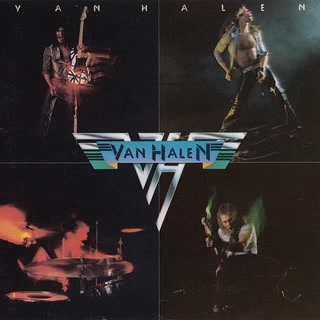
The debut was recorded mostly live at Sunset Sound with producer Ted Templeman, and every tab puts it a half step down. TuneLit's measurement confirms E♭ for every song where the open low string can be heard, and places the album about 13 cents above it: sharp of E♭, but much closer to E♭ than to E. The songs spread out more than on most records. Runnin' with the Devil and Atomic Punk sit about 28 to 29 cents above E♭, I'm the One right on it, and On Fire about 5 cents below. Ain't Talkin' 'bout Love sits at the album value; its solo is doubled on an electric sitar.
Ice Cream Man starts with David Lee Roth on acoustic guitar. The main tab puts his part in open E♭ (E♭ B♭ E♭ G B♭ E♭, open E tuned a half step down), while Eddie's part, the bulk of the song, is in E♭ Standard like everything else.
With TuneLit: the album button opens E♭ Standard at +13 ¢. Runnin' with the Devil and Atomic Punk have their own +28 and +29 ¢, I'm the One plain E♭, On Fire −5 ¢.
Main tuning: E♭ Standard +28 ¢ (A ≈ 447.3), measured on the Japanese CD. Guitar World suggests about +40.
This is the album that best fits the "between E♭ and E" reputation: seven of the ten songs sit 26 to 37 cents above E♭, about a third of the way to E. Bottoms Up! is the highest at about 37 cents, enough for its page to offer two readings. D.O.A. and Women in Love... are lower, about 12 to 13 cents above E♭. The audio check hears E♭ on every song.
Spanish Fly is the odd one out. Eddie played it on a nylon-string Ovation, and Bonedo's workshop and both Songsterr tabs put it a whole step down, in D Standard. TuneLit measured it about 12 cents above D and hears D as its lowest string.
With TuneLit: E♭ Standard at +28 ¢ for most songs; Spanish Fly opens D Standard at +12 ¢.
Main tuning: E♭ Standard +5 ¢ (A ≈ 441.3), measured on the Japanese CD.
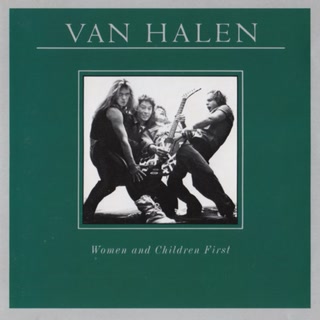
The album as a whole is back near a clean E♭: Everybody Wants Some!!, Romeo Delight, Loss of Control and Take Your Whiskey Home all sit within about 8 cents of it. Three songs do not: Fools, Could This Be Magic? and In a Simple Rhyme sit 29 to 31 cents above E♭, much like Van Halen II.
The opener is different again. The sound that starts And the Cradle Will Rock... is Eddie's Wurlitzer electric piano through a phaser and his Marshall, and its tab puts the guitars in E Standard, not E♭. The record agrees: it sits right at concert-pitch E, a half step above the rest of the album. On Could This Be Magic?, Roth plays acoustic guitar (tabbed in open E♭) while Eddie adds slide.
With TuneLit: E♭ Standard at +5 ¢; And the Cradle Will Rock... opens E Standard; Fools, Could This Be Magic? and In a Simple Rhyme use their own +29 to +31 ¢.
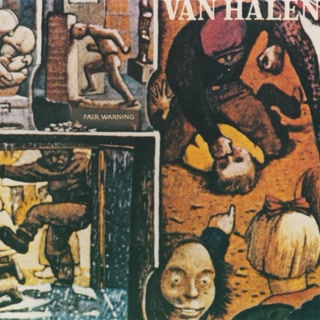
Main tuning: E♭ Standard +5 ¢ (A ≈ 441.2), measured on the Japanese CD.
Fair Warning is where Eddie started dropping the low string. Unchained is Drop D tuned down a half step, C♯ G♯ C♯ F♯ A♯ D♯, as Far Out Magazine and Bonedo describe it, and the tabs give "Dirty Movies", Sinner's Swing! and Hear About It Later the same Drop C♯. The most-viewed Songsterr tab of Unchained is in Drop C, but its notes sit a half step below the record; the Drop C♯ tab fits as written, and TuneLit hears C♯ as the open low string. Unchained itself measures right at concert pitch.
Push Comes to Shove is tabbed in E Standard, and the record agrees, but it sits about 36 cents sharp (A ≈ 449.1), between E and F. Its page shows both readings. Sunday Afternoon in the Park and One Foot Out the Door, built on synthesizer parts, sit 18 to 22 cents above E♭.
With TuneLit: E♭ Standard at +5 ¢, Drop C♯ for the four dropped songs (only the low string goes down a further whole step), and E Standard at +36 ¢ for Push Comes to Shove.
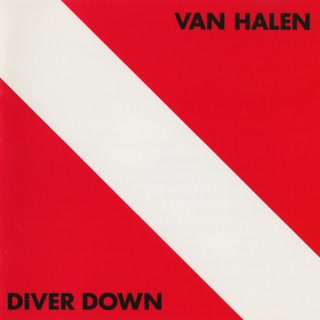
Main tuning: E Standard −27 ¢ (A ≈ 433.1), measured on the Japanese CD.
This is the album that really sits between notes. Most songs are tabbed in E Standard, and they measure flat by 20 to 45 cents: Where Have All the Good Times Gone! about 35, Cathedral about 44, Big Bad Bill (Is Sweet William Now) about 19. A 440 tuner reads these as somewhere between E♭ and E. Only Dancing in the Street sits at concert-pitch E.
The songs tabbed in E♭ sit at or above E♭: Secrets right on it (Eddie played it on the 12-string neck of a Gibson doubleneck) and (Oh) Pretty Woman about 27 cents above. TuneLit's audio check hears E♭ as the open low string of Pretty Woman, where the tabs put it. Intruder, the noisy lead-in, reads about halfway between E♭ and E, too unsure for its own value.
Little Guitars was played on a small Les Paul-style guitar by David Petschulat. The tabs give it F C F B♭ D G, which on a full-size guitar is Drop D with a capo at the 3rd fret, and the record matches that, about 17 cents flat. Happy Trails is sung a cappella.
With TuneLit: E Standard at −27 ¢ is the starting point, with own values for most songs: Where Have All the Good Times Gone! at −35 ¢, Cathedral at −44 ¢, Dancing in the Street at concert pitch, Secrets in E♭, (Oh) Pretty Woman in E♭ at +27 ¢, and Little Guitars in Drop D with a capo at the 3rd fret, −17 ¢.
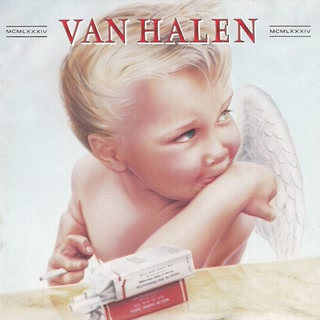
Main tuning: E Standard +8 ¢ (A ≈ 441.9), measured on the US CD.
1984 was the first album made at Eddie's own 5150 studio, with keyboards beside the guitar. Jump is driven by his Oberheim OB-Xa; Wikipedia, citing the Van Halen Guitar Anthology, puts it in C major, and the record sits at concert pitch. Hot for Teacher, Girl Gone Bad, I'll Wait and Drop Dead Legs (tabbed in Drop D) sit between concert pitch and about 19 cents sharp.
Panama is the famous argument. The most-viewed Songsterr tab is in E♭, a second one almost as popular is in E, and Wikipedia gives the key as E♭ major against the published score's E major. The record settles it: the notes of the E♭ tab match it as written, the E tabs sit a half step above it, and TuneLit hears an open E♭ string. Panama sits about 34 cents above E♭ (A ≈ 448.8), two thirds of the way to E.
Two songs pull the other way. Top Jimmy, with its harmonics intro, sits about 42 cents above E (A ≈ 450.7), close to halfway to F; one tab puts its clean guitar in an altered tuning, D A D A C D, and the others in standard. House of Pain sits about 25 cents flat. The title track, a synthesizer intro, measures about 28 cents flat.
With TuneLit: E Standard at +6 ¢; Panama opens E♭ Standard at +34 ¢; Top Jimmy E Standard at +42 ¢ (both readings shown); Hot for Teacher +19 ¢; House of Pain −25 ¢; Drop Dead Legs Drop D.
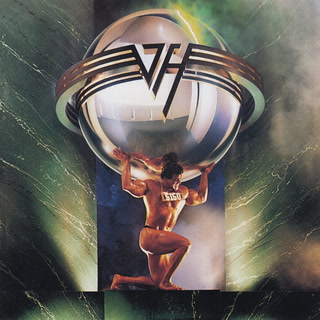
Main tuning: E Standard −5 ¢ (A ≈ 438.7), measured on the US CD.
Sammy Hagar's arrival brought concert-pitch E Standard. Hagar was an established guitarist, which let Eddie move to keyboards on some songs; Why Can't This Be Love, Dreams and Love Walks In are built on them. Good Enough drops its 6th string a fifth, to a low A an octave below the 5th string (A A D G B E), and the title track is in Drop C♯, Drop D a half step down. Best of Both Worlds stands apart at about 31 cents sharp (A ≈ 448), and Love Walks In and 5150 sit 12 to 15 cents sharp.
With TuneLit: E Standard at −5 ¢; Good Enough opens the custom A A D G B E; 5150 Drop C♯ at +12 ¢; Best of Both Worlds +31 ¢.
Main tuning: E Standard at concert pitch (A 440), measured on the US CD.
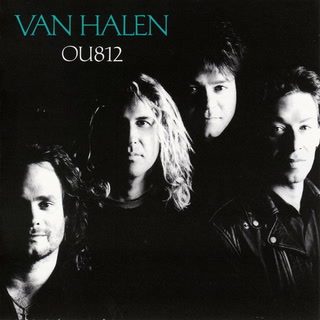
Every tab of OU812 is in E Standard, and the album median sits exactly at A 440, but this is the album where single songs wander most. Mine All Mine, Finish What Ya Started and A Apolitical Blues sit about 9 to 10 cents sharp; Cabo Wabo, Black and Blue and Sucker in a 3 Piece 12 to 16 cents flat. Two songs land between notes. A.F.U. (Naturally Wired) sits about 40 cents sharp of E; TuneLit's audio check hears an open E there, but the only tab's notes fit the record better a half step lower, so check it by ear. Source of Infection sits almost exactly halfway between E♭ and E, about 50 cents flat of E. A Apolitical Blues, the Little Feat cover, was on the CD only.
With TuneLit: E Standard; nearly every song has its own value, from −50 ¢ (Source of Infection) to +40 ¢ (A.F.U.).
Main tuning: E Standard at concert pitch (about +4 ¢, A ≈ 440.9), measured on the US CD.
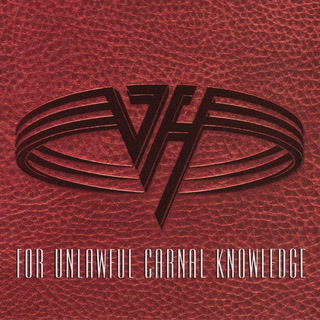
A guitar-heavy record at concert pitch. Poundcake opens with a Makita power drill held to the pickups and, per Wikipedia, has electric 12-strings under the main guitar; it sits about 13 cents sharp. Spanked sits about 26 cents flat, and its crunchy verse riff is played on a six-string bass guitar tuned like a guitar an octave down. Runaround is the album's E♭ song: its tab's rhythm guitars are a half step down, and TuneLit hears the open E♭ string. Right Now is built on Eddie's piano, and 316 is a short acoustic piece named after Wolfgang's birthday.
With TuneLit: E Standard; Runaround opens E♭ Standard; Poundcake +13 ¢, Spanked −26 ¢.
Main tuning: E Standard at concert pitch (about −3 ¢, A ≈ 439.2), measured on the US CD.
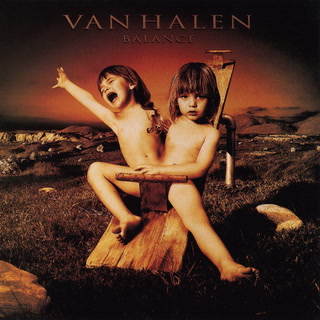
Eddie told Guitar World that most of Balance was in D minor, and the tabs agree: Don't Tell Me (What Love Can Do), Amsterdam and Baluchitherium are in Drop D, the rest in E Standard. On Baluchitherium, the deep part that sounds like a six-string bass is, by Eddie's account, a Music Man Albert Lee guitar strung heavier and tuned down to a low A. The record is the steadiest Van Halen album: every guitar song sits within about 8 cents of concert pitch.
With TuneLit: E Standard, Drop D for the three songs above (Amsterdam +8 ¢).
Main tuning: E Standard at concert pitch (about −2 ¢, A ≈ 439.5), measured on the European CD.
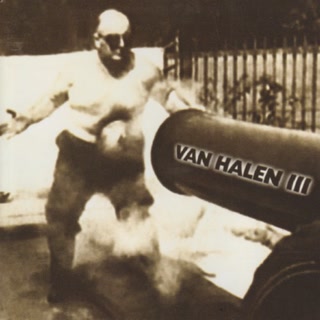
Gary Cherone's only album is also the one with the most unusual tunings, though only a few hand-made tabs exist. Neworld, an acoustic opener, is tabbed in Drop D. Josephina's acoustic lowers the top two strings a whole step (E A D G A D). Primary, played on an electric sitar, and the slide song Ballot or the Bullet are tabbed in open A with a low A on the 6th string (A A E A C♯ E). How Many Say I is a piano ballad sung by Eddie. The record sits at concert pitch, with Year to the Day about 18 cents flat.
With TuneLit: E Standard, plus Drop D, E A D G A D and A A E A C♯ E where noted.
Main tuning: E♭ Standard at concert pitch (about −1 ¢, A ≈ 439.8), measured on the European CD.
Roth's return took the band back to E♭, and the songs measure close to a clean, concert-pitch E♭; Bullethead sits about 9 cents flat. Tattoo is the exception the tabs point to: it is in E Standard, and the audio check confirms it. Stay Frosty starts with Roth's fingerpicked acoustic intro (tabbed in open C) and is tabbed in Drop C for the band. Honeybabysweetiedoll is tabbed in C Standard, two whole steps down; Eddie said the strange sounds in its intro come from a Whammy, an octave pedal and a sustainer, and TuneLit could not confirm the low C from the audio, so treat that one as a good guess.
With TuneLit: E♭ Standard at concert pitch; Tattoo E Standard; Stay Frosty Drop C; Honeybabysweetiedoll C Standard.
TuneLit lab
What TuneLit measured
TuneLit's Match-a-recording estimator takes a stretch of each song, finds the strongest notes and compares them with the equal-tempered grid. That pins the offset down to a few cents, but only within one semitone, so the semitone itself (E, E♭, D) comes from the tabs and sources above. A second check listens for the lowest open string; for Van Halen it agreed with the tabs on 110 of 127 songs and contradicted none in a way a second source supported. It also confirmed the E♭ of (Oh) Pretty Woman, which a measurement alone would have placed a semitone low.
We measured the earliest CD pressing of each album in our library: the US CDs of Van Halen, 1984 and the Hagar albums, the 1988–89 Japanese CDs of Van Halen II to Diver Down, and the European CDs of Van Halen III and A Different Kind of Truth. The audio is never uploaded or published; only the numbers appear on this page.
Album
Sources said
TuneLit measured
Equivalent A
Van Halen (1978)
E♭, about +40 ¢
E♭ +13 ¢
A ≈ 443.3
Van Halen II (1979)
E♭, about +40 ¢
E♭ +28 ¢
A ≈ 447.3
Women and Children First (1980)
E♭
E♭ +5 ¢
A ≈ 441.3
Fair Warning (1981)
E♭, Drop C♯
E♭ +5 ¢
A ≈ 441.2
Diver Down (1982)
E, some E♭
E −27 ¢
A ≈ 433.1
1984 (1984)
E, Panama E♭
E +8 ¢
A ≈ 441.9
5150 (1986)
E
E −5 ¢
A ≈ 438.7
OU812 (1988)
E
E ±0 ¢
A 440
For Unlawful Carnal Knowledge (1991)
E
E +4 ¢
A ≈ 440.9
Balance (1995)
E, Drop D
E −3 ¢
A ≈ 439.2
Van Halen III (1998)
E
E −2 ¢
A ≈ 439.5
A Different Kind of Truth (2012)
E♭
E♭ −1 ¢
A ≈ 439.8
Three things stand out. First, the "between E♭ and E" reputation fits Van Halen II and Diver Down best, from opposite sides: Van Halen II sits about 28 cents above E♭, Diver Down's E songs 20 to 45 cents below E. The debut is only about 13 cents sharp of E♭. Second, single songs move far more than on most bands' records. The spread inside one album reaches about 34 cents on Van Halen, 40 on Fair Warning and 90 on OU812, and no source explains it. Third, the pressing matters a little. The original CDs from the US, Japan, Germany and Canada agree within about a cent per album, but the 2015–2016 Japanese remasters of the six Roth-era albums run about 2 to 10 cents higher than the original CDs (Diver Down the most), and the 2000 HDCD remasters differ by up to about 5 cents. If your copy is a remaster and sounds a touch sharp, that is why.
Keep a few limits in mind. Anything within ±4 ¢ counts as concert pitch. Heavily processed songs, keyboard pieces and tracks with little guitar give less reliable readings, so they use their album's value unless they clearly differ. And a measurement cannot tell a guitar tuned sharp from a tape running fast.
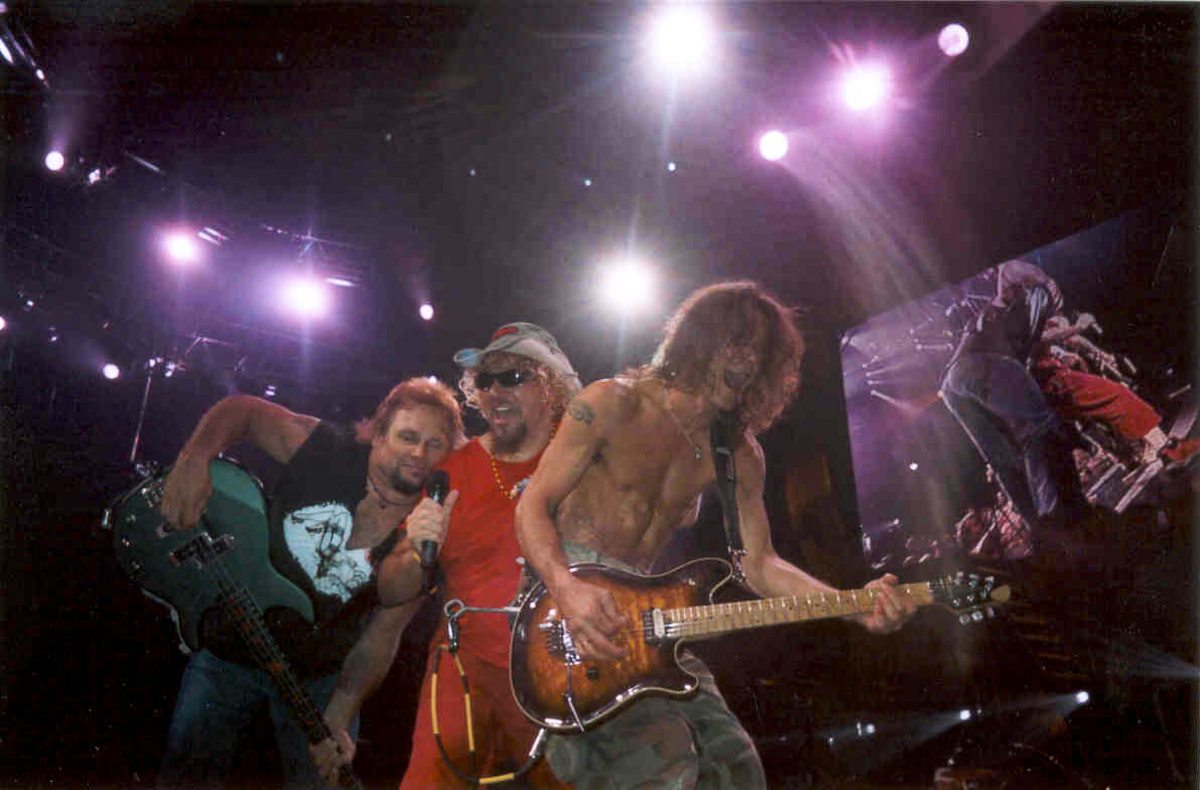
Michael Anthony, Sammy Hagar and Eddie Van Halen (left to right) on stage together during the 2004 reunion tour with Hagar.
Evidence
How sure are these numbers?
Every tuning on the album pages carries a status label. The offsets of all twelve albums are Measured by TuneLit. The tuning names rest on other evidence:
Official: Eddie's own words, as with the low-A guitar on Baluchitherium.
Widely reported: magazines and reference works agree, as with Unchained's Drop C♯ and the E♭ of the first two albums.
Community: tabs only, mostly Songsterr. Most Van Halen songs rest on this level, and TuneLit checked each popular tab's notes against the record: nearly all fit as written.
Disputed: sources disagree. For Van Halen: Panama, listed in E♭ after the measurement.
If a song still sounds a touch off, move the reference a hertz or two; near 440 Hz, one hertz is about 4 cents.
Eddie Van Halen playing Eruption at the Bell Centre, Montreal, on 10 November 2007, on the reunion tour with David Lee Roth and Wolfgang Van Halen.
Cheat sheet
Quick reference
Van Halen (1978): E♭ Standard +13 ¢. Runnin' with the Devil and Atomic Punk +28/+29 ¢; I'm the One E♭; On Fire −5 ¢.
Van Halen II (1979): E♭ Standard +28 ¢. D.O.A. and Women in Love... +12/+13 ¢; Bottoms Up! +37 ¢; Spanish Fly D Standard +12 ¢.
Women and Children First (1980): E♭ Standard +5 ¢. And the Cradle Will Rock... E Standard; Fools, Could This Be Magic?, In a Simple Rhyme about +30 ¢.
Fair Warning (1981): E♭ Standard +5 ¢. Drop C♯: Unchained, "Dirty Movies", Sinner's Swing!, Hear About It Later. Push Comes to Shove E Standard +36 ¢.
Diver Down (1982): E Standard −27 ¢, songs from −44 ¢ to concert pitch. E♭: Secrets, (Oh) Pretty Woman (+27 ¢). Little Guitars Drop D, capo 3.
1984 (1984): E Standard +6 ¢. Panama E♭ +34 ¢; Top Jimmy E +42 ¢; House of Pain −25 ¢; Drop Dead Legs Drop D.
5150 (1986): E Standard −5 ¢. Good Enough A A D G B E; 5150 Drop C♯; Best of Both Worlds +31 ¢.
OU812 (1988): E Standard at A 440, songs from −50 ¢ to +40 ¢.
For Unlawful Carnal Knowledge (1991): E Standard. Runaround E♭; Spanked −26 ¢.
Balance (1995): E Standard; Drop D for Don't Tell Me (What Love Can Do), Amsterdam, Baluchitherium.
Van Halen III (1998): E Standard; Neworld Drop D; Josephina E A D G A D; Primary, Ballot or the Bullet A A E A C♯ E.
A Different Kind of Truth (2012): E♭ Standard. Tattoo E; Stay Frosty Drop C; Honeybabysweetiedoll C Standard.
Golden rule: with Van Halen, set the song's reference A first. The semitone is usually what the tab says; the cents almost never are.
Questions
What tuning does Van Halen use?
Mostly E Standard: 7 of 12 albums. Van Halen, Van Halen II, Women and Children First, Fair Warning and A Different Kind of Truth are in E♭ Standard. Many albums also have songs in other tunings, and the album pages list them song by song.
Why does Van Halen sound out of tune when I play along?
Some records are not at concert pitch. Van Halen II sits about 28 cents sharp (A ≈ 447); Diver Down sits about 27 cents flat (A ≈ 433); Van Halen sits about 13 cents sharp (A ≈ 443). A guitar tuned to A 440 clashes with them. Every Tune button on these pages sets the measured pitch for you.
How did TuneLit measure Van Halen's records?
We played original CDs and LPs through TuneLit's pitch analysis: the strongest notes of each song are compared with the A 440 grid, which gives the offset in cents. That cannot tell the semitone, so the tuning name comes from interviews, the press and tabs, and for 1 song from TuneLit's semitone check from the audio, backed by a tab or source. The audio is never stored or published.
Colors and font
Font
Colors
Menu
Install the app
Android (Chrome): menu ⋮ → Install app or Add to Home screen.
Computer (Chrome, Edge): the install icon at the right end of the address bar.
iPhone: Safari → Share → Add to Home Screen.
It opens full screen and keeps tuning with no connection.