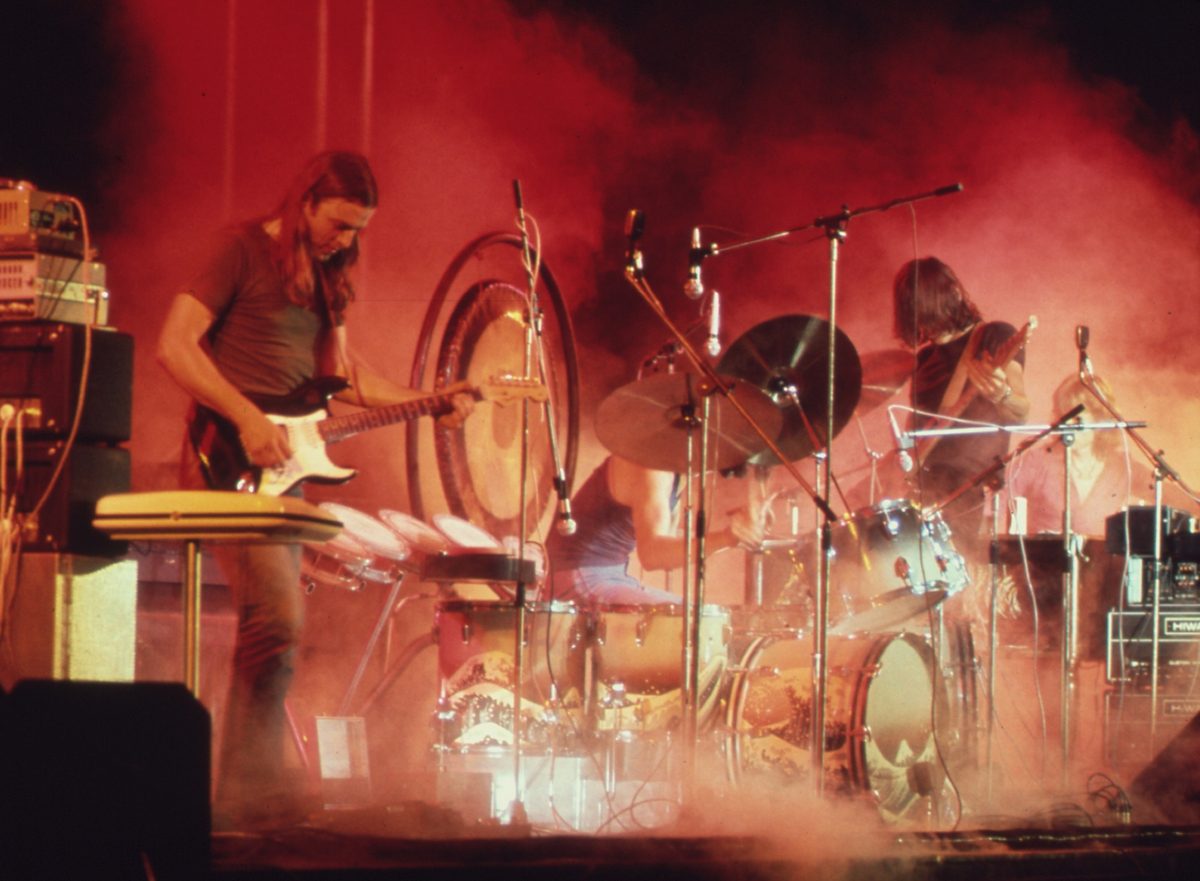
David Gilmour with his Stratocaster (left) and Roger Waters on bass (right) on stage at Merriweather Post Pavilion, Columbia, Maryland, in 1973, the year of The Dark Side of the Moon.
In short
How Pink Floyd tunes
Syd Barrett, David Gilmour and Roger Waters played nearly everything in standard tuning, so what matters for playing along is the handful of exceptions and the pitch of the records themselves. The exceptions are Gilmour's steel guitars in open tunings (open E minor on One of These Days, open G6 on The Great Gig in the Sky and the slide fills of Breathe), Fearless in an open G tuning Syd taught Waters, The Narrow Way in Drop D, Dogs a whole step down in D Standard, Run Like Hell in Drop D, Poles Apart in DADGAD and the high-strung acoustic of Hey You.
Read more
TuneLit measured twelve of the fifteen studio albums from the owner's Japanese CDs and LPs. Most sit within 10 cents of A 440, but The Wall runs about 11 cents sharp (A ≈ 443), with In the Flesh?, Hey You and Run Like Hell 25 to 39 cents sharp, and single songs on other albums sit well away from their records: Time 23 cents flat, One of These Days 22 flat, The Gnome 34 flat. We found no published figure for any of this; the numbers are TuneLit's own.
Pink Floyd guitar parts are rarely hard to tune for. Syd Barrett, David Gilmour and Roger Waters played almost everything in plain standard tuning, and the few exceptions are well known: Gilmour's steel guitars in open tunings, Dogs a whole step down, Run Like Hell in Drop D, Poles Apart in DADGAD, and one strange acoustic on The Wall. What catches players out is something else. Tune to a perfect E, start The Wall, and In the Flesh? sounds almost a quarter tone sharp. Play along with Time and you are sharp against the record. The guitars were in standard tuning; the records themselves do not all sit at A 440.
This page goes through all fifteen studio albums, from The Piper at the Gates of Dawn (1967) to The Endless River (2014). For each one you get the tuning the sources give, the pitch TuneLit measured on the owner's Japanese CDs and LPs, and the songs that break the pattern. The album pages list every song with a Tune button that opens the tuner in exactly that tuning, reference pitch included.
The story
Standard tuning, with a handful of exceptions
Tab books, transcriptions and the gear notes collected on gilmourish.com agree that Pink Floyd's normal guitar parts are in standard tuning (E A D G B E), from Syd's Esquire on Piper to Gilmour's Black Strat on Dark Side, Wish You Were Here and The Wall, his Steinberger on A Momentary Lapse of Reason and his Strats on The Division Bell. Slide parts on a normal guitar are in standard tuning too: Syd's slide parts on Astronomy Domine and Lucifer Sam, played with a Zippo lighter,, and Gilmour's slide on If, San Tropez and Echoes, are all tabbed that way.
The exceptions, all listed on the album pages:
Steel guitar in open E minor (E B E G B E): One of These Days. Gilmour later used the same tuning on stage for High Hopes.
Steel guitar in open G6 (D G D G B E): The Great Gig in the Sky, and the slide fills of Breathe. Live, also Shine On You Crazy Diamond and Wot's... Uh the Deal.
Open G, taught by Syd: Fearless, played by Roger Waters. Tabs disagree on the exact strings; we list G G D G B B, as the most detailed transcription has it.
Drop D (D A D G B E): The Narrow Way on Ummagumma (tabs) and Run Like Hell on The Wall (Gilmour's own words).
D Standard (D G C F A D): Dogs on Animals, a whole step down.
High-strung acoustic: Hey You, where Gilmour's Ovation carries octave-up strings.
DADGAD: Poles Apart on The Division Bell, which Gilmour said came straight out of the tuning.
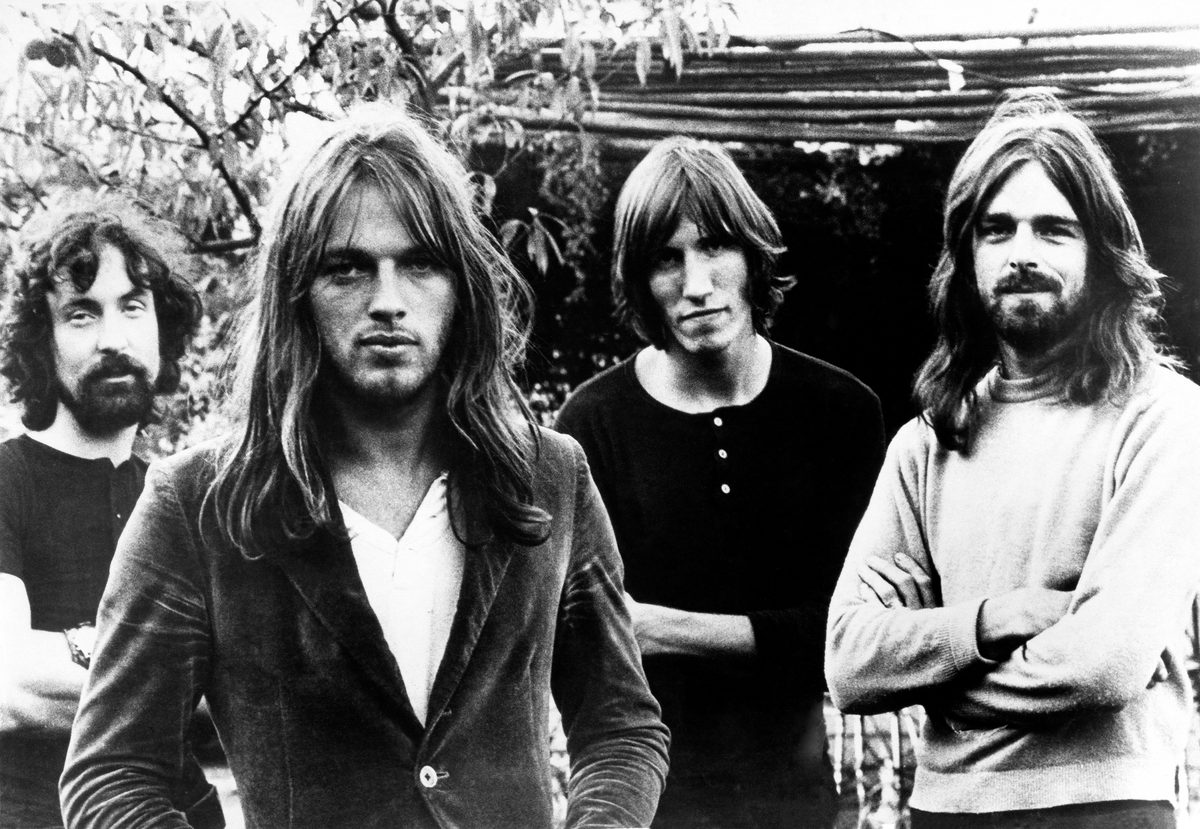
Pink Floyd in a 1974 press photo: Nick Mason, David Gilmour, Roger Waters and Richard Wright (left to right).
The story
How far the records sit from A 440
A tuner judges every note against a reference A, normally 440 Hz. A record can sit a few cents above or below that grid for many reasons: the band tuned to a piano or an organ that was itself off, a tape machine ran a little fast or slow, a song was recorded with the tape slowed down and played back at normal speed. A cent is a hundredth of a semitone. Under about 5 cents nobody hears it; at 10 to 15 a careful ear notices a sour edge; at 20 or more, playing along in standard tuning at A 440 sounds plainly out of tune.
We looked for published figures on the pitch of these records and found none. The one varispeed story with a source is Welcome to the Machine: Gilmour has said the tape was slowed by half a semitone so he could reach one vocal line, then set back to normal speed, which leaves the finished track where it was recorded. So every number on this page is TuneLit's own, measured from the owner's copies.
The short version:
Most albums sit within 10 cents of A 440. A Saucerful of Secrets, Atom Heart Mother, Obscured by Clouds, The Dark Side of the Moon and The Division Bell are at concert pitch. The Piper at the Gates of Dawn, More, Meddle and Wish You Were Here are 6 to 10 cents flat, Animals and The Final Cut 6 to 7 cents sharp.
The Wall is sharp. About 11 cents overall (A ≈ 443), and some songs much more: In the Flesh? about 39 cents, Hey You and Run Like Hell about 26, In the Flesh and Outside the Wall about 20. Only Nobody Home sits at concert pitch.
Single songs move away from their albums. Time is about 23 cents flat, while the rest of The Dark Side of the Moon is at 440 and The Great Gig in the Sky is 11 cents sharp. One of These Days is 22 cents flat and Fearless 17, while Seamus and Echoes sit at 440. The Gnome is 34 cents flat, The Gold It's in the... 26.
The Tune buttons already include these offsets. To set one by hand, pick the tuning, tap the A 440 chip and enter the song's value: 443 for The Wall, 434 for Time, 450 for In the Flesh?. A measurement hears the result, not the cause, so it cannot say whether a sharp song was played on sharp instruments or sped up on tape.
The story
Gilmour's steel guitars
Gilmour's slide sound on the 1970s albums came mostly from steel guitars played flat on his lap or on a stand, not from a bottleneck on a Strat. According to gilmourish.com, he bought a Fender 1000 twin-neck pedal steel in Seattle in 1970 and used it, mostly without its pedals, on Meddle, The Dark Side of the Moon and Wish You Were Here. From 1974 he played inexpensive Japanese Jedson lap steels on stage, and from 1994 a 1960s Fender Deluxe.
Two tunings cover nearly everything:
Open G6, D G D G B E. Open G with the top string raised from D to E, so a straight bar gives a G major chord with an added sixth. Breathe, The Great Gig in the Sky and Shine On You Crazy Diamond Part VI use it, and live versions of Wot's... Uh the Deal.
Open E minor, E B E G B E. A bar across all strings gives a minor chord. One of These Days, as tabbed from the record and as Gilmour has played it on stage since 1971 (first on a Stratocaster, later on lap steel), and High Hopes on stage.
You do not need a steel guitar to play these parts. Tune a spare guitar to the notes above, raise the action if you can, and play with a slide resting on the strings. TuneLit's tuner handles any six notes: the Tune buttons for One of These Days and The Great Gig in the Sky open it with these strings already set, and for Breathe and Shine On, where the main guitar is in standard tuning, the song notes give the steel tuning.
The story
The high-strung acoustic on The Wall
For The Wall Gilmour restrung an Ovation acoustic with plain strings: the A, D and G strings an octave higher than normal and the low E two octaves higher, so the guitar sounds E4 A3 D4 G4 B3 E4 from the bottom string up. It is Nashville tuning with an extra twist on the sixth string. He wrote the melody of Comfortably Numb on it and played the arpeggios of Hey You on it; it also fills out the choruses of Comfortably Numb and the acoustics of Mother.
TuneLit lists Hey You in this tuning, since that part is the song. You need a high-strung set for it, but you can play the same chord shapes on a normal guitar in standard tuning: the notes are the same, just an octave lower on four strings. For Comfortably Numb and Mother the main parts are in standard tuning, so the album's tuning applies.
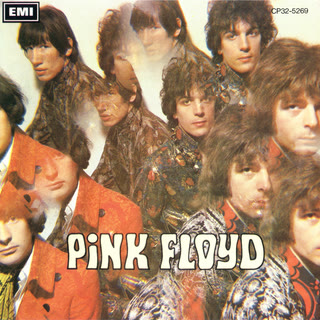
Syd Barrett's album, recorded at Abbey Road with Norman Smith producing. Every tab we found, from Astronomy Domine to Bike, is in standard tuning, and so are Syd's slide parts. Flaming and The Scarecrow add a 12-string acoustic, also in standard tuning. One bass tab of Bike drops the bass's E string to D.
TuneLit measured the first Japanese CD (Toshiba-EMI CP32-5269) about 6 cents flat (A ≈ 438.4), close enough to concert pitch for most players. The Gnome is the outlier: about 34 cents flat (A ≈ 431.5), steady from the first verse to the last. Set the reference to 431 or 432 for that one.
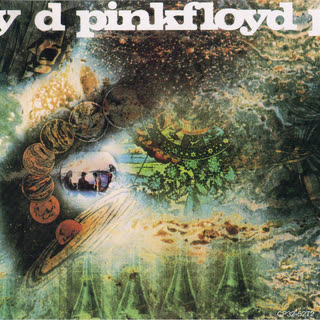
The record where Gilmour joined and Syd left; Jugband Blues, the last song Syd wrote for the band, closes it. All tabs use standard tuning, including Syd's slide on Remember a Day and the acoustic on See-Saw. The CD sits at concert pitch. Jugband Blues is a little lower, about 8 cents flat. The title track is mostly organ, percussion and effects, and its reading is too weak to mean much.
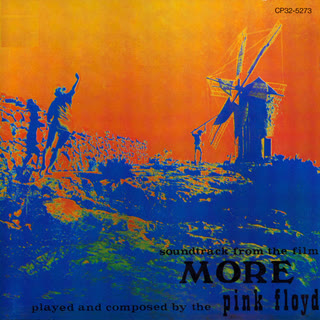
The soundtrack to Barbet Schroeder's film More, and the first album with Gilmour as the main guitarist and singer: hard-hitting The Nile Song and Ibiza Bar, acoustic Green Is the Colour and Cymbaline (nylon strings), and instrumentals. Everything with a tab is in standard tuning. The CD sits about 8 cents flat (A ≈ 438), and Green Is the Colour about 16 (A ≈ 436).
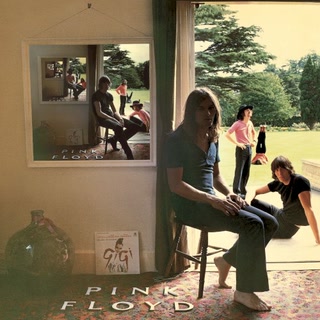
A double album: four songs recorded live in 1969 and a studio disc with one piece by each member. It is not in the owner's library, so it is not measured. The live songs (Astronomy Domine, Careful with That Axe, Eugene, Set the Controls for the Heart of the Sun, A Saucerful of Secrets) and Waters' Grantchester Meadows, with two acoustic guitars, are tabbed in standard tuning. Gilmour's three-part The Narrow Way is the exception: tabs put the acoustic Part I and the electric Part III in Drop D, while Part II is tabbed in standard tuning and another tab of Part III stays in standard. Wright's Sysyphus and Mason's The Grand Vizier's Garden Party have almost no guitar.
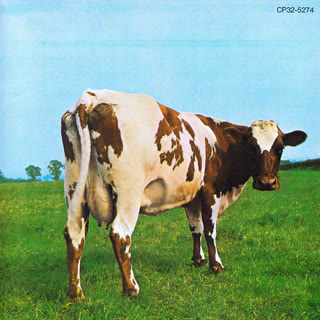
The title suite, with brass and choir, takes up the first side; then a song each from Waters (If), Wright (Summer '68) and Gilmour (Fat Old Sun), and the kitchen collage Alan's Psychedelic Breakfast. Guitars are in standard tuning, slides included. Both tabs of the suite drop the bass's E string to D, so TuneLit lists that for the bass. One tab of Fat Old Sun adds a pedal steel in a C F C F A C tuning, but Gilmour bought his pedal steel only after these sessions, so we do not list it. The CD sits at concert pitch.
The normal guitar parts are in standard tuning, Echoes included, and the album has the band's two most famous early exceptions:
One of These Days: the slide part is Gilmour's Fender 1000 steel in open E minor (E B E G B E), the tuning he has used for the song on stage ever since. The driving line everyone knows is two basses in standard tuning, Gilmour and Waters, one with old dull strings.
Fearless: Waters plays an acoustic in an open G tuning that Syd Barrett showed him. The most detailed tab, and two others, have it as G G D G B B (the low E raised to G, the A lowered to G, the top E lowered to B); other tabs use ordinary open G, D G D G B D. We list the first and mark it disputed.
A Pillow of Winds is disputed in a different way: fan tabs and the strummed acoustic are in standard tuning, while one detailed transcription puts an electric arpeggio part in E B E F♯ G B and the slide in open E. No band source settles it, so TuneLit keeps standard tuning.
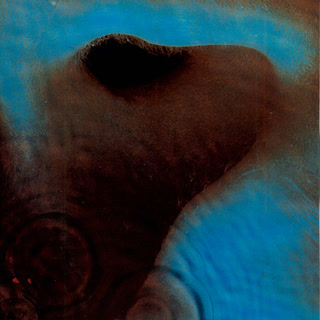
The owner's copy is a 2009 Japanese CD, not a first pressing. It sits about 7 cents flat overall (A ≈ 438.3), but the songs spread more than on any other Floyd album: One of These Days 22 cents flat (A ≈ 434.4), Fearless 17, A Pillow of Winds and San Tropez about 7, Seamus and Echoes at concert pitch. Echoes needs a word: TuneLit's value comes from its opening minutes. Read in sections, its sung verses come out about 20 cents lower than the opening, the long middle section returns to concert pitch and the closing section sits about 10 cents low. If the verses sound sour at A 440, try A 435.
A second soundtrack for Barbet Schroeder, this time La Vallée, recorded quickly in France between Dark Side sessions. Tabs keep everything in standard tuning, including the slide on the title track. That one deserves a caution: a transcription of a 1972 live version uses an open tuning (E B D F♯ B D, a half step down), so the studio steel may not have been in standard tuning either. One detailed tab of When You're In lowers the high string to C, but nothing else supports it. Gilmour later played Wot's... Uh the Deal with a lap steel in open G6.
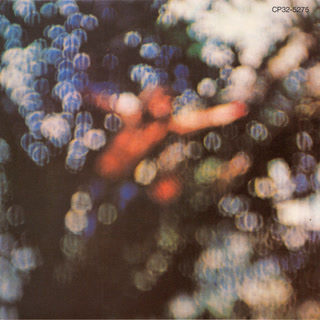
The CD sits at concert pitch. The Gold It's in the... is about 26 cents flat (A ≈ 433.5), Stay about 17 and Mudmen about 13.
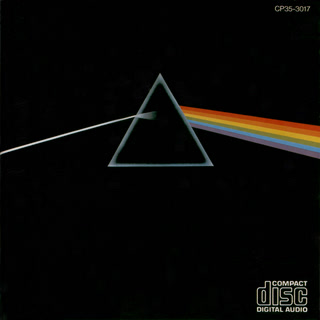
Gilmour's Black Strat in standard tuning on every song with guitar: Breathe, Time, Money (in B minor, with the last part of the solo on a 24-fret guitar), Us and Them, Any Colour You Like, Brain Damage and Eclipse. The steel guitar is the exception. On Breathe it adds the slide fills, and on The Great Gig in the Sky it is the only guitar, both in open G6 (D G D G B E) according to gilmourish.com and the most detailed tabs. TuneLit lists Breathe in standard tuning, because the chords are the main part, and The Great Gig in the Sky in G6.
The first Japanese CD (CP35-3017) sits at concert pitch overall, with two clear exceptions. Time is about 23 cents flat (A ≈ 434), and not only during the clocks and roto-tom intro: the verses and the solo read the same. The Great Gig in the Sky is about 11 cents sharp (A ≈ 443). So the album needs three settings: A 440 for most of it, A 434 for Time and A 443 for Great Gig. On the CD, Speak to Me and Breathe share one track; TuneLit's reading of it belongs to Breathe.
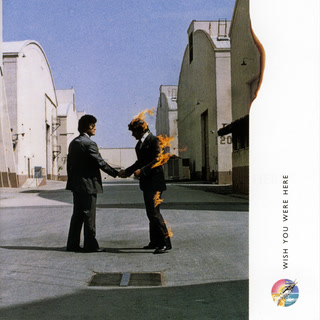
Standard tuning for the Strat parts of Shine On You Crazy Diamond (in G minor), Have a Cigar, and the six- and 12-string acoustics of Welcome to the Machine and the title song. The intro of Wish You Were Here is a 12-string processed to sound like a radio; the solo and the strumming are a Martin six-string, without a capo. The steel parts use open G: Part VI of Shine On opens with Gilmour's steel in open G6 according to Wikipedia and gilmourish.com (one tab keeps it in standard), and the pedal steel behind the title song is tabbed in open G (D G D G B D). The main guitars are in standard tuning, so that is what the songs list.
The owner's CD (TOCP-65560, a later Japanese issue) sits about 10 cents flat (A ≈ 437.6), with the title song the exception at concert pitch. The first half of Shine On reads closer to 5 cents flat; at that size the difference is hard to hear.
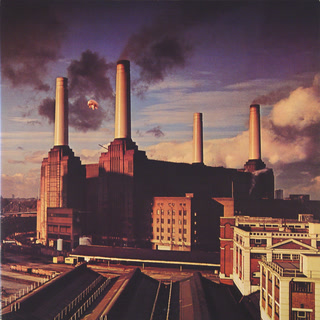
Standard tuning for Pigs on the Wing, Pigs (Three Different Ones) and Sheep. Dogs is a whole step down, D Standard (D G C F A D): gilmourish.com says both the Telecaster and the Ovation acoustic were tuned that way, and the song moved from E minor, as the band played it live in 1974, to D minor on the record. Tabs written in E Standard play it a whole step too high.
Measured from an original Japanese LP (25AP 340), the album sits about 7 cents sharp (A ≈ 441.7), Dogs included; Pigs on the Wing (Part Two) is about 4 cents flat. An LP depends on the turntable's speed, and the CD running times we could compare differ between editions by more than the effect, so a few cents of turntable error cannot be ruled out here. Treat the last few cents with care.
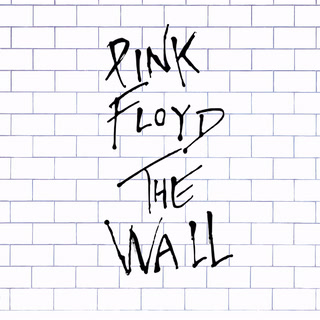
Standard tuning for most of the album, with three exceptions on the guitar side. Run Like Hell is in Drop D, as Gilmour told Musician magazine in 1992; his tech Phil Taylor said he still played it on a Drop D Telecaster in 1994. Hey You is played on the high-strung Ovation described above, as are parts of Comfortably Numb and Mother, where the main guitars are in standard tuning. Is There Anybody Out There? has a classical guitar played by session player Joe DiBlasi, in standard tuning.
The pitch is the real story. TuneLit measured an original Japanese double LP (40AP 1750~1), whose running time matches the 1985 CD within 0.1 %, so the turntable is not the cause. The album sits about 11 cents sharp (A ≈ 443). Comfortably Numb, Another Brick in the Wall (Part 2), Mother and most of the record are close to that. A few songs sit higher:
In the Flesh?: about 39 cents sharp (A ≈ 450), steady through the whole song.
Hey You and Run Like Hell: about 26 cents (A ≈ 447).
Outside the Wall: about 21 cents; In the Flesh: about 19.
The Trial, mostly orchestra and voices: about 43 cents.
Nobody Home is the one song at concert pitch. In the Flesh? and The Trial sit close to halfway between two notes, so their pages offer two Tune buttons; with the guitars in standard tuning and the semitone check from the audio agreeing, the E Standard reading is the one to start with.
Roger Waters' last album with the band, built largely on piano, acoustic guitar and orchestra, with Gilmour's electric guitar on a few songs and his only lead vocal on Not Now John. No source gives any song an alternate tuning, and the tabs use standard tuning. Measured from an original Japanese LP (25AP 2410), the album sits about 6 cents sharp (A ≈ 441.6); The Gunner's Dream is higher (16 cents), The Hero's Return lower (11 cents flat) and The Post War Dream at concert pitch.
Gilmour's first album leading the band, mostly on a Steinberger and a Strat. It is not in the owner's library, so it is not measured. Neither the tabs nor gilmourish.com's session notes give any song an alternate tuning. Sorrow sounds as if it were tuned very low, but its huge opening tone came from playing the guitar through a PA in an empty Los Angeles arena and recording the room; the tab and the guitar parts are in standard tuning, and Tony Levin plays a 5-string bass under it. Yet Another Movie ends with a slide solo, a lap steel according to Wikipedia; its tuning is not documented.
Standard tuning for nearly all of it: Strats, a Les Paul on A Great Day for Freedom, a Whammy pedal on Marooned (the octave leaps are the pedal, not a tuning), the talk box on Keep Talking, a Gibson J-200 acoustic on Lost for Words. Two exceptions:
Poles Apart is in DADGAD (D A D G A D). Gilmour said he thought he had invented the tuning, and the song came out of it within minutes; on tour he kept a second J-200 in it.
High Hopes ends with a lap steel solo. The rest of the song is piano and a nylon-string acoustic in standard tuning. The lap steel is in open E minor (E B E G B E) on stage; nobody from the band has named the studio tuning, so the song lists standard tuning and the note gives the steel's.
The first Japanese CD (SRCS 7324) sits at concert pitch on every song.
Built mostly from instrumental recordings made during the Division Bell sessions, finished twenty years later. It is not in the owner's library, so it is not measured. No song-level tuning is documented. Louder than Words, the one song with vocals, adds a high-strung acoustic (a Nashville-style set) to electric guitars in standard tuning, and It's What We Do features a baritone Telecaster whose tuning is not known.
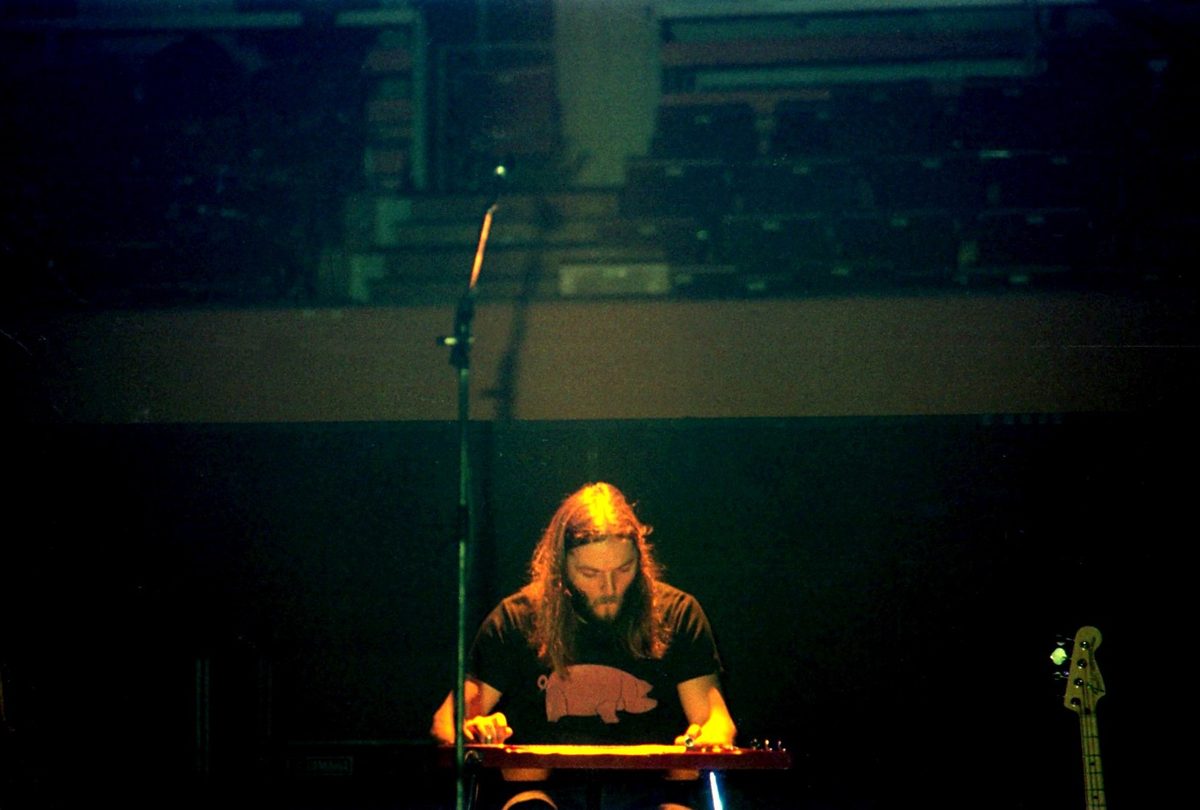
David Gilmour playing lap steel guitar with Pink Floyd at the Festhalle, Frankfurt, Germany, 26 January 1977.
TuneLit lab
What TuneLit measured
TuneLit measured 120 tracks from twelve albums: the first Japanese CD pressings of the albums from Piper to The Dark Side of the Moon, a 2009 Japanese CD of Meddle, a later Japanese CD of Wish You Were Here, the first Japanese pressing of The Division Bell, and original Japanese LPs of Animals, The Wall and The Final Cut. The method listens to 90 seconds of each track from 0:45 and compares the strongest notes with the A 440 grid. The album value is the middle of its songs, weighted by how clear each reading was; a song gets its own value when it sits 8 cents or more away from its album with a clear reading.
What stands out:
Nothing is far off on average. Album values run from about 10 cents flat (Wish You Were Here) to 11 cents sharp (The Wall), much closer to A 440 than, for example, Pantera's flat-tuned records.
The Wall is the sharp one, and inside it a group of songs sits 20 to 40 cents sharp. On the LP the turntable is not the cause.
Single songs carry the surprises: Time 23 cents flat on a 440 album, The Gnome 34 flat, One of These Days 22 flat, The Gold It's in the... 26 flat, In the Flesh? 39 sharp. These readings are steady from start to finish of each song, so they are not a passing intro or effect.
Echoes is not one pitch. Its sections read differently, from concert pitch to about 20 cents flat.
Limits to keep in mind. A turntable running 0.3 % fast or slow moves a needle drop by about 5 cents, which matters for Animals and The Final Cut. Remasters can differ from first pressings; we measured the editions named above and nothing else. Songs built on organs, orchestras, sound effects or synthesizers (A Saucerful of Secrets, On the Run, Quicksilver, Party Sequence) give weak readings; their values matter little for guitar anyway. Values within ±4 cents count as concert pitch.
The audio semitone check, which tests whether the record's lowest open string really sits where the tuning says, agrees with 85 of the 120 songs, including Dogs in D Standard, Run Like Hell in Drop D, Poles Apart in DADGAD, Fearless in its open G and The Great Gig in the Sky in G6. Twelve songs point a half step up to F, the method's known mistake on songs that rarely play their open low E (Another Brick in the Wall Part 2, Southampton Dock and others); none of them moved.
Evidence
How sure are these numbers?
Every tuning on the album pages has a status label:
Official: a band member or his tech said it. Run Like Hell (Drop D) and Poles Apart (DADGAD), in Gilmour's own words.
Widely reported: several independent sources agree, such as the gear notes on gilmourish.com, Wikipedia's song articles and the most detailed tabs. The steel tunings, Dogs and the high-strung Hey You are at this level.
Community: tabs only. Most of the early albums, The Final Cut and the last three albums rest on tabs, which all agree on standard tuning.
Disputed: the sources disagree. Fearless (G G D G B B or D G D G B D) and A Pillow of Winds.
Measured by TuneLit: our own pitch analysis of the owner's CDs and LPs, giving the offset in cents. Only the numbers are published; the audio is never stored or shared.
A measurement knows the offset only within a semitone, so the tuning's name (E Standard, Drop D, D Standard) comes from the sources above, and the measured cents go on top. If a song still sounds a little off, move the reference by a hertz: near 440 Hz, one hertz is about 4 cents.
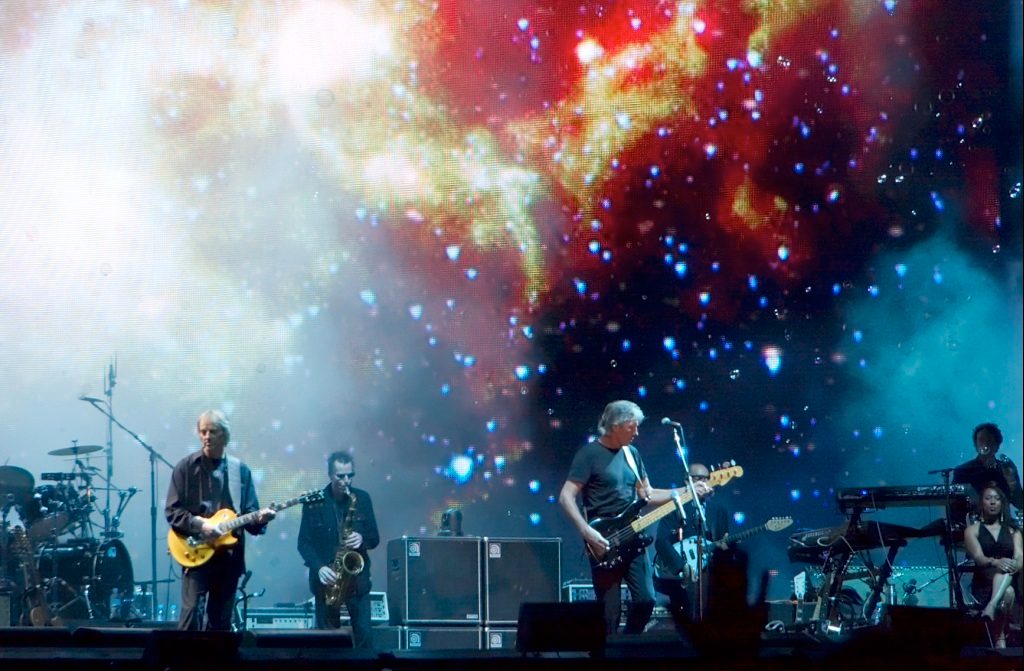
Roger Waters (centre, at the microphone) on his Dark Side of the Moon Live tour in Perth, Australia, 2007.
Cheat sheet
Quick reference
The Piper at the Gates of Dawn (1967): E Standard −6 ¢ (A ≈ 438). The Gnome −34 ¢ (A ≈ 431.5).
A Saucerful of Secrets (1968): E Standard at A 440. Jugband Blues −8 ¢.
More (1969): E Standard −8 ¢. Green Is the Colour −16 ¢.
Ummagumma (1969, not measured): E Standard; The Narrow Way in Drop D.
Atom Heart Mother (1970): E Standard at A 440; the suite's bass in Drop D.
Meddle (1971): E Standard −7 ¢. One of These Days: steel in open E minor (E B E G B E), −22 ¢. Fearless: G G D G B B (or open G D G D G B D), −17 ¢. Seamus and Echoes at A 440 (Echoes' verses about −20 ¢).
Obscured by Clouds (1972): E Standard at A 440. The Gold It's in the... −26 ¢, Stay −17 ¢, Mudmen −13 ¢.
The Dark Side of the Moon (1973): E Standard at A 440. Time −23 ¢ (A ≈ 434). The Great Gig in the Sky: steel in open G6 (D G D G B E), +11 ¢. Breathe's steel fills in open G6.
Wish You Were Here (1975): E Standard −10 ¢ (A ≈ 437.6); the title song at A 440. Steel parts in open G.
Animals (1977): E Standard +7 ¢ (LP). Dogs: D Standard +7 ¢. Pigs on the Wing (Part Two) −4 ¢.
The Wall (1979): E Standard +11 ¢ (A ≈ 443). In the Flesh? +39 ¢, Hey You (high-strung, E4 A3 D4 G4 B3 E4) +26 ¢, Run Like Hell (Drop D) +26 ¢, Outside the Wall +21 ¢, In the Flesh +19 ¢, Nobody Home at A 440.
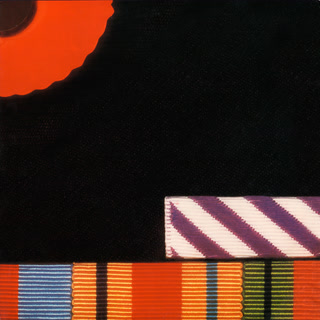
The Final Cut (1983): E Standard +6 ¢ (LP). The Gunner's Dream +16 ¢, The Hero's Return −11 ¢, The Post War Dream at A 440.
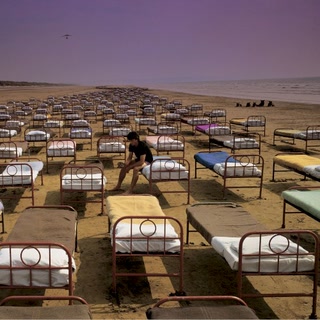
A Momentary Lapse of Reason (1987, not measured): E Standard throughout.
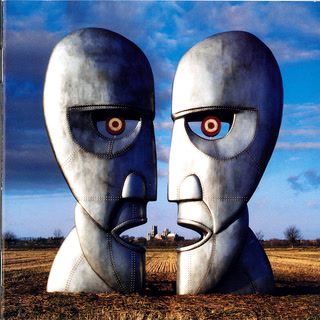
The Division Bell (1994): E Standard at A 440. Poles Apart in DADGAD; High Hopes' steel solo in open E minor.
The Endless River (2014, not measured): E Standard.
Golden rule: the strings are almost always standard; check the song's A value, especially on The Wall and a few single songs, before you suspect your ears.
Questions
What tuning does Pink Floyd use?
Mostly E Standard: 15 of 15 albums. Many albums also have songs in other tunings, and the album pages list them song by song.
Why does Pink Floyd sound out of tune when I play along?
Some records are not at concert pitch. The Wall sits about 11 cents sharp (A ≈ 443). A guitar tuned to A 440 clashes with them. Every Tune button on these pages sets the measured pitch for you.
How did TuneLit measure Pink Floyd's records?
We played original CDs and LPs through TuneLit's pitch analysis: the strongest notes of each song are compared with the A 440 grid, which gives the offset in cents. That cannot tell the semitone, so the tuning name comes from interviews, the press and tabs. The audio is never stored or published.
Colors and font
Font
Colors
Menu
Install the app
Android (Chrome): menu ⋮ → Install app or Add to Home screen.
Computer (Chrome, Edge): the install icon at the right end of the address bar.
iPhone: Safari → Share → Add to Home Screen.
It opens full screen and keeps tuning with no connection.