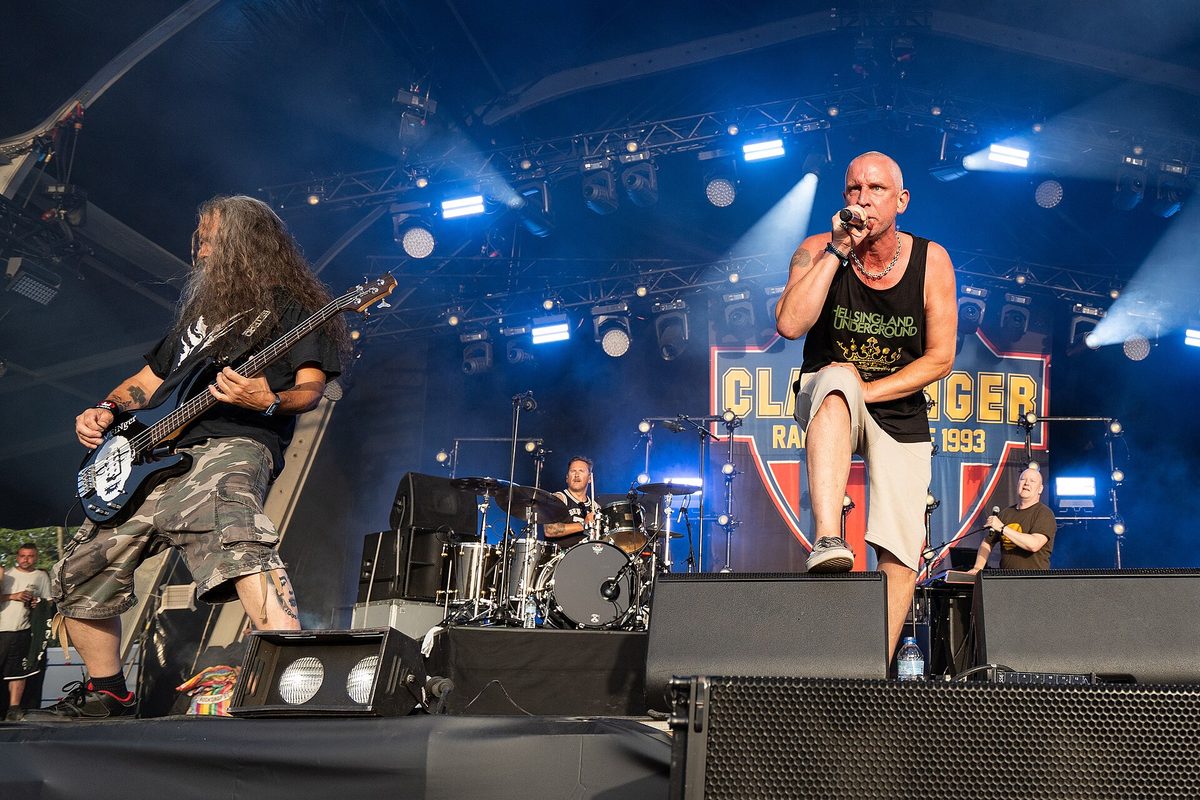
Clawfinger at Hellfest, Clisson, France, 28 June 2024: singer Zak Tell at the front, the bassist on the left and the drummer behind.
In short
How Clawfinger tunes
Clawfinger, the Stockholm band that mixed rap vocals, programmed beats and heavy guitars, tuned lower as the years went by. Tabs put Deaf Dumb Blind (1993) and Use Your Brain (1995) in Drop D, with Rosegrove the one song left in E Standard, and the self-titled album (1997) a whole step lower in Drop C.
Read more
A Whole Lot of Nothing (2001) and Zeros & Heroes (2003) mix Drop D and D Standard with Drop C, B Standard, Drop A and a 7-string in Drop G, and by Hate Yourself with Style (2005) and Life Will Kill You (2007) most tabs need a low A, on a baritone or a 7-string. Before We All Die (2026) goes back to Drop D for its singles. Clawfinger tabs are scarce, so many songs rest on a single community transcription. TuneLit measured the seven albums of 1993 to 2007 from the CDs: the first three sit 6 to 9 cents sharp (A ≈ 442), A Whole Lot of Nothing and Zeros & Heroes are at concert pitch, and the last two are a few cents sharp again. TuneLit's semitone check from the audio confirms the low string on 60 of 81 songs, including Drop C for Two Sides and Pin Me Down, where the tabs disagree.
Clawfinger came out of Stockholm in the early 1990s with a sound few bands had then: rapped vocals over programmed beats, keyboards and samples, with two guitars hammering out short, heavy riffs underneath. If you want to play those riffs along with the records, the first thing to know is that the guitars almost never sit in standard tuning. The band started in Drop D, moved down to Drop C in 1997, and by the mid-2000s was writing songs around a low A on baritone and 7-string guitars.
This page collects what is known about Clawfinger's tunings, from Deaf Dumb Blind (1993) to Before We All Die (2026), album by album and song by song. One warning up front: Clawfinger tabs are scarce. There are no official tab books, and the band's guitarists have not talked much about tuning in interviews we could find. Most of what follows rests on community transcriptions from Songsterr and Ultimate Guitar, and for many songs there is exactly one tab, sometimes a machine transcription. We say so wherever it applies.
To make up for that, TuneLit measured the seven albums from 1993 to 2007 from CDs in our own library. A measurement gives the exact pitch of the record, and TuneLit's semitone check from the audio listens for the lowest open string, which tells us when a tab's tuning fits the record and when it does not. The album list above opens every album, where each song has a Tune button that opens the tuner in exactly that tuning, offset included.
The story
Clawfinger's tunings at a glance
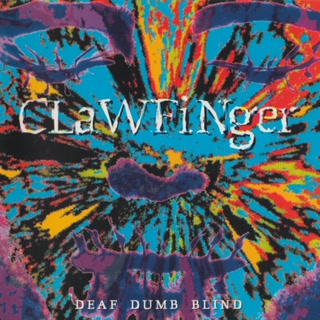
Deaf Dumb Blind (1993): Drop D, about 9 cents sharp. Rosegrove is in E Standard.
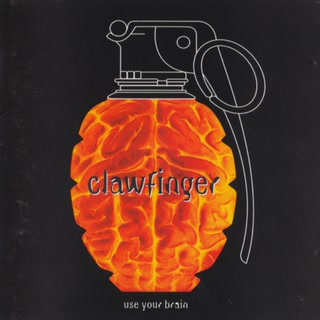
Use Your Brain (1995): Drop D, about 6 cents sharp. Pin Me Down is in Drop C.
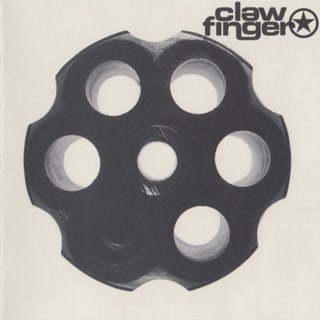
Clawfinger (1997): Drop C, about 8 cents sharp.
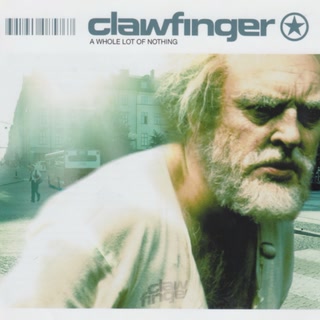
A Whole Lot of Nothing (2001): mostly Drop D at concert pitch, with D Standard, Drop C and E Standard songs.
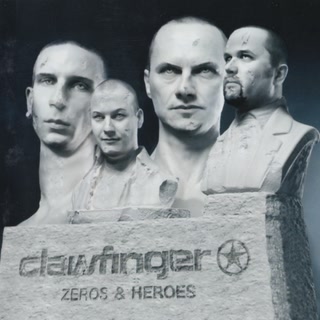
Zeros & Heroes (2003): mostly Drop D at concert pitch, with songs in B Standard, Drop A, Drop C and a 7-string in Drop G.
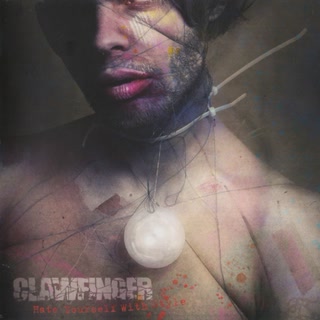
Hate Yourself with Style (2005): Drop A as far as anyone knows, from a single tab.
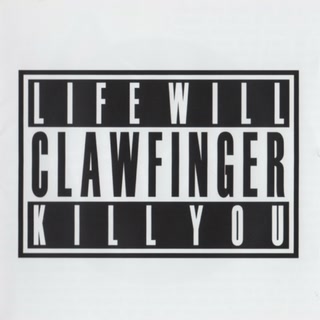
Life Will Kill You (2007): a low A, mostly on a 7-string guitar, about 6 cents sharp.
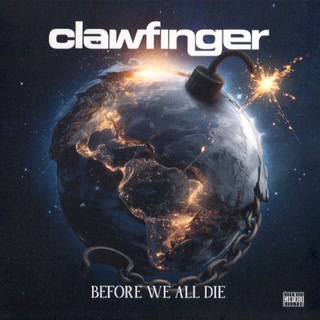
Before We All Die (2026): Drop D on the singles, a 7-string and Drop C on two other songs. Not measured.
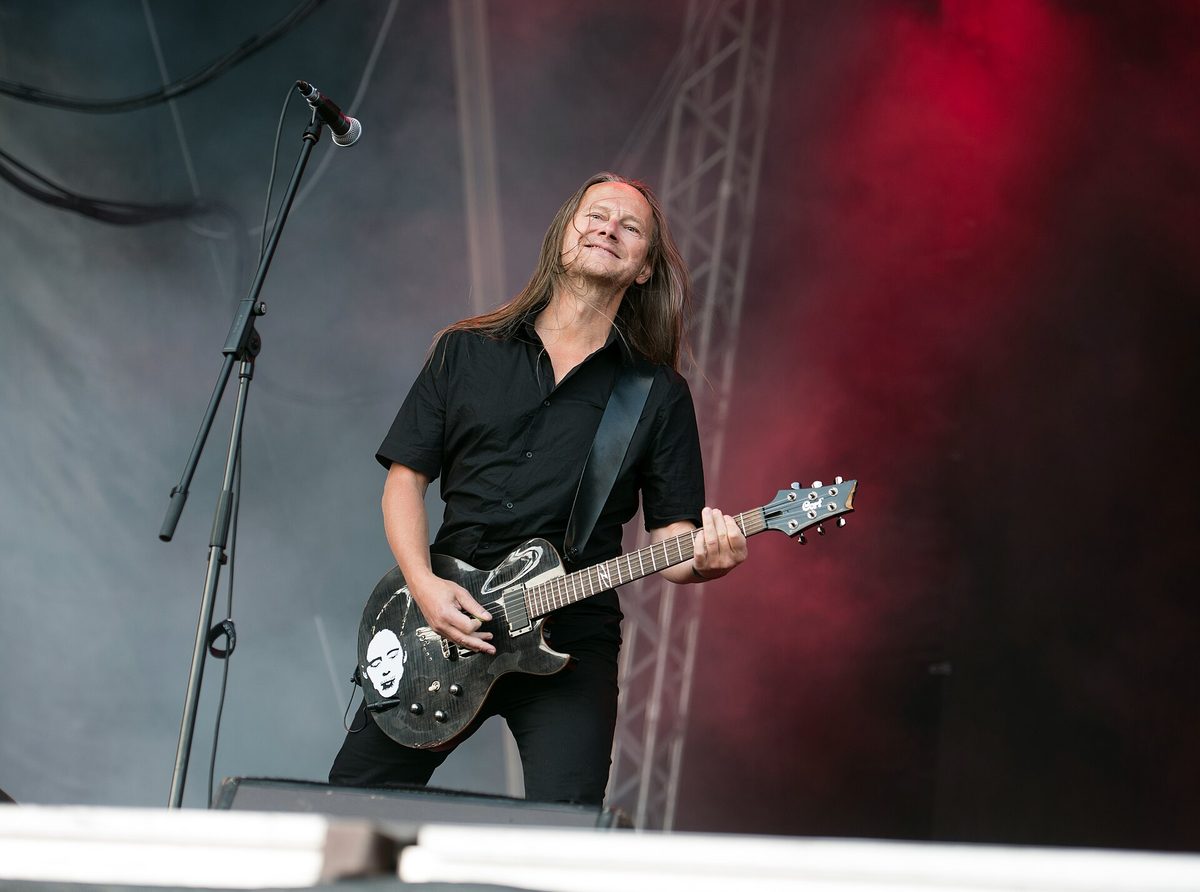
Guitarist and co-founder Bård Torstensen with his Cort guitar at Hammaburg Fest, Hamburg, 16 August 2019.
The story
How the tuning changed, era by era
1993 to 1995: Drop D. The first two albums are built on Drop D, the simplest of the dropped tunings: only the 6th string goes down a whole step, from E to D, so a single finger across the three lowest strings plays a power chord. Every tab of Deaf Dumb Blind except one uses it, and so do all the tabs of Use Your Brain except Pin Me Down. The tabbed riffs of Bård Torstensen and Erlend Ottem, the band's two Norwegian guitarists, sit mostly on the two or three lowest strings, exactly where Drop D lets one finger play a power chord. The odd song out is Rosegrove, tabbed in plain E Standard.
1997: a whole step lower. For the self-titled third album the band moved to Drop C: the whole guitar down a whole step to D Standard, then the 6th string dropped another whole step to C (C G C F A D). Every Ultimate Guitar tab of the album and most of the Songsterr tabs use it. The riffs stay where the fingers already were, on the two or three lowest strings, but the whole record sounds a step darker.
2001 to 2003: mixing tunings. A Whole Lot of Nothing leaned on electronics and synthesizers more than any album before it, and the guitar tunings go in several directions at once. The tabbed songs use Drop D, D Standard, Drop C and, for the Ultravox cover Vienna, E Standard. Zeros & Heroes brought the guitars back to the front with more involved riffs, and it is the first album to go far below Drop C: Recipe for Hate is tabbed in B Standard, Money Power Glory in Drop A, and Live Like a Man on a 7-string guitar in Drop G. Erlend Ottem left the band in 2003, and Bård Torstensen took over the lead guitar.
2005 to 2007: the low A. Bård Torstensen's Wikipedia page says, without citing a source, that he used an Epiphone Les Paul baritone, a Schecter baritone and an Ibanez 7-string tuned to Drop A in these years. The tabs agree as far as they go. The only tab of Hate Yourself with Style is in Drop A, and most tabs of Life Will Kill You need a low A string, usually the 7th string of a 7-string guitar. Two songs on Life Will Kill You go the other way: None the Wiser is tabbed in Drop C, and The Cure & the Poison in plain E Standard.
2026: back to Drop D, mostly. Clawfinger split up in 2013 and returned in 2017 with occasional singles. Before We All Die, their first studio album since 2007, came out in February 2026. Songsterr tabs put its singles Scum and Going Down (Like Titanic) in Drop D, Ball & Chain on a 7-string a whole step down, and the title track in Drop C.
TuneLit lab
A few cents sharp: what TuneLit measured
A tuner judges every note against a reference A, normally 440 Hz. A record can sit slightly above or below that grid, because the band tuned that way or because the tape or the mastering moved it, and a measurement hears only the result. TuneLit measured the original CD editions from our own library: German MVG pressings of the first three albums, and the GUN and Nuclear Blast CDs of the later ones. The audio itself is never uploaded or published; only the numbers appear on this page.
Album
Tabs say
TuneLit measured
Equivalent A
Deaf Dumb Blind (1993)
Drop D
+9 ¢
A ≈ 442
Use Your Brain (1995)
Drop D
+6 ¢ (Undone +16 ¢)
A ≈ 442
Clawfinger (1997)
Drop C
+8 ¢ (Wrong State of Mind +19 ¢)
A ≈ 442
A Whole Lot of Nothing (2001)
Drop D and others
−3 ¢ (concert pitch; Vienna +13 ¢)
A 440
Zeros & Heroes (2003)
Drop D and others
+2 ¢, concert pitch (Bitch −9 ¢)
A 440
Hate Yourself with Style (2005)
Drop A
+11 ¢, low confidence
A ≈ 443
Life Will Kill You (2007)
low A
+6 ¢
A ≈ 441.5
The pattern is easy to read. The three 1990s albums all sit a few cents sharp, between 6 and 9 cents, which puts the reference A near 442 Hz. That is small: most players would call it in tune, and a guitar at concert pitch will sound close. But it is consistent across the three records, and on Deaf Dumb Blind every song with a clear reading lands between about +4 and +13 cents. A 2014 reissue of Deaf Dumb Blind in our library reads within about a cent of the 1993 CD on every song, so the offset belongs to the master, not to one pressing.
A Whole Lot of Nothing and Zeros & Heroes come back to concert pitch. Each has one song that stands out: Vienna sits about 13 cents sharp, and Bitch about 9 cents flat. Life Will Kill You is a little sharp again, at about 6 cents.
Hate Yourself with Style is the one album we could not read cleanly. Three songs, The F****t in You, Breakout and Without a Case, measure at or just below concert pitch with good confidence. The others scatter between 9 and 40 cents sharp, all with low confidence, and they pull the album value up to about 11 cents. Treat that number as rough: if a song from this album sounds off, try concert pitch first.
A few limits apply to every number here. Dense, distorted mixes with samples and synths are harder to read than a clean guitar, so single songs scatter; most songs therefore use their album's value, and only songs that clearly differ get their own. Anything within ±4 cents counts as concert pitch. You do not need to type any of these values: every Tune button already includes them.
The story
When the tabs and the record disagree
A pitch measurement knows the offset only within one semitone, so the tuning's name, Drop D or Drop C or E Standard, comes from the tabs. To check those names, TuneLit's semitone check listens to the lowest notes of each song. The bass and the guitars play their open low string often and the note just below it almost never, so the check can tell whether the low string sits where the tab says, or a semitone higher or lower. When it agrees with a tab, that is a strong confirmation. When it disagrees, it is only a hint, because a song that never plays its open low string, or a synth bass that goes below the guitars, can fool it.
We ran it on all 81 songs of the seven measured albums. It agrees with the database on 60 of them, is not sure on 17 and disagrees on 4. The useful results:
Two Sides (Clawfinger) is tabbed in Drop C on Ultimate Guitar but in E Standard by two Songsterr tabs. The check hears a low C, which fits Drop C, like the rest of the album.
Pin Me Down (Use Your Brain) is in Drop C in a Songsterr machine transcription and in Drop D in an older Ultimate Guitar tab. The check hears C again, so it is listed in Drop C.
Rosegrove (Deaf Dumb Blind) really is the E Standard song of the album: the check hears E, not the D of the songs around it.
On Deaf Dumb Blind the check agrees with Drop D on every other song, including Wonderful World and Sad to See Your Sorrow, which have no tab at all.
The disagreements and the doubtful songs:
It (Use Your Brain), Are You Man Enough and Simon Says (A Whole Lot of Nothing) have no tab, so they follow their album's Drop D. The check hears C♯ under all three. That could be a guitar tuned a half step lower for these songs, or a synth bass below the guitars; nothing confirms either, so they stay in Drop D until someone checks them by ear.
Vienna is tabbed in E Standard, and the check picks F. The song sits on F, one fret above the open E, and that is the check's best-known mistake, so the tab stands.
Don't Look at Me (A Whole Lot of Nothing) has no tab; its lowest note is C, a whole step below the album's D.
Four Letter Word and Step Aside (Zeros & Heroes) have no tab either. A low B, the low string of Recipe for Hate, sounds often in both.
On Hate Yourself with Style, The Best & the Worst, God Is Dead and Without a Case have their lowest notes on C♯, C and G, not on the A of the album's only tab.
Every one of these songs keeps the tuning its album gives it, with a note on its row. If you work out one of them by ear, you will know more than any tab we found.
Main tuning: Drop D +9 ¢ (A ≈ 442), measured by TuneLit on the CD.
The debut is the most consistent record in the catalogue. Every tab on Songsterr and Ultimate Guitar except one is in Drop D: the opening single, The Truth, Don't Get Me Wrong, I Need You, Catch Me, Warfair and I Don't Care. The Truth also has a slide part in its intro and verses in the Ultimate Guitar tab. TuneLit's semitone check confirms the low D on all nine Drop D songs, including the two that have no tab. Rosegrove is the exception, tabbed in E Standard and confirmed by the check.
With TuneLit: every Tune button opens Drop D at +9 ¢, except Rosegrove, which opens E Standard at +9 ¢. Bring the 6th string up to E for that one song, then back down.
Live: a community tab of a live version of the opening single keeps Drop D. No live recording was measured.
Main tuning: Drop D +6 ¢ (A ≈ 442), measured by TuneLit on the CD.
The second album stays in Drop D: Power, Do What I Say, Undone and Tomorrow are all tabbed there, and Do What I Say has the best-rated Clawfinger tab on Ultimate Guitar. Pay the Bill's tabs agree on the low D but not on the rest: Ultimate Guitar and one Songsterr part use Drop D, with the riff on E at the 2nd fret, while Songsterr's main part uses D Standard. Either works for playing along. Pin Me Down goes lower, to Drop C, and the check agrees.
The record sits about 6 cents sharp, with Undone higher at about 16 cents (A ≈ 444). It is the doubtful song: there is no tab, and the check hears C♯ as its lowest note.
With TuneLit: Drop D at +6 ¢ for most songs, +16 ¢ for Undone, Drop C at +6 ¢ for Pin Me Down.
Main tuning: Drop C +8 ¢ (A ≈ 442), measured by TuneLit on the CD.
The self-titled album drops everything a whole step. Biggest & the Best, I'm Your Life & Religion, Hold Your Head Up, Don't Wake Me Up and Wrong State of Mind are all tabbed in Drop C (C G C F A D), and Two Sides is in Drop C on Ultimate Guitar. Two Songsterr tabs of Two Sides use E Standard instead, but the semitone check hears a low C under it, as under every other song of the album where it gives an answer. A single Songsterr tab writes the bass part of I'm Your Life & Religion a whole step below the guitars; no other source mentions it.
The CD sits about 8 cents sharp, like the two albums before it. Wrong State of Mind is higher, about 19 cents (A ≈ 445), and the closer I Guess I'll Never Know sits right at concert pitch.
With TuneLit: Drop C at +8 ¢, with the two songs above at their own values.
Main tuning: Drop D at concert pitch (measured −2.5 ¢), with several exceptions.
This is the album where the tabs split up. Two Steps Away, Confrontation and Paradise are tabbed in Drop D, which serves as the album's default here. Out to Get Me, the single with the most-viewed Clawfinger tab on Songsterr, is in D Standard (D G C F A D), as in the best-rated Ultimate Guitar version. Burn in Hell has a single tab in Drop C, and the cover of Ultravox's Vienna is tabbed in E Standard with a 5-string bass. Nothing Going On is disputed: one tab uses Drop D, a machine transcription uses E Standard, and Bård Torstensen's Wikipedia page mentions an unusual baritone tuning with its low strings on G for it. All three play the riff on the open A string, so any of them works for playing along.
The CD measures at concert pitch, the first Clawfinger album to do so. Vienna is the exception at about 13 cents sharp. Half of the songs have no tab, and the check hears other low notes on three of them (see above).
With TuneLit: Drop D at A 440 by default; D Standard for Out to Get Me, Drop C for Burn in Hell, E Standard at +13 ¢ for Vienna.
Main tuning: Drop D at concert pitch (measured +2 ¢), with several lower songs.
The title track and 15 Minutes of Fame are tabbed in Drop D on both Songsterr and Ultimate Guitar. Then the album goes deep. Recipe for Hate is in B Standard (B F♯ B E G♯ C♯), confirmed by two tabs and by the semitone check. Money Power Glory is in Drop A (A E A D F♯ B), B Standard with the low string a whole step lower. Kick It has a single tab in Drop C, and Live Like a Man a single tab for a 7-string guitar in Drop G (G D G C F A D), whose low G is by far the strongest low note in the recording.
The CD sits at concert pitch. Bitch is the one song that differs, about 9 cents flat (A ≈ 438). Four Letter Word and Step Aside have no tab with a tuning; they follow the album's Drop D, but a low B sounds often in both.
With TuneLit: Drop D at A 440 by default, Drop D at −9 ¢ for Bitch, and the Tune buttons of the other songs open B Standard, Drop A, Drop C or the 7-string Drop G as tabbed.
Main tuning: Drop A +11 ¢ (A ≈ 443), from a single tab and a rough measurement.
Only one song of this album has a tab: the opener, in Drop A (A E A D F♯ B), on Songsterr, with very few views. That fits the Drop A baritone and 7-string described on Bård Torstensen's Wikipedia page, and TuneLit's semitone check hears a low A on that song and five more. So the album is listed in Drop A, with every other song following it. But the audio also suggests other tunings on some songs: its lowest notes sit on C♯ in The Best & the Worst, on C in God Is Dead and on G in Without a Case.
The measurement is the least clean in the catalogue. The opener, Breakout and Without a Case read at or just below concert pitch with good confidence, and they get those values. The other songs read between 9 and 40 cents sharp with low confidence, which puts the album at about 11 cents.
With TuneLit: Drop A at +11 ¢ by default; the three songs above open at their own values. If a song sounds off, try concert pitch, then a different low note.
Main tuning: 7-string Drop A +6 ¢ (A ≈ 441.5), measured by TuneLit on the CD.
Most tabs of this album need a low A. On a 7-string guitar, Prisoners is tabbed in Drop A (A E A D G B E), The Price We Pay a whole step down (A D G C F A D), and the title track with its two lowest strings dropped (A D A D G B E). Where Can We Go from Here? is tabbed for a 6-string in Drop A (A E A D F♯ B). Two songs break the pattern: None the Wiser is tabbed in Drop C, and The Cure & the Poison, the longest song of the album, in E Standard. Every one of these tunings rests on a single Songsterr tab, except The Cure & the Poison, which Ultimate Guitar tabs the same way. The semitone check agrees with the low A on eight songs and with both exceptions.
The CD sits about 6 cents sharp, evenly across the album.
With TuneLit: the default opens a 7-string guitar in Drop A at +6 ¢. On a 6-string, use a baritone or heavy strings and tune the songs as Drop A (A E A D F♯ B); the riffs mostly live on the lowest strings.
Live: a Live @ Novarock 2007 recording exists; TuneLit has not measured it.
The comeback album is not in our library, so nothing on it is measured. Songsterr tabs put the singles Scum and Going Down (Like Titanic) in Drop D, and a chord chart of Scum on Ultimate Guitar agrees. Ball & Chain is tabbed for a 7-string guitar a whole step down (A D G C F A D), and the title track in Drop C. The other songs have no tab yet and follow the album's Drop D.
With TuneLit: every button uses concert pitch, as no offset is known.
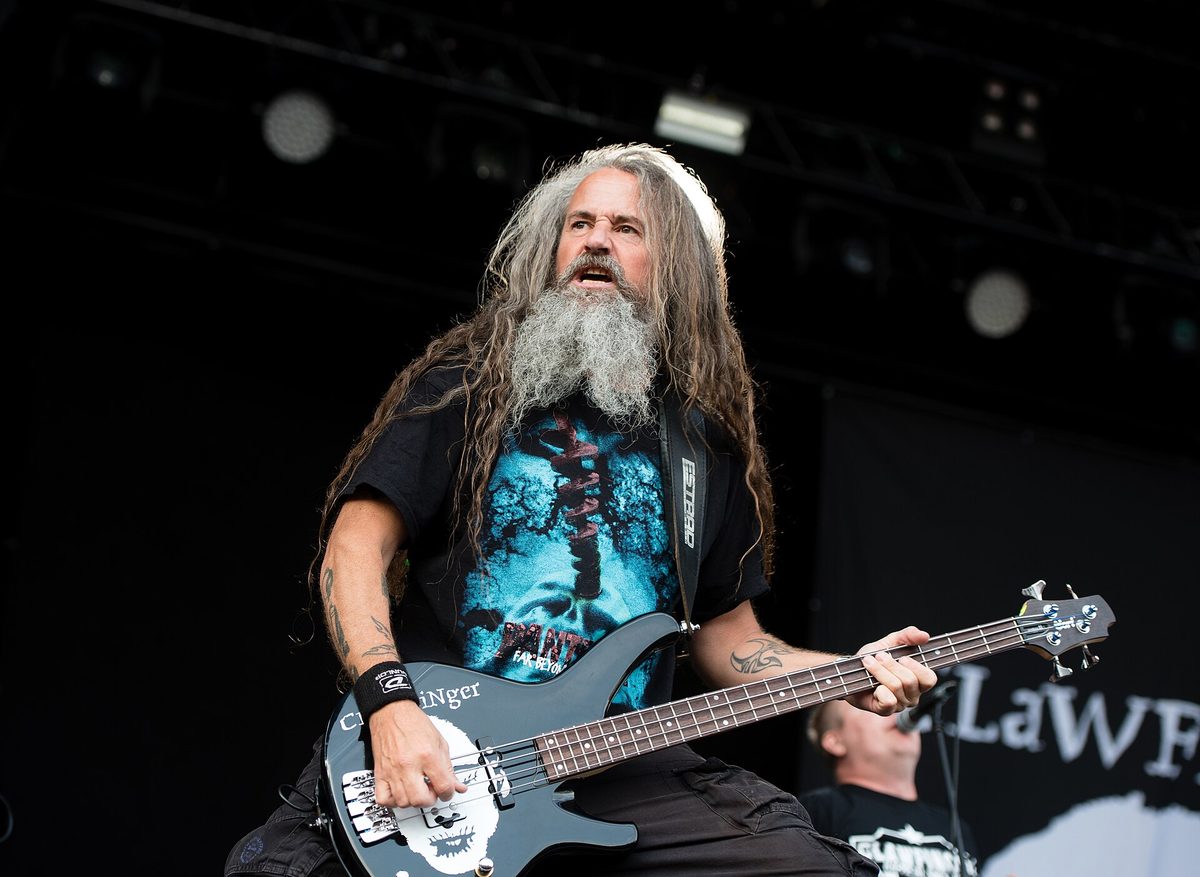
Clawfinger's bassist playing a band-branded bass at Hammaburg Fest, Hamburg, 16 August 2019.
The story
Practical tips
Low tunings need heavier strings. Drop D works on any normal set. For Drop C, B Standard and especially Drop A on a 6-string guitar, the low strings get floppy and go sharp when you dig in; a heavier set or a baritone guitar holds the pitch better.
7-string songs on a 6-string. The songs tabbed for a 7-string (Live Like a Man, most of Life Will Kill You, Ball & Chain) keep their riffs mostly on the lowest strings. On a 6-string you can tune to Drop A or B Standard and follow the riffs, but chords on the higher strings will not match the tab exactly.
Mind the samples. Clawfinger records are full of synths and programmed parts, and on some songs a synth bass plays under the guitars. If the low notes of a song seem to contradict its tuning, that is often why.
The offsets are small. Even the sharpest albums sit only about 9 to 11 cents above concert pitch. Every Tune button includes the measured value, but if you play with a band or a backing track at A 440, concert pitch will sound close enough.
Evidence
How sure are these numbers?
Every tuning on the album pages carries a status label. The measured albums show Measured by TuneLit, because their offset comes from our own analysis of the CD. The tuning name still rests on the other kinds of evidence:
Official: the band said it. For Clawfinger we found no such statement.
Widely reported: trusted outlets agree. None for Clawfinger either.
Community: community transcriptions, mostly Songsterr and Ultimate Guitar tabs. Almost every Clawfinger tuning sits here, often on a single tab, sometimes a machine transcription.
Disputed: the tabs disagree. We show the most likely setting and explain the other: Pay the Bill, Pin Me Down, Two Sides and Nothing Going On.
Measured by TuneLit: our own pitch analysis of an original recording, giving the offset in cents. Only the numbers are published; the audio is never stored or shared.
Singer Zak Tell on stage at Hammaburg Fest, Hamburg, 16 August 2019.
Cheat sheet
Quick reference
Deaf Dumb Blind (1993): Drop D +9 ¢. E Standard +9 ¢: Rosegrove.
Use Your Brain (1995): Drop D +6 ¢; Undone +16 ¢. Drop C: Pin Me Down. Check by ear: It.
Clawfinger (1997): Drop C +8 ¢; Wrong State of Mind +19 ¢; I Guess I'll Never Know at A 440.
A Whole Lot of Nothing (2001): Drop D at A 440. D Standard: Out to Get Me. Drop C: Burn in Hell. E Standard +13 ¢: Vienna. Check by ear: Are You Man Enough, Don't Look at Me, Simon Says.
Zeros & Heroes (2003): Drop D at A 440; Bitch −9 ¢. B Standard: Recipe for Hate. Drop A: Money Power Glory. Drop C: Kick It. 7-string Drop G: Live Like a Man. Check by ear: Four Letter Word, Step Aside.
Hate Yourself with Style (2005): Drop A +11 ¢ (rough); the opener and Without a Case at A 440, Breakout −7 ¢. Check by ear: The Best & the Worst, Without a Case, God Is Dead.
Life Will Kill You (2007): 7-string Drop A +6 ¢. 7-string A Standard: The Price We Pay. A D A D G B E: Life Will Kill You. Drop C: None the Wiser. E Standard: The Cure & the Poison. 6-string Drop A: Where Can We Go from Here?
Before We All Die (2026): Drop D (not measured). 7-string A Standard: Ball & Chain. Drop C: Before We All Die.
Golden rule: start from the album's tuning, and when a song has no tab, trust your ears over the default.
Questions
What tuning does Clawfinger use?
Mostly Drop D: 5 of 8 albums. Hate Yourself with Style and Life Will Kill You are in Drop A; Clawfinger is in Drop C. Many albums also have songs in other tunings, and the album pages list them song by song.
Why does Clawfinger sound out of tune when I play along?
Some records are not at concert pitch. Hate Yourself with Style sits about 11 cents sharp (A ≈ 443). A guitar tuned to A 440 clashes with them. Every Tune button on these pages sets the measured pitch for you.
How did TuneLit measure Clawfinger's records?
We played original CDs and LPs through TuneLit's pitch analysis: the strongest notes of each song are compared with the A 440 grid, which gives the offset in cents. That cannot tell the semitone, so the tuning name comes from interviews, the press and tabs. The audio is never stored or published.
Colors and font
Font
Colors
Menu
Install the app
Android (Chrome): menu ⋮ → Install app or Add to Home screen.
Computer (Chrome, Edge): the install icon at the right end of the address bar.
iPhone: Safari → Share → Add to Home Screen.
It opens full screen and keeps tuning with no connection.