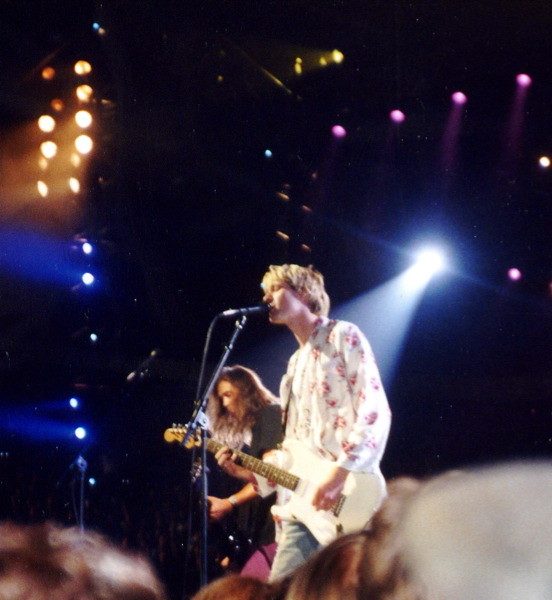
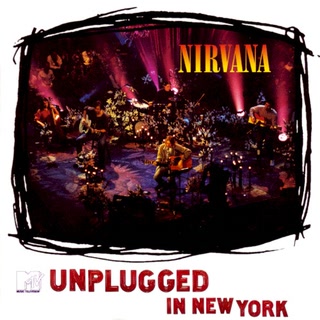
Kurt Cobain singing and playing guitar, with Krist Novoselic on bass behind him, live at the MTV Video Music Awards in Los Angeles, 9 September 1992.
In short
How Nirvana tunes
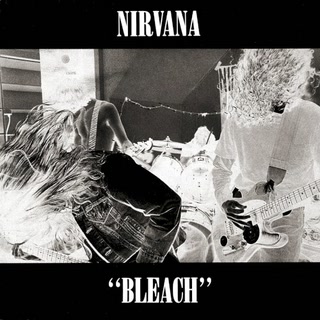
Nirvana stuck to a few plain tunings, but which one moved with the era. Tabs put most of Bleach (1989) in E Standard, with Drop D songs, a Drop C Blew and two E♭ songs from the 1988 demo session.
Read more
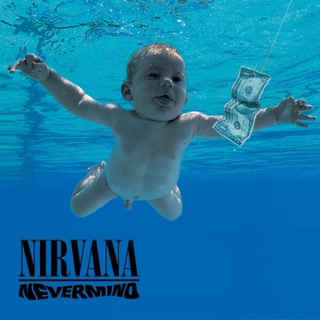
Nevermind (1991) is mostly E Standard, while Come as You Are, Lithium and Drain You are a whole step down in D Standard and On a Plain is in Drop D. TuneLit measured the Nevermind CD about 14 cents sharp (A ≈ 443.6) on the songs from the May 1991 sessions; Polly, kept from a 1990 session, sits at concert pitch, and Something in the Way, played on a detuned acoustic, about 45 cents flat. By 1992 the band tuned a half step down on stage, and In Utero (1993) is in E♭ Standard with three Drop C♯ songs. MTV Unplugged in New York is in E♭ too, so its versions of older songs sit a half step away from the studio records.
Nirvana songs are some of the first riffs many guitarists ever learn, and they are also some of the most argued-about tunings on the internet. Search for almost any Nevermind song and you will find tabs in E Standard, in E♭, in D, even in C♯, all claiming to be right. The good news is that the tabs keep coming back to a handful of plain tunings: standard, a half step down, a whole step down, and the same three with the low string dropped, plus a battered acoustic that was never tuned to anything in particular. The catch is that Kurt Cobain moved between them from record to record, and sometimes from song to song.
This page sorts that out album by album, from Bleach (1989) to MTV Unplugged in New York (1994). For each record you get the main tuning, the songs that break the pattern, what the tabs and the people in the room said, and, for Nevermind, what TuneLit measured on the CD itself. Every song on the album pages has a Tune button that opens the tuner in exactly that tuning, reference pitch included.
The story
The short version
Bleach (1989): mostly E Standard. Negative Creep and Swap Meet are in Drop D, Blew is in Drop C, and the two songs from the January 1988 demo (Floyd the Barber, Paper Cuts) are a half step down.
Nevermind (1991): mostly E Standard. Come as You Are, Lithium and Drain You are a whole step down in D Standard, On a Plain is in Drop D, and Something in the Way was played on a detuned acoustic. The CD runs about 14 cents sharp.
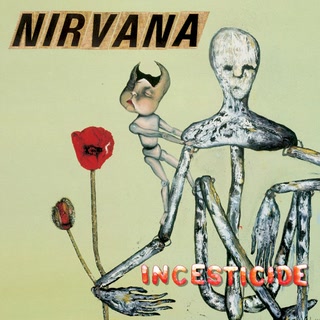
Incesticide (1992): a compilation, so it follows its sources: E Standard for the 1990–91 material, E♭ for the 1988 demo songs, Drop D for Stain and Been a Son.
In Utero (1993): E♭ Standard, with Scentless Apprentice, Heart-Shaped Box and All Apologies in Drop C♯.
MTV Unplugged in New York (1994): E♭ Standard almost throughout, with On a Plain and All Apologies in Drop C♯.
On stage: standard pitch in 1991, a half step down from 1992 on.
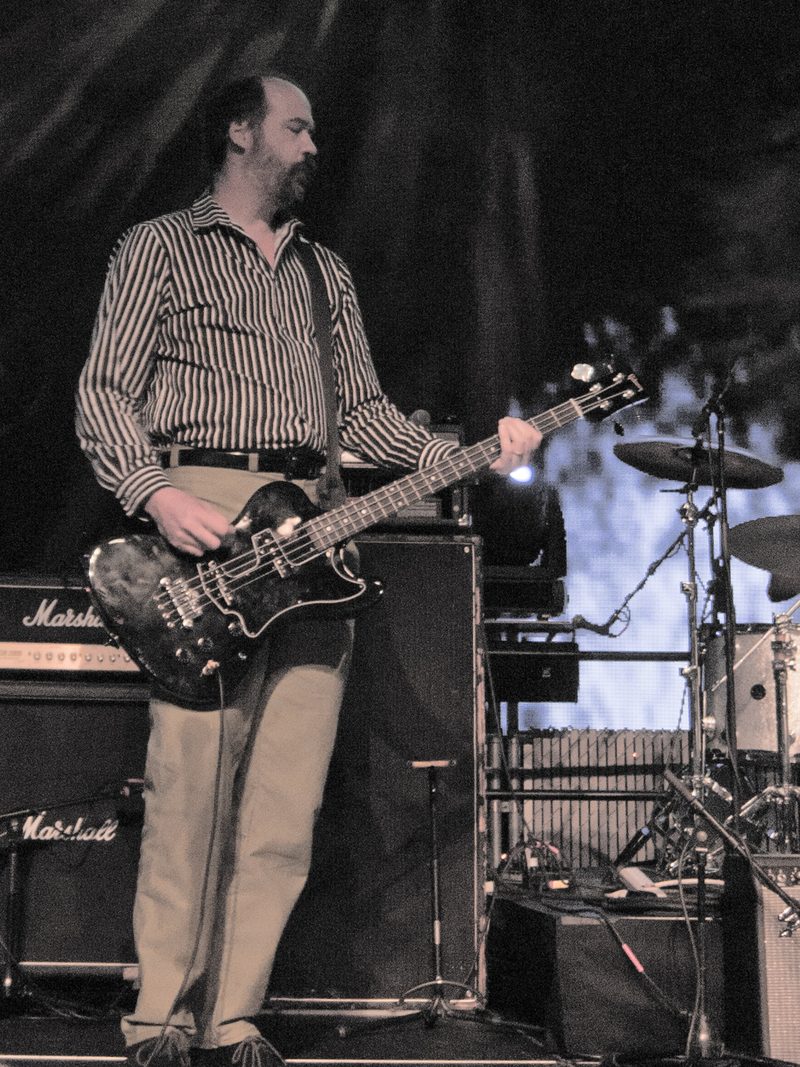
Krist Novoselic on bass at the Nevermind 20th-anniversary celebration at the EMP Museum, Seattle, 21 September 2011.
The story
Nevermind runs a little sharp
Tabs assume a tuner set to A 440. TuneLit's measurement of the Nevermind CD found something the tabs could not: the songs recorded in May 1991, mostly at Sound City in Van Nuys, all sit above concert pitch, by about 9 to 18 cents, around 14 on average. (Territorial Pissings is too noisy to read reliably, so it simply follows the others.) That is the same as tuning your guitar with the reference A at about 443.6 Hz instead of 440.
Fourteen cents is about a seventh of a semitone. You will not mistake it for a different tuning, but against a sustained chord or a clean arpeggio you will hear your guitar sitting a little under the record, and bends will seem to land short. That alone can make a Nevermind play-along sound slightly off even when every fret is right.
No source we found explains the offset. It could come from how the instruments were tuned in the room, from tape speed during recording or mixing, or from mastering, and a measurement cannot tell these apart: it only hears the result. Two songs stand apart, and both have an obvious story. Polly, the only song on the album kept from the April 1990 session at Smart Studios, sits right at concert pitch. Something in the Way, played on an acoustic that Butch Vig said was never tuned to any standard pitch, sits about 45 cents flat.
The Tune buttons already include these numbers. To do it by hand, pick the tuning, tap the A 440 chip and set the reference to 443.6 Hz (444 is close enough), or nudge Fine-tune to +14 cents.
The story
How Nirvana's tuning changed, era by era
1988–1989: standard tuning, with a few drops. On the band's first studio session, a demo recorded on 23 January 1988 with Melvins drummer Dale Crover, tabs put every song a half step down. Two of those recordings, Floyd the Barber and Paper Cuts, were remixed for Bleach, and five more turned up later on Incesticide, which is why both records have a little cluster of E♭ songs. The rest of Bleach, recorded with Jack Endino at Reciprocal Recording in Seattle, is tabbed in E Standard, with Drop D for the heavier riffs. Blew is the exception everyone remembers: according to Krist Novoselic, on the first day of the sessions the band tuned down without realising they were already low, recorded several songs that way, and the next day redid everything except Blew a little higher. That left Blew in Drop C, lower than anything else on the album.
1990–1991: Nevermind, and the first whole-step-down songs. Most of Nevermind stays in E Standard, but three songs go a whole step down to D Standard: Come as You Are, Lithium and Drain You. Wikipedia notes that Lithium is played with E-major shapes on strings tuned a whole tone low, so it sounds in D major, and that the published sheet music ignores the lowered tuning. Butch Vig later remembered the band tuning down to D, or maybe C♯, after learning that Black Sabbath tuned low. MOJO prints that memory next to In Bloom and LiveNirvana's session notes next to Breed, but neither record sounds tuned down (see the Nevermind section below); the three D Standard songs fit it far better. On a Plain drops only the low string, to D. Polly and Something in the Way were played on a cheap, battered acoustic that Kurt never restrung; Vig remembered it as never properly tuned, so everyone else had to tune to it.
1991 on stage: back to concert pitch. Tabs of the October 1991 Paramount show in Seattle put everything at standard pitch: E Standard for most songs and Drop D for the drop-tuned ones. That put Lithium and Drain You a whole step above the record, and Wikipedia confirms that the Drain You from Del Mar, recorded in December 1991, is in standard tuning, unlike the studio version.
1992–1994: a half step down for good. By the Reading Festival in August 1992, tabs show the whole set a half step down. E Standard songs such as Smells Like Teen Spirit, In Bloom and School came out a half step below their records, the D Standard songs a half step above, and the Drop D songs moved to Drop C♯. Exactly when the switch happened is not documented. In Utero, recorded in February 1993, kept the same habit: E♭ Standard, with Drop C♯ for three songs. MTV Unplugged in New York, taped in November 1993, is in E♭ too.
Main tuning: E Standard (from the tabs; not measured).
Bleach was released on Sub Pop in June 1989. The original album has eleven songs; later CDs add Big Cheese and Downer, which belong to other sessions. Songsterr's main tabs put About a Girl, School, Scoff, Mr. Moustache and Sifting in plain E Standard.
The exceptions are worth knowing before you start. Blew, the opener, is in Drop C: C G C F A D, a whole step below Drop D. Its main tab is in Drop C and a second one in C Standard; for bassists, the main tab writes the bass in C Standard (C F B♭ E♭), while a corrected version drops only the low string to C. Live, the song climbed back up: Drop D at the 1991 Paramount show, Drop C♯ by Live and Loud in 1993. Negative Creep and Swap Meet are in Drop D. Floyd the Barber and Paper Cuts come from the January 1988 demo and are tabbed in E♭ Standard, like everything else from that session; one little-used Floyd tab has it in E.
Love Buzz, the Shocking Blue cover that was also Nirvana's first single, is the real puzzle. The main Songsterr tab, kept by a site moderator, is written in F Standard, a half step above normal tuning. A less-viewed tab plays the same frets in E Standard, a half step lower. Both cannot match the record, and since TuneLit has not measured Bleach we cannot settle it. Its Tune button follows the main tab and opens F Standard. If you would rather not raise your strings, E Standard with a capo at the first fret gives exactly the same notes; read the tab's fret numbers from the capo. If the record sounds a half step low against you, drop back to E Standard and use the E Standard tab.
With TuneLit: E Standard for most of the album, Drop D for tracks 7 and 9, Drop C for track 1, E♭ for tracks 2 and 6, and F Standard (or E with a capo at the first fret) for Love Buzz.
Live: the 1991 Paramount tabs are at standard pitch; from 1992 these songs were played a half step lower.
Main tuning: E Standard +14 ¢ (A ≈ 443.6), measured by TuneLit on the CD (DGC DGCD-24425).
Nevermind was recorded with Butch Vig in May 1991, mostly at Sound City in Van Nuys, and mixed by Andy Wallace. Most of it is tabbed in E Standard: Smells Like Teen Spirit, In Bloom, Breed, Territorial Pissings, Lounge Act and Stay Away. TuneLit measured these between 9 and 15 cents sharp (Territorial Pissings is too noisy to read), so every Tune button for them opens E Standard +14 ¢.
Smells Like Teen Spirit is in F minor on the record, built on F5, B♭5, A♭5 and D♭5 power chords in E Standard. A popular C♯ Standard version on Songsterr is the main tab with the same frets and every string tuned lower, made for singing it lower, so it does not match the record. Our semitone check from the audio (below) hears F rather than E as the song's lowest note, because the riff never touches the open low E; that is a known blind spot of the method, and the tab's notes match the record.
In Bloom is the most argued-about song here. The main tab is in E Standard. A Songsterr version in E♭ Standard has almost as many views, but it is the main tab with every string a half step lower, so it plays a half step below the record. Butch Vig's memory of tuning down to D or C♯ is printed under In Bloom in MOJO. The record does not support it: the low notes TuneLit counted match the E Standard tab's bass line almost exactly (B♭, C, E♭, G and F♯ in nearly the same proportions), while D and C♯ hardly ever sound. TuneLit lists it in E Standard +14 ¢ and marks it disputed.
Come as You Are, Lithium and Drain You are a whole step down: D G C F A D. Kurt played the Come as You Are riff through an Electro-Harmonix Small Clone chorus, and Vig remembered Krist tuning his bass unusually for that song and running it through a DBX sub-harmonic unit. For Drain You, a Drop D version of the tab also circulates, but the main D Standard tab's bass line matches the notes on the record. All three measure with the rest of the album, so their buttons open D Standard +14 ¢.
On a Plain is in Drop D, recorded in D major according to Wikipedia; it measures with the album, so Drop D +14 ¢.
Polly is the one Nevermind song that does not come from the 1991 sessions. It was recorded at Smart Studios in Madison in April 1990, with Chad Channing adding the cymbals, and Kurt played it on a five-string Stella acoustic he had bought cheaply and never restrung. Vig said in 1996 that the guitar sat about a step and a half below E, and in 1998 that everything else had to be tuned to it. The record itself sits right at concert pitch (+4 ¢, within our margin), its notes match the E Standard tab, and our audio check agrees that E is the low string. Whatever the old guitar's pegs said, the result is E Standard at A 440.
Something in the Way was recorded with Kurt playing the same kind of battered acoustic, a 12-string Stella strung with only five strings, while sitting in the control room. Vig said it was tuned down a few steps and to no standard pitch, so Krist's bass and Kirk Canning's cello had to be tuned to it. The main tab is in Drop C♯, and the measurement explains the trouble: the whole track sits about 45 cents flat, so a 440 tuner reads the low string as C♯ −45, almost halfway down to C. The tab's notes (C♯ and F) land exactly on that grid, and our audio check hears C♯ as the low string, so TuneLit lists Drop C♯ −45 ¢ (A ≈ 428.7). Without that check, the album's own sharp offset would have pulled the song a semitone up, to C♯ +55, which is a different note.
Territorial Pissings is so noisy that the measurement is unsure of it (confidence 0.21), so it uses the album value. Lounge Act ends with the tape slowing down so the last chord grinds to a halt, as MOJO describes; that is a tape effect, not a retune. Later pressings of the CD hide a thirteenth track, Endless, Nameless, after a long silence at the end of Something in the Way. The CD we measured is a 12-track pressing without it, so it is not covered here.
With TuneLit: stay in E Standard +14 ¢ for tracks 1, 2, 4, 7, 9 and 10. Drop the whole guitar a whole step for tracks 3, 5 and 8, drop only the low string for track 11, use plain E Standard at concert pitch for Polly, and Drop C♯ −45 ¢ for Something in the Way.
Live: in 1991 the band played these songs at standard pitch, so Lithium, Drain You and Come as You Are were higher than the record; from 1992 everything was a half step down.
Main tuning: E Standard (from the tabs; not measured).
Released in December 1992, Incesticide gathers singles, B-sides, BBC radio sessions and outtakes from 1988 to 1991, so its tunings follow their sources. Dive, Sliver, Turnaround, Molly's Lips, Son of a Gun, (New Wave) Polly, Big Long Now and Aneurysm are tabbed in E Standard. Aneurysm and (New Wave) Polly are the November 1991 BBC versions, not the single B-side or the Nevermind take.
Five tracks come from the same January 1988 demo session as Floyd the Barber: Beeswax, Downer, Mexican Seafood, Hairspray Queen and Aero Zeppelin. All are tabbed in E♭ Standard. Stain, first released on the Blew EP, and Been a Son, here in its 1991 BBC version, are in Drop D.
With TuneLit: E Standard for most of the album, E♭ for tracks 9 to 13, Drop D for tracks 3 and 4.
Main tuning: E♭ Standard (from the tabs; not measured).
In Utero was recorded with Steve Albini at Pachyderm Studios in Minnesota in February 1993, and by then half-step-down tuning was the band's normal. Serve the Servants, Rape Me, Frances Farmer Will Have Her Revenge on Seattle, Dumb, Very Ape, Milk It, Pennyroyal Tea, Radio Friendly Unit Shifter and Tourette's are all tabbed in E♭ Standard.
Three songs drop the low string a further whole step, to Drop C♯ (C♯ G♯ C♯ F♯ A♯ D♯): Scentless Apprentice, built on a riff by Dave Grohl, Heart-Shaped Box, whose key Wikipedia gives as A♭ minor, and All Apologies. Songsterr also has very popular Heart-Shaped Box tabs in Drop D and Drop C, but they are the same tab moved to other keys, so they do not match the record; the Drop C♯ tab does. Serve the Servants also has a rarely used E Standard tab; the main tab and the Live and Loud tab both use E♭.
Non-US CDs add a hidden track, Gallons of Rubbing Alcohol Flow Through the Strip, which is tabbed in E♭ as well. The last song the band recorded in a studio, You Know You're Right (January 1994, released in 2002), is also tabbed in E♭.
With TuneLit: E♭ Standard for nine songs, Drop C♯ for tracks 2, 3 and 12. Going from E♭ to Drop C♯ only means lowering the sixth string a whole step.
Live: the 1993 Live and Loud tabs use the same tunings as the album.
Main tuning: E♭ Standard (from the tabs; not measured).
TuneLit includes this live album because so many players learn these versions rather than the studio ones, and they are not at the same pitch. The show was taped on 18 November 1993 at Sony Music Studios in New York, with Pat Smear on second guitar and Lori Goldston on cello; Kurt played a 1959 Martin D-18E through his amp and pedals. Almost the whole set is tabbed in E♭ Standard: About a Girl, Come as You Are, Jesus Doesn't Want Me for a Sunbeam, The Man Who Sold the World, Pennyroyal Tea, Dumb, Polly, the three Meat Puppets songs (Plateau, Oh Me, Lake of Fire) and Where Did You Sleep Last Night.
That has consequences for the older songs. Come as You Are sounds a half step higher here than on Nevermind, while About a Girl and Polly sound a half step lower than on Bleach and Nevermind. On a Plain moved from Drop D to Drop C♯, and All Apologies stays in Drop C♯ as on In Utero. Something in the Way is disputed: the more-viewed Unplugged tab is in Drop C, a less-viewed one in Drop C♯. TuneLit lists Drop C♯, which needs only the low string dropped from the E♭ Standard the rest of the show uses, but nothing confirms it.
The Man Who Sold the World is a good example of why tabs disagree. The main tab is in E♭; a hugely popular E Standard version uses the same frets with every string a half step higher, so it sounds a half step above the record. Fine for playing on your own, wrong for playing along.
With TuneLit: E♭ Standard for everything except On a Plain, Something in the Way and All Apologies, which drop the sixth string to C♯.
TuneLit lab
What TuneLit measured
TuneLit's Match-a-recording estimator takes a stretch of each song, finds the strongest notes and compares them with the equal-tempered grid. That pins the record's offset from A 440 down to a few cents, but only within one semitone, so the tuning's name (E, D, C♯) still comes from the tabs and sources. A second check listens for the lowest open string: the bass and guitars play it often, and the note just below it almost never. We measured the Nevermind CD from the owner's library (a US DGC pressing without the hidden track). Bleach, Incesticide, In Utero and MTV Unplugged are not in the library, so their pages use the tabs' tunings at concert pitch. The audio itself is never uploaded or published; only the numbers appear on this page.
Song (Nevermind, 1991)
Tabs say
TuneLit measured
Equivalent A
Album (May 1991 sessions)
E Standard
+14 ¢ (songs from +9 to +18)
A ≈ 443.6
Smells Like Teen Spirit, In Bloom, Breed, Stay Away
E Standard
+14 to +15 ¢
A ≈ 443.6
Lounge Act
E Standard
+9 ¢
uses the album value
Come as You Are, Lithium, Drain You
D Standard
+13, +16, +18 ¢
uses the album value
On a Plain
Drop D
+10 ¢
uses the album value
Territorial Pissings
E Standard
unclear (confidence 0.21)
uses the album value
Polly (Smart Studios, 1990)
E Standard
+4 ¢
A 440
Something in the Way
Drop C♯
−45 ¢
A ≈ 428.7
The semitone check agreed with the tabs on ten of the twelve songs. The two exceptions are both known blind spots rather than errors in the tabs. In Smells Like Teen Spirit the open low E never sounds, so the method picks F. In In Bloom the open E is hardly used and the bass line leans on E♭, the note just below it, so the method cannot choose; the E Standard tab's notes match the record, and the E♭ tab is a transposed copy. For Something in the Way the check settled which side of the grid the song sits on: C♯ 45 cents flat, as the tab's name says, not D.
Keep a few limits in mind. Values within ±4 ¢ count as concert pitch. Single songs scatter by a few cents, so only clear outliers get their own value. And a measurement hears the result, not the cause.
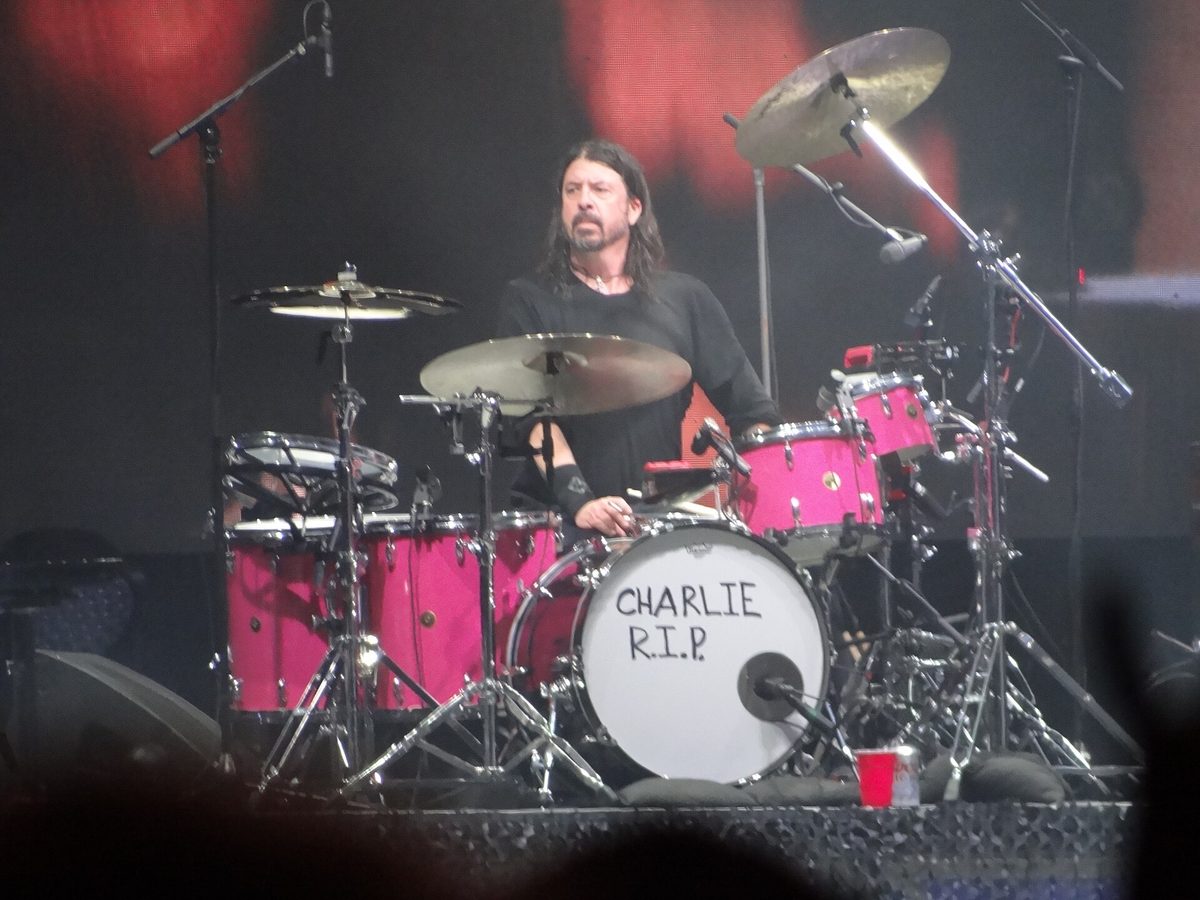
Dave Grohl, Nirvana's drummer from 1990 to 1994, behind the drums at the Shaky Knees festival, Atlanta, 22 October 2021.
The story
Why the tabs disagree so much
Three things make Nirvana tabs look more contradictory than the music is.
First, live versions. From 1992 the band played everything a half step down, so tabs made from Reading, Live and Loud or MTV Unplugged put studio songs in E♭, and 1991 live tabs put the D Standard songs in E. Both are right for the version they transcribe.
Second, transposed copies. Songsterr lets anyone save a version of a tab with the strings retuned, often to sing it lower. Smells Like Teen Spirit in C♯ Standard, In Bloom in E♭, Breed in C♯ and Heart-Shaped Box in Drop D are such copies: same frets, different tuning, so they sound in another key. Several of them have nearly as many views as the real transcriptions.
Third, pitch. Nevermind sits about 14 cents sharp and Something in the Way 45 cents flat, so a tab that is right about the frets can still sound slightly off against a guitar tuned to A 440.
The rule of thumb: tune to whatever the tab you are reading says, and check that it was made from the version you are playing along with.
Evidence
How sure are these numbers?
Every tuning on the album pages carries a status label:
Measured by TuneLit: our own pitch analysis of an original recording, giving the offset in cents. Here, every Nevermind song.
Official: the band or its crew named the tuning. Nothing on this page reaches that level: Krist Novoselic's account of Blew explains why it is so low but does not name the tuning, and Butch Vig, the producer, is quoted where his memories apply.
Widely reported: trusted outlets agree, usually backed by tabs, such as Lithium, On a Plain and Blew.
Community: from transcriptions, mostly Songsterr's main tabs. Most of Bleach, Incesticide, In Utero and MTV Unplugged rests on this level.
Disputed: the sources disagree. We show the most likely setting and explain the other one: In Bloom, Polly, Love Buzz, the bass of Blew and the Unplugged Something in the Way.
If a song still sounds a touch off, move the reference a hertz or two; near 440 Hz, one hertz is about 4 cents.
Cheat sheet
Quick reference
Bleach (1989): E Standard. Drop D: Negative Creep, Swap Meet. Drop C: Blew. E♭: Floyd the Barber, Paper Cuts. Love Buzz: F Standard as the main tab has it, or E Standard with a capo at the 1st fret (disputed).
Nevermind (1991): E Standard +14 ¢ (A ≈ 443.6). D Standard +14 ¢: Come as You Are, Lithium, Drain You. Drop D +14 ¢: On a Plain. E Standard at A 440: Polly. Drop C♯ −45 ¢ (A ≈ 428.7): Something in the Way.
Incesticide (1992): E Standard. E♭: Beeswax, Downer, Mexican Seafood, Hairspray Queen, Aero Zeppelin. Drop D: Stain, Been a Son.
In Utero (1993): E♭ Standard. Drop C♯: Scentless Apprentice, Heart-Shaped Box, All Apologies.
MTV Unplugged in New York (1994): E♭ Standard. Drop C♯: On a Plain, All Apologies, Something in the Way (disputed; some tabs say Drop C).
Live: standard pitch in 1991, a half step down from 1992.
Golden rule for Nevermind: set the reference to about 443.6 Hz, or tap the Tune buttons, which already do it.
Questions
What tuning does Nirvana use?
Mostly E Standard: 3 of 5 albums. In Utero and MTV Unplugged in New York are in E♭ Standard. Many albums also have songs in other tunings, and the album pages list them song by song.
Why does Nirvana sound out of tune when I play along?
Some records are not at concert pitch. Nevermind sits about 14 cents sharp (A ≈ 444). A guitar tuned to A 440 clashes with them. Every Tune button on these pages sets the measured pitch for you.
How did TuneLit measure Nirvana's records?
We played original CDs and LPs through TuneLit's pitch analysis: the strongest notes of each song are compared with the A 440 grid, which gives the offset in cents. That cannot tell the semitone, so the tuning name comes from interviews, the press and tabs, and for 1 song from TuneLit's semitone check from the audio, backed by a tab or source. The audio is never stored or published.
Colors and font
Font
Colors
Menu
Install the app
Android (Chrome): menu ⋮ → Install app or Add to Home screen.
Computer (Chrome, Edge): the install icon at the right end of the address bar.
iPhone: Safari → Share → Add to Home Screen.
It opens full screen and keeps tuning with no connection.