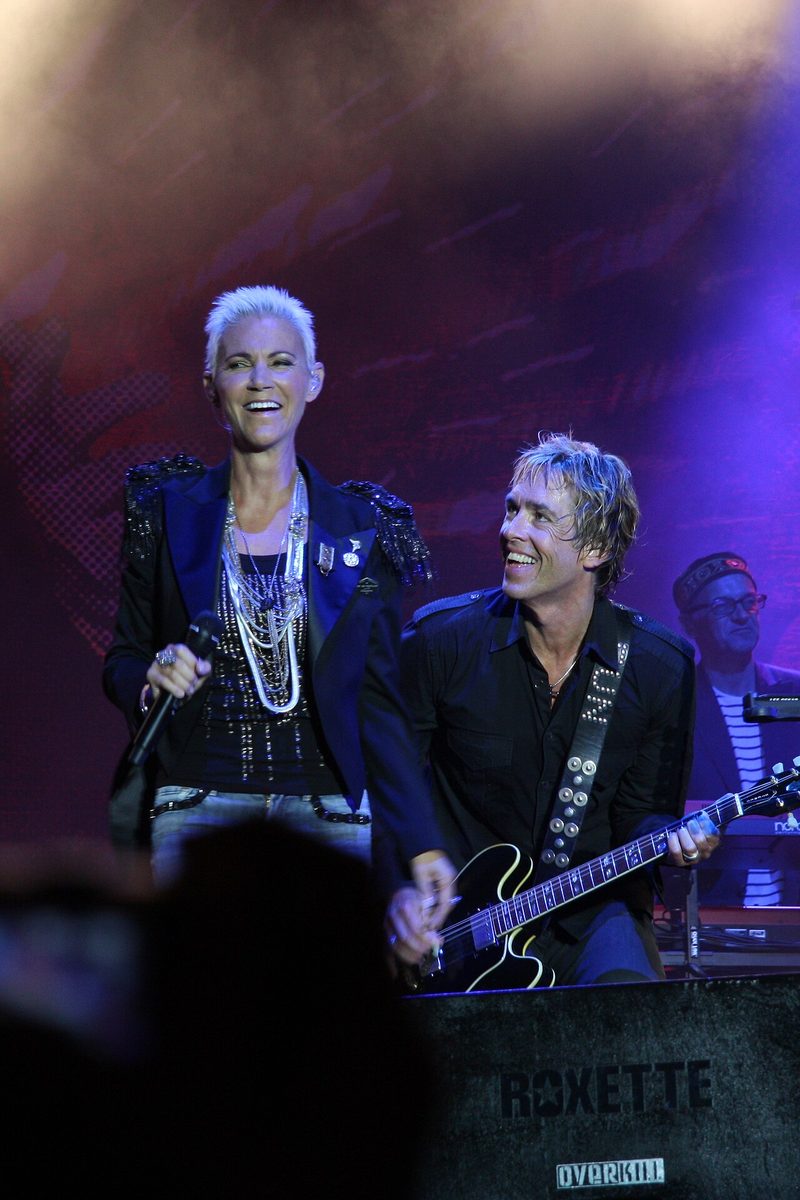
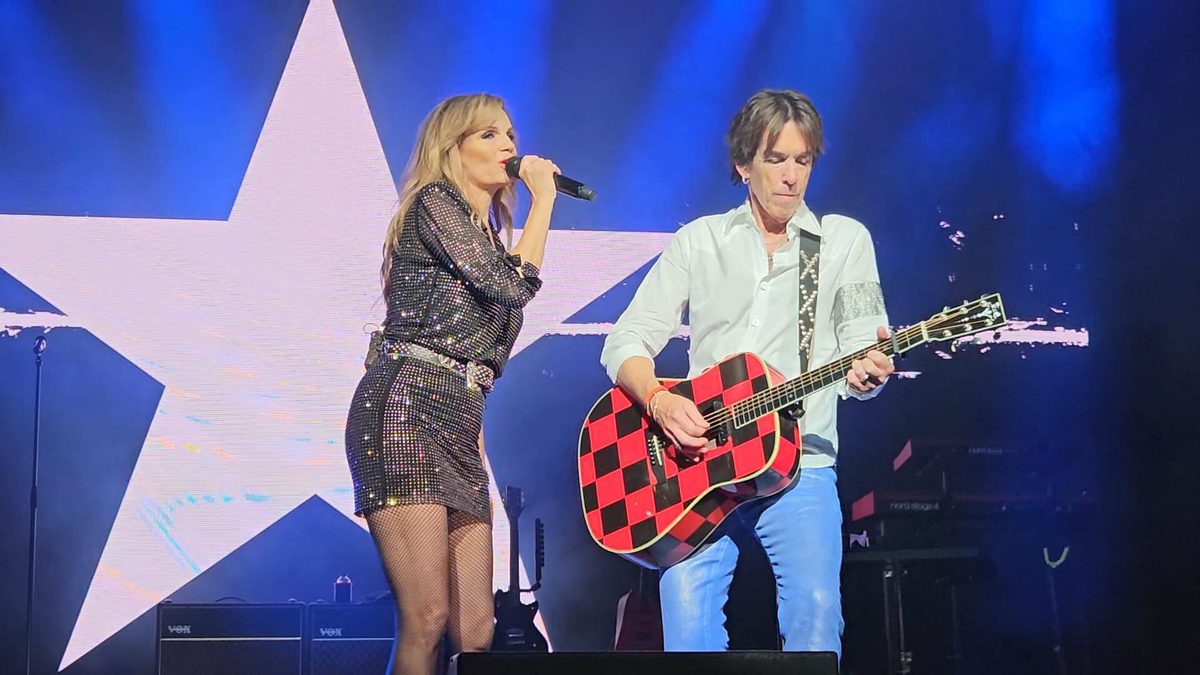
Marie Fredriksson and Per Gessle, with his guitar, on stage in Halmstad, Sweden, 14 August 2010.
In short
How Roxette tunes
Roxette's guitars were in plain E Standard on all ten studio albums: every tab and chord sheet agrees, and the songs live in their keys and the occasional capo, not in dropped or open strings. What changes is the pitch of the records.
Read more
TuneLit measured the original CDs and, where the library has them, the LPs. Pearls of Passion (1986) sits about 8 cents flat (A ≈ 438), Joyride and Tourism 5 to 6 cents sharp, and everything from Crash! Boom! Bang! on within 3 cents of A 440. A handful of songs stand out: Spending My Time, Small Talk, Sleeping in My Car and The First Girl on the Moon sit 23 to 30 cents sharp (A ≈ 446–448), and on Have a Nice Day one song lands almost halfway between two notes. For those, set the reference A before you play along; for the rest, a tuner at 440 is fine.
If you pick up a guitar to play along with Roxette, the good news comes first: you almost certainly do not need to retune. Every tab, chord sheet and transcription we found for their ten studio albums uses plain E Standard, and nothing in the credits or the players' own words points to anything else. Roxette was a pop band. Its songs live in their keys, their chord shapes and the occasional capo, not in dropped or open strings.
What does change is the pitch of the records. A pop record can end up a few cents above or below A 440, and TuneLit measured how far. We analysed the original CDs, plus the needle drops of the LPs where the owner's library has them, album by album and song by song. Most of the catalog sits within a few cents of concert pitch. A handful of songs, several of them hit singles, do not, and on those a guitar tuned to a normal 440 tuner sounds slightly sour against the record.
This page goes through all ten studio albums, from Pearls of Passion (1986) to Good Karma (2016): the tuning, the measured pitch, the songs that sit somewhere else, which recordings are live, and what the chord sheets say about keys and capos. On every album page each song has a Tune button that opens the tuner at exactly the right pitch.
The story
The short version
Tuning: E Standard (E A D G B E) for every song on every studio album. A few community tabs claim a half-step-down guitar; the records do not support it (see below).
Pitch: most albums are at concert pitch within a few cents. Pearls of Passion is about 8 cents flat (A ≈ 438), Joyride about 6 cents sharp and Tourism about 5 cents sharp (A ≈ 441.5). Everything from Crash! Boom! Bang! on is within 3 cents of A 440.
The sharp songs: Spending My Time (+23 ¢), the Joyride version of Soul Deep (+21 ¢), Small Talk (+27 ¢), Sleeping in My Car (+24 ¢) and The First Girl on the Moon (+30 ¢) sit about a quarter of a semitone sharp, A ≈ 445–448. On Have a Nice Day, You Can't Put Your Arms Around What's Already Gone sits 42 cents sharp, almost halfway to the next note.
Keys and capos: the popular chord sheets for the hits are written in the record's own key, mostly without a capo. Where a sheet uses a capo, or where it is written in a different key from the record, the song's notes on the album page say so.
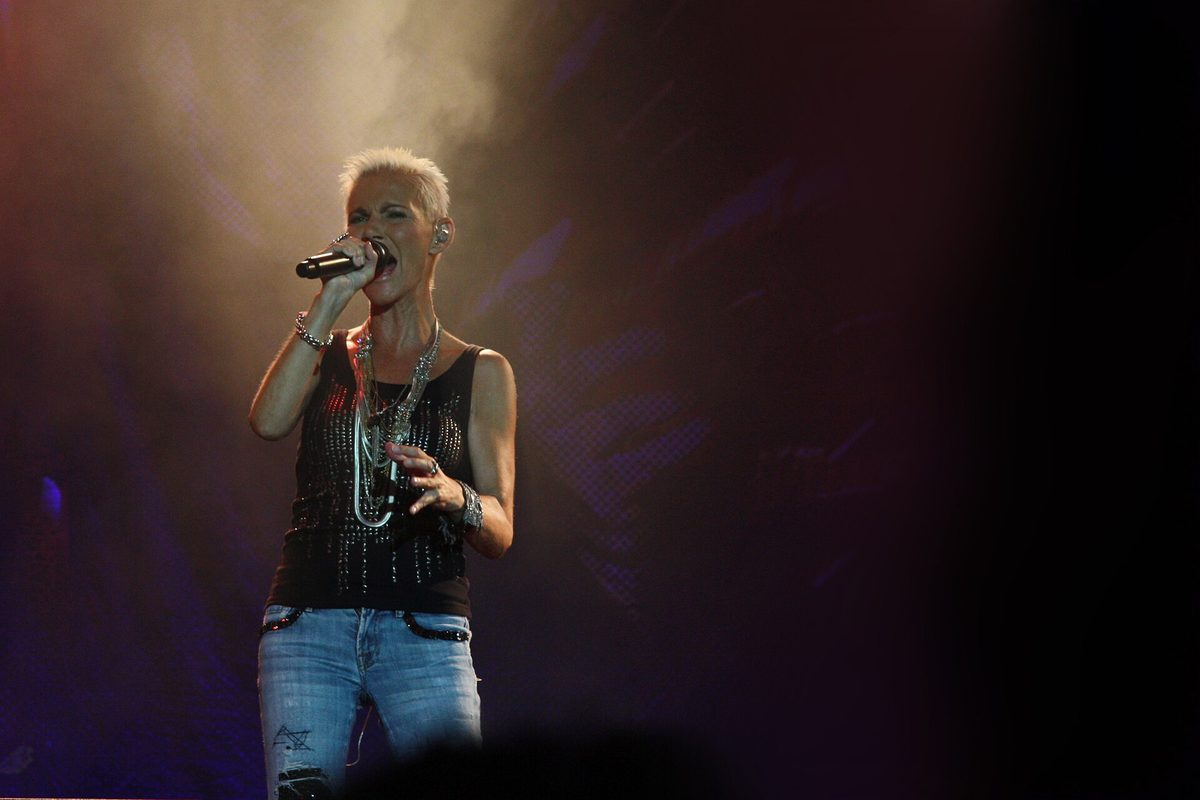
Marie Fredriksson singing with Roxette in Halmstad, Sweden, 14 August 2010.
The story
Who played the guitars
Roxette was Per Gessle and Marie Fredriksson. Gessle wrote most of the songs, sang and played rhythm guitar; Fredriksson sang and played piano and keyboards. In the studio they worked with a regular team. Producer Clarence Öfwerman played keyboards and arranged, Anders Herrlin played bass and programmed, and Jonas Isacsson played lead guitar from the first album through Room Service (2001). The credits add other guitarists over the years, among them Mats "MP" Persson, Pelle Sirén, Janne Oldaeus and Micke "Nord" Andersson. From Have a Nice Day on, Christoffer Lundquist played bass and guitars, and he co-produced Charm School, Travelling and Good Karma with Gessle and Öfwerman.
Isacsson joined as a session player, not as a band member. In a 2015 interview with The Daily Roxette he explained that the famous riff of The Look was an idea he had been playing before the session. He tried it in the solo bars, and Gessle at once wanted it as the opening riff. He also said that on Cry he imitated Delta blues slide guitar rather than playing it the traditional way. Neither story involves an unusual tuning, and the tabs of both songs are in standard.
The story
Half a step down? What the records say
A few community tabs are written for a guitar tuned a half step down (E♭ A♭ D♭ G♭ B♭ E♭), and one Joyride tab even claims that most Roxette songs were played that way. A pitch measurement on its own cannot tell E Standard from E♭ Standard, because both put the strings on the same grid of notes. The key of the record can, though. TuneLit's analysis also counts which bass notes the record plays, and those notes match the chords that the standard-tuning sheets name: Joyride is in A, Listen to Your Heart in B minor, It Must Have Been Love in C, Dangerous in E, The Heart Shaped Sea in D.
On a guitar tuned a half step down, the same chord shapes would sound a semitone lower than the record. To play Joyride in A on such a guitar you would have to finger B♭ shapes, with no open strings left to ring. The half-step-down tab of Joyride names the chords A, D and E, and its riff only lands in the record's key on a standard-tuned guitar. The E♭ labels on chord sheets for The Heart Shaped Sea and Shadow of a Doubt have the same problem: their chords, as written, already match the record in standard tuning. So TuneLit lists every song in E Standard and notes the tabs that disagree.
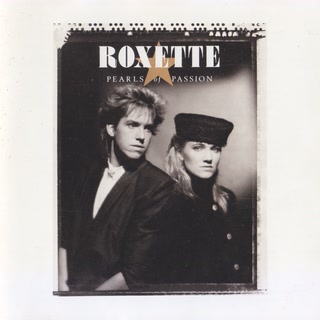
Main tuning: E Standard −8 ¢ (A ≈ 438), measured by TuneLit on the original Swedish CD; the LP agrees.
Roxette's debut was recorded at EMI Studios in Stockholm between March and September 1986, with Jonas Isacsson on guitars and Tommy Cassemar on bass. Tabs are scarce, but the chord sheets that exist are in standard tuning and match the record's keys as written, for example Surrender in D minor and Call of the Wild in C♯ minor.
This is the only Roxette album that sits clearly under concert pitch. The CD measures about 8 cents flat and the LP about 9, so the whole record is close to A 438. Secrets That She Keeps is the lowest song, about 14 cents flat (A ≈ 436.4). The closing ballad So Far Away is the exception the other way: it sits right at concert pitch, about 9 cents above the rest, on both copies.
With TuneLit: the Tune button gives "E Standard −8 ¢". Secrets That She Keeps has its own "−14 ¢" and So Far Away plain E Standard. Eight cents is small, but you will hear it against long, sustained chords.
Main tuning: E Standard, at concert pitch (+2 ¢ on the CD, +5 ¢ on the LP).
The breakthrough album was recorded at EMI Studios in Stockholm in 1988, with three songs (Cry, Chances and View from a Hill) produced by Adam Moseley; the credits also list Trident II in London. Isacsson played electric and acoustic guitars, Gessle guitar, Herrlin bass; Janne Oldaeus added slide.
Everything is tabbed in standard tuning. The Look is in A with Isacsson's riff and no capo. Listen to Your Heart is in B minor, with a key change near the end, and every popular chord sheet plays it without a capo. Dangerous is in E. Dressed for Success is in F: the most popular chord sheet puts a capo on the 3rd fret and uses D, G and A shapes, while another plays F and B♭ barre chords. Chances is in F minor, and one sheet plays it with a capo on the 1st fret and E minor shapes. For Paint, the acoustic chord sheet we found only matches the record with a capo on the 3rd fret.
The album is at concert pitch, and only one song clearly is not: Dangerous sits about 11 cents sharp on the CD and 14 on the LP (A ≈ 443). View from a Hill dips about 6 cents under.
With TuneLit: a normal tuner at A 440 is right for almost everything; Dangerous has its own "E Standard +11 ¢". The original LP leaves out (I Could Never) Give You Up.
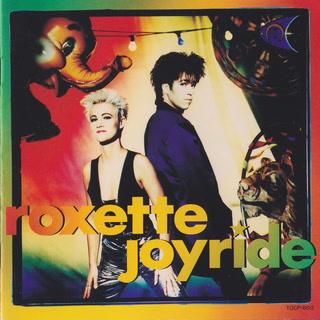
Main tuning: E Standard +6 ¢ (A ≈ 441.6), measured on the Japanese CD.
Joyride was recorded at Tits & Ass Studio in Halmstad and EMI Studios in Stockholm, with Isacsson on guitars, mandolin and slide and Gessle on rhythm guitar. The title track is in A, Fading Like a Flower in F and Spending My Time in B, all in standard tuning. For Fading Like a Flower the best-known chord sheet puts a capo on the 5th fret and plays C shapes; other sheets play the F, B♭ and D minor chords directly. For Spending My Time the main sheets play it in B without a capo, while acoustic arrangements use a capo on the 2nd fret.
The CD sits about 6 cents sharp. The LP needle drop reads about 2 cents flat, but it is lower by the same 8 to 9 cents on every song, which points to the turntable's speed rather than the music. The pattern from song to song is the same on both copies, and three songs stand clearly above the rest: Spending My Time (+23 ¢ on the CD, A ≈ 446), Small Talk (+27 ¢, A ≈ 447) and Soul Deep (+21 ¢, A ≈ 445). Soul Deep is a re-recording of the Pearls of Passion song; the 1986 original sits about 3 cents flat. Hotblooded is the lowest, at concert pitch.
Things Will Never Be the Same needs a word of warning. Its chord sheets are in D, which matches the live version on Tourism. The Joyride studio recording is in B♭, four semitones lower. To play along with it, put a capo on the 1st fret and play the sheet's chords as A shapes (D becomes A, B minor becomes F♯ minor, G becomes D, A becomes E).
With TuneLit: the album button gives "E Standard +6 ¢"; Spending My Time, Soul Deep and Small Talk have their own values (+23, +21, +27 ¢), and Hotblooded plain E Standard. The original LP leaves out I Remember You, Soul Deep and Church of Your Heart.
Main tuning: E Standard +5 ¢ (A ≈ 441.3), measured on the Japanese CD; the 2LP agrees within a cent.
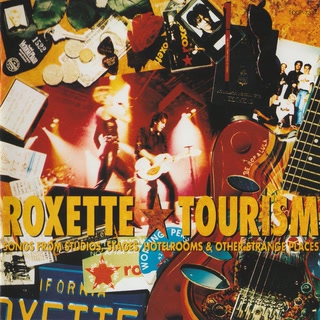
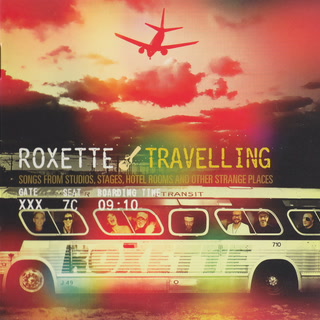
Tourism, subtitled Songs from Studios, Stages, Hotelrooms & Other Strange Places, was put together during the 1991–92 Join the Joyride! tour. Its sixteen tracks come from very different places:
Live on stage: The Look and Joyride (Sydney Entertainment Centre, December 1991) and Things Will Never Be the Same (Hallenstadion, Zürich, November 1991).
Live without an audience: Never Is a Long Time, played in an empty nightclub in São Paulo in May 1992.
Hotel room: Here Comes the Weekend and So Far Away, recorded in room 603 of the Alvear Palace Hotel in Buenos Aires in May 1992.
Studio: How Do You Do! (Halmstad and Stockholm), Fingertips (Rio de Janeiro), The Heart Shaped Sea (Ocean Way, Los Angeles), The Rain, Keep Me Waiting and Cinnamon Street (Stockholm, Cinnamon Street finished in Copenhagen), Silver Blue (begun in Stockholm in 1987–88, finished in 1992), and two songs recorded in Stockholm in 1990, during the Joyride period: Come Back (Before You Leave) and Queen of Rain.
It Must Have Been Love is a new country-style version recorded at Ocean Way in Los Angeles with Greg Leisz on pedal steel, opened by a short live clip from a stadium show in Santiago.
Everything is in standard tuning. How Do You Do! is in C, Queen of Rain in B minor, Silver Blue in E♭ and The Heart Shaped Sea in D. The hotel-room So Far Away is a semitone lower than the 1986 original, and the chord sheet we found for Never Is a Long Time is written a semitone below the record, so it needs a capo on the 1st fret. The songs spread more than on a single-session album, from about 12 cents flat to 10 sharp, but most sit within a few cents of the album value. The live Things Will Never Be the Same is the clear outlier at about 12 cents flat (A ≈ 437) on both the CD and the LP, while the live The Look sits about 10 cents sharp. The Rain sits at concert pitch.
With TuneLit: "E Standard +5 ¢" for the album; Things Will Never Be the Same has "−12 ¢", The Rain plain E Standard.
Main tuning: E Standard, at concert pitch (+3 ¢ on the Japanese CD and on the LP).
Recorded between February 1993 and January 1994 in Halmstad, Stockholm, London and Capri, with a bigger guitar line-up than before: Gessle (acoustic, electric and resonator guitars), Isacsson, Mats Persson, Pelle Sirén and Janne Oldaeus. Standard tuning throughout. The title track is in C♯ minor as the main chord sheet writes it, without a capo; one sheet uses a guitar tuned a half step down with D minor shapes, which gives the same notes.
The album as a whole is at concert pitch, but it has the widest spread of any Roxette record, and the CD and the LP agree on every song that stands out. Sleeping in My Car, written last for the album, sits about 24 cents sharp (A ≈ 446), and The First Girl on the Moon about 30 cents sharp (A ≈ 447.7). Go to Sleep (+14 ¢) and Harleys & Indians (Riders in the Sky) (+10 ¢) are sharp too, while the title track, Vulnerable and I Love the Sound of Crashing Guitars sit a few cents under 440.
With TuneLit: plain E Standard for the album, with own values for Sleeping in My Car (+24 ¢), The First Girl on the Moon (+30 ¢), Go to Sleep (+14 ¢) and Harleys & Indians (+10 ¢). At a quarter of a semitone, the two sharpest songs will sound clearly off against a guitar tuned to 440. The Japanese CD adds Almost Unreal as a bonus track, which is not part of the album here.
Main tuning: E Standard, at concert pitch (+0.2 ¢ on the CD).
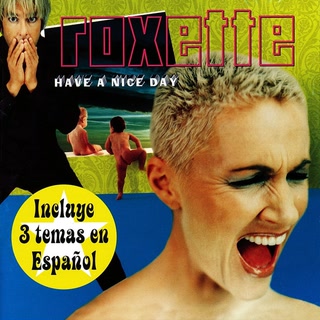
Roxette's first album of new songs since 1994 was recorded in 1998 in Halmstad, Stockholm and Marbella. The guitars came from Gessle, Isacsson, Mats Persson, Micke "Nord" Andersson (including a Rickenbacker) and Staffan Astner, with Christoffer Lundquist on bass. The chord sheets are in standard tuning: Anyone is in B♭ and Crush on You in B minor. Two sheets are written in a different key from the record: the one for I Was So Lucky needs a capo on the 1st fret, and the one for Stars a capo on the 3rd fret, to match. The sheet we found for It Will Take a Long Long Time is in A, while the record is in F♯.
Most of the album is exactly at concert pitch, but three songs are not. Waiting for the Rain and It Will Take a Long Long Time sit 16 to 17 cents sharp (A ≈ 444). You Can't Put Your Arms Around What's Already Gone sits 42 cents sharp, almost halfway between two notes. No chord sheet exists for it. TuneLit lists it as E Standard +42 ¢; the same notes can also be read as E♭ Standard tuned 42 cents sharp. If your chords sound a half step off against the record, try that instead.
Our copy is the edition with three Spanish-language bonus tracks (Quisiera volar, Alguien, Lo siento); they are not part of the album here.
With TuneLit: A 440 for most of the album; own values for the three songs above.
Main tuning: E Standard, at concert pitch (+0.6 ¢ on the Japanese CD).
Recorded at Atlantis and Polar Studios in Stockholm, with Isacsson, Lundquist, Mats Persson and Gessle on 6- and 12-string guitars (and Gessle on banjo). This is the most even album we measured: every song is within 8 cents of A 440, and none differs enough from the rest to get its own value. A normal tuner at 440 is right for all of it. Milk and Toast and Honey is in D♭: the most popular chord sheet plays it with C shapes and a capo on the 1st fret, and another sheet uses the same shapes.
The Japanese CD adds an extended version of Entering Your Heart as a bonus track, which is not part of the album here.
Main tuning: E Standard, at concert pitch (+2.5 ¢ on the CD and on the LP).
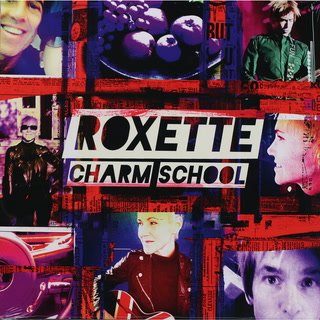
The first Roxette studio album in ten years was produced by Christoffer Lundquist, Clarence Öfwerman and Per Gessle at Tits & Ass Studio in Halmstad, Lundquist's Aerosol Grey Machine in Scania and Atlantis in Stockholm. Gessle and Lundquist played the guitars and Lundquist the bass. The chord sheets are in standard tuning; In My Own Way is in D, and its chord sheet plays it with a capo on the 2nd fret and C shapes.
The CD and the 2011 LP give exactly the same album value. No One Makes It on Her Own sits about 6 cents flat on both, 9 cents under the rest. We measured disc 1 of Charm School Revisited, which is the original album.
Main tuning: E Standard, at concert pitch (+0.4 ¢ on the CD).
Like Tourism twenty years earlier, Travelling mixes studio work with recordings from the road. Stars is a soundcheck from Dubai in May 2011, She's Got Nothing On (But the Radio) was recorded live in Rio de Janeiro in April 2011, and It Must Have Been Love comes from the Night of the Proms shows in Rotterdam in 2009, with an orchestra. Turn of the Tide uses hotel-room recordings from Cape Town and Sun City, and two songs go back much further: See Me to sessions in 1993 and The Weight of the World to 1998 and 2002. The rest was finished in 2011 by Gessle and Lundquist.
Every song is within 5 cents of A 440, so a normal tuner is right for the whole album. The live Stars is a semitone lower than the 1999 studio version, while She's Got Nothing On keeps the key of the Charm School recording and It Must Have Been Love is in C.
Main tuning: E Standard, at concert pitch (+0.5 ¢ on the CD).
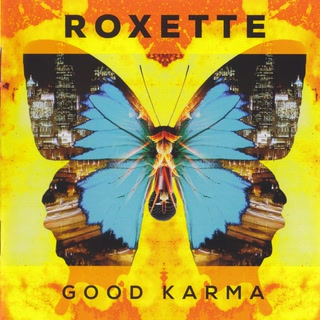
Roxette's last album was recorded in Halmstad, Scania, Djursholm and Täby and produced by Gessle, Lundquist and Öfwerman, with Addeboy vs. Cliff on several tracks. Hardly any tabs exist for it; the few chord sheets are in standard tuning.
The CD is at concert pitch, every song within 4 cents, except You Make It Sound So Simple at about 12 cents sharp (A ≈ 443). The LP needle drop reads about 8 cents higher on every track, the same turntable effect as on the Joyride LP in the other direction, and it shows the same 11–12 cent jump on You Make It Sound So Simple.
TuneLit lab
What TuneLit measured
We measured the original CD of every studio album (for Crash! Boom! Bang! and Room Service the Japanese pressings, for Have a Nice Day the edition with Spanish bonus tracks, for Charm School the first disc of Charm School Revisited) and cross-checked seven of them against needle drops of the LP: Pearls of Passion, Look Sharp!, Joyride, Tourism, Crash! Boom! Bang!, Charm School and Good Karma.
Pearls of Passion (1986): about 8 ¢ flat (A ≈ 438), LP the same. Secrets That She Keeps −14 ¢, So Far Away at concert pitch.
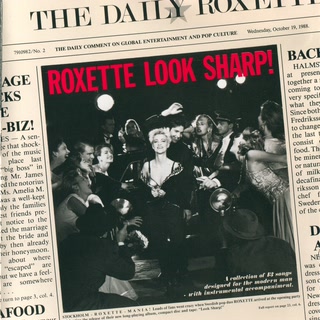
Look Sharp! (1988): concert pitch. Dangerous +11 ¢, View from a Hill −6 ¢.
Joyride (1991): +6 ¢ (A ≈ 441.6). Spending My Time +23 ¢, Soul Deep +21 ¢, Small Talk +27 ¢; Hotblooded at concert pitch.
Tourism (1992): +5 ¢ (A ≈ 441.3). The live Things Will Never Be the Same −12 ¢; The Rain at concert pitch.
Crash! Boom! Bang! (1994): concert pitch. The First Girl on the Moon +30 ¢, Sleeping in My Car +24 ¢, Go to Sleep +14 ¢, Harleys & Indians +10 ¢.
Have a Nice Day (1999): concert pitch. You Can't Put Your Arms Around What's Already Gone +42 ¢ (between two notes), It Will Take a Long Long Time +17 ¢, Waiting for the Rain +16 ¢.
Room Service (2001): concert pitch, every song.
Charm School (2011): concert pitch. No One Makes It on Her Own −6 ¢.
Travelling (2012): concert pitch, every song.
Good Karma (2016): concert pitch. You Make It Sound So Simple +12 ¢.
Two things stand out. First, the catalog moves a little and then settles: the debut is slightly flat, Joyride and Tourism slightly sharp, and from 1994 on the albums sit at A 440. Second, the songs that stand out from their albums are almost always on the sharp side. Spending My Time, Sleeping in My Car and The First Girl on the Moon sit roughly a quarter of a semitone above the rest of their albums. A measurement cannot tell why. It hears the result, whether that comes from a tape running a little fast, a mix sped up to brighten it, or instruments tuned that way, and no source we found explains it.
The LP cross-checks matter here. On Pearls of Passion, Look Sharp!, Tourism, Crash! Boom! Bang! and Charm School, the CD and the LP agree within a few cents on almost every song. The Joyride LP reads 8 to 9 cents lower than the CD on every track, and the Good Karma LP about 8 cents higher, which is what a turntable running a little slow or fast does to a needle drop. Even there, the songs that stand out on the CD stand out on the LP by the same amount. So the sharp songs are in the masters, not in our copies.
We also ran TuneLit's semitone check from the audio on every song. It listens for the lowest open string, and on Roxette's records it mostly cannot settle anything: in pop songs the bass follows the chords of the key, so the notes just below and above the low E are played as often as the E itself. It confirmed E Standard on most songs and gave no reason to move any.
Per Gessle with a chequered acoustic guitar at the Rock Zottegem festival, Belgium, 13 July 2025.
The story
Keys, capos and chord sheets
Because the tuning never changes, the key is what decides whether your playing fits the record. TuneLit compared the chords that the popular sheets name with the bass notes we measured on each record. For nearly every hit they match exactly, in standard tuning and without a capo: The Look in A, Listen to Your Heart in B minor, It Must Have Been Love in C, Joyride in A, How Do You Do! in C, Dangerous in E, Crash! Boom! Bang! in C♯ minor, Queen of Rain in B minor.
A few songs are usually played with a capo. The data lists one only where the chord sheets do not disagree and the record's key confirms it: Milk and Toast and Honey (capo 1, C shapes) and In My Own Way (capo 2, C shapes). Elsewhere the sheets disagree, and either way works because both give the record's notes. Fading Like a Flower is in F: one sheet uses capo 5 with C shapes, others play it directly. Dressed for Success is also in F, with capo 3 and D shapes in one sheet and barre chords in another. Spending My Time is in B, played directly or with capo 2 in acoustic versions.
A handful of chord sheets are simply in a different key from the record, which is why playing along with them sounds wrong even with a perfectly tuned guitar. Things Will Never Be the Same is the big one: the sheets follow the live version in D, while the Joyride studio recording is in B♭. Others are a semitone or more off: Never Is a Long Time on Tourism, I Was So Lucky, Stars and It Will Take a Long Long Time on Have a Nice Day, and an acoustic sheet of Paint. The song notes on each album page say how to fix them. Live versions do not always keep the studio key either: the hotel-room So Far Away on Tourism and the live Stars on Travelling are each a semitone lower than the studio originals.
Evidence
How sure are these numbers?
Every album and song carries a status label. All Roxette tunings now show Measured by TuneLit, because the offset comes from our own analysis of a CD or LP. The tuning name, E Standard, rests on the tabs:
Widely reported: Look Sharp!, Joyride, Tourism and Crash! Boom! Bang!, where many independent tabs and chord sheets agree, including licensed transcriptions of the hits.
Community: the other albums, where the evidence is a smaller number of community tabs and chord sheets. Good Karma has hardly any.
Measured by TuneLit: the offset in cents, from our pitch analysis of the original CDs and LPs. Only the numbers are published; the audio is never stored or shared.
No interview or album credit we found names a tuning at all, so nothing here is labelled official. The one song left between two notes is You Can't Put Your Arms Around What's Already Gone, which has no chord sheet at all. It is listed as E Standard +42 ¢; if it sounds a half step off, shift the tuner down a half step and keep the same reference.
If a song still sounds a touch off, move the reference A by a hertz. Near 440 Hz, one hertz is about 4 cents.
Cheat sheet
Quick reference
Every album: E Standard. Most songs in their written key without a capo.
Pearls of Passion (1986): A ≈ 438 (−8 ¢). Secrets That She Keeps −14 ¢; So Far Away A 440.
Look Sharp! (1988): A 440. Dangerous +11 ¢, View from a Hill −6 ¢.
Joyride (1991): +6 ¢ (A ≈ 441.6). Spending My Time +23 ¢, Soul Deep +21 ¢, Small Talk +27 ¢, Hotblooded A 440. Things Will Never Be the Same is in B♭, not the D of the chord sheets.
Tourism (1992): +5 ¢ (A ≈ 441.3). Things Will Never Be the Same (live) −12 ¢, The Rain A 440.
Crash! Boom! Bang! (1994): A 440. The First Girl on the Moon +30 ¢, Sleeping in My Car +24 ¢, Go to Sleep +14 ¢, Harleys & Indians +10 ¢.
Have a Nice Day (1999): A 440. You Can't Put Your Arms Around What's Already Gone +42 ¢ (check by ear), It Will Take a Long Long Time +17 ¢, Waiting for the Rain +16 ¢.
Room Service (2001): A 440. Milk and Toast and Honey: capo 1.
Charm School (2011): A 440. No One Makes It on Her Own −6 ¢. In My Own Way: capo 2.
Travelling (2012): A 440.
Good Karma (2016): A 440. You Make It Sound So Simple +12 ¢.
Questions
What tuning does Roxette use?
Mostly E Standard: 10 of 10 albums. Many albums also have songs in other tunings, and the album pages list them song by song.
How did TuneLit measure Roxette's records?
We played original CDs and LPs through TuneLit's pitch analysis: the strongest notes of each song are compared with the A 440 grid, which gives the offset in cents. That cannot tell the semitone, so the tuning name comes from interviews, the press and tabs. The audio is never stored or published.
Colors and font
Font
Colors
Menu
Install the app
Android (Chrome): menu ⋮ → Install app or Add to Home screen.
Computer (Chrome, Edge): the install icon at the right end of the address bar.
iPhone: Safari → Share → Add to Home Screen.
It opens full screen and keeps tuning with no connection.