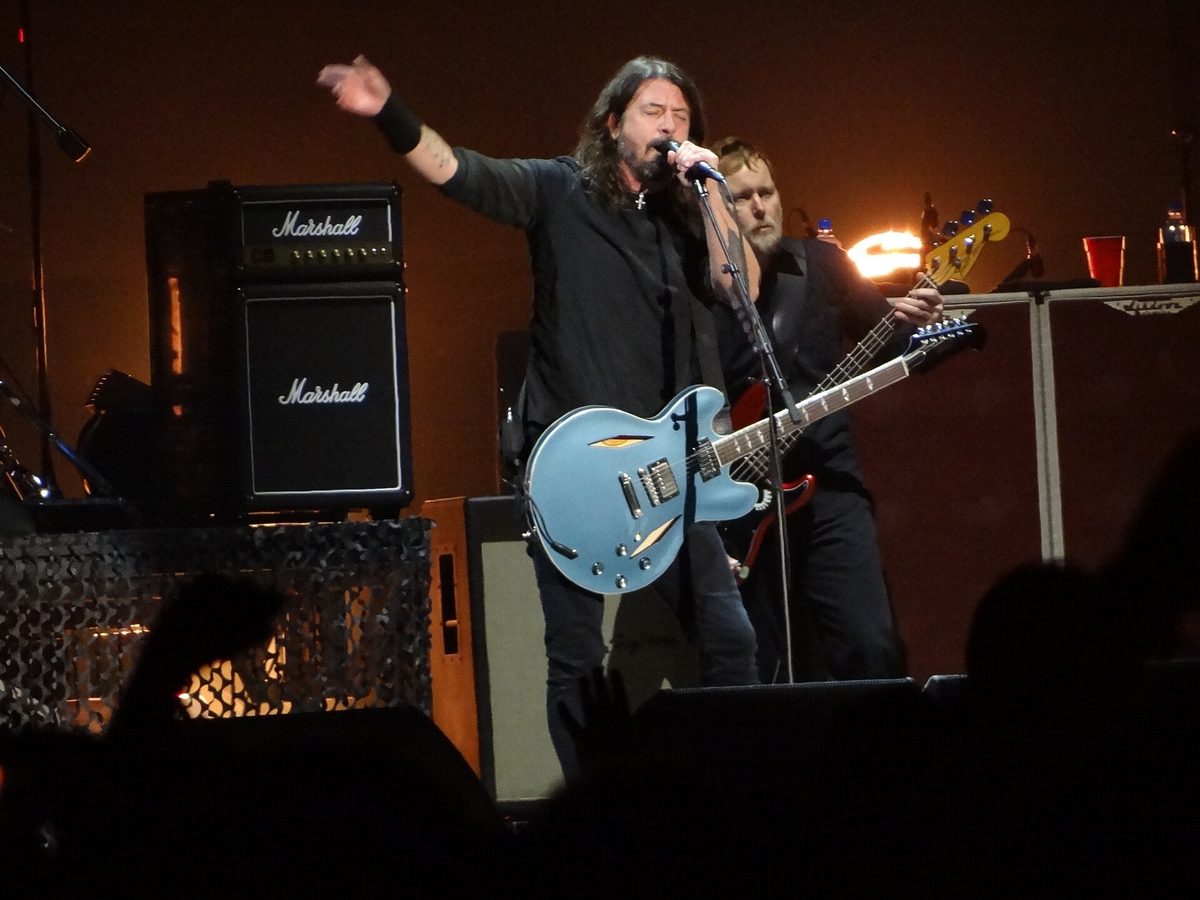
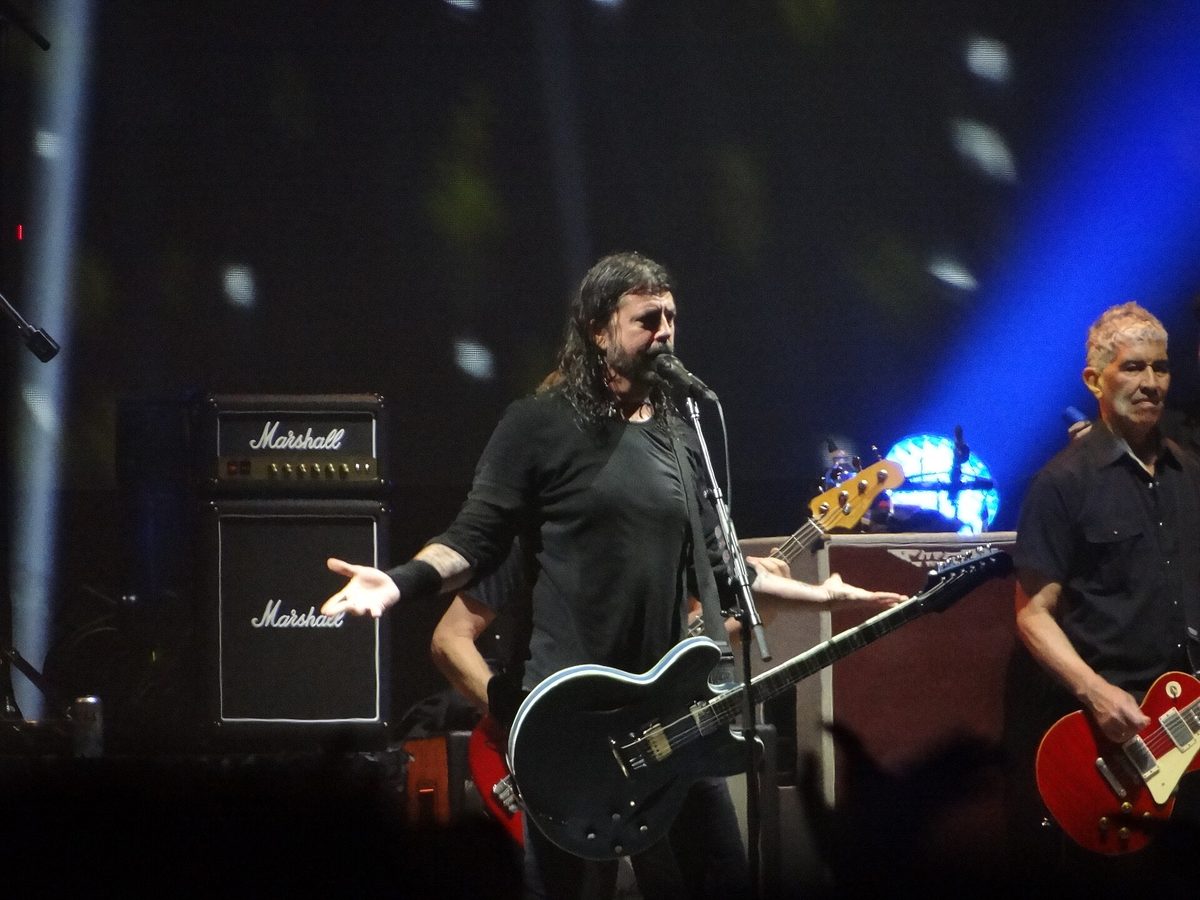
Dave Grohl with his blue Gibson and Nate Mendel on bass at the Shaky Knees festival, Atlanta, 22 October 2021.
In short
How Foo Fighters tunes
Foo Fighters records are easy to tune to: TuneLit measured all eleven studio albums from CD and the Saint Cecilia EP from its download, and ten of the twelve sit within a few cents of A 440. One by One is the exception at about 10 cents flat (A ≈ 437.4), Medicine at Midnight sits about 5 cents sharp, and half of In Your Honor runs about 7 cents flat.
Read more
What changes from song to song is the shape of the tuning. Dave Grohl writes mostly in E Standard and drops the 6th string to D for a heavier bottom: Monkey Wrench and Everlong by his own account, plus Alone + Easy Target, Hey, Johnny Park!, February Stars, Low, Halo, Razor, Shame Shame and Rest, among others. Drop D is common on the first four albums and rare after 2005. A few songs go further: X-Static is a half step down, Weenie Beenie uses C G D G B E, Stacked Actors drops the low string all the way to A, and See You lowers the top string to D. Most of the catalog rests on community tabs, and TuneLit's audio check of the low string agrees with them on nearly every song.
Good news first: if you want to play along with Foo Fighters, you will rarely fight the record's pitch. TuneLit measured all eleven studio albums from CD and the Saint Cecilia EP from its download, and almost every one sits within a few cents of concert pitch, A 440. The real question with this band is the shape of the tuning. Dave Grohl writes in plain E Standard most of the time, and when he wants a heavier bottom he drops the 6th string to D. A handful of songs go further: a half step down, a low C, a low A, a lowered top string.
This page collects what is known about every Foo Fighters studio album and the 2015 EP, song by song: the tuning the tabs and the band give, what TuneLit measured on the CD, the songs that break their album's pattern, and how to set it all up in TuneLit. The album list above opens every album, where each song has a Tune button that opens the tuner in exactly that tuning.
The story
Concert pitch, almost always
Some bands' records sit a quarter tone or more away from a normal tuner. Foo Fighters records do not. Ten of the twelve releases measure within about 3 cents of A 440, which no ear can tell from concert pitch, so TuneLit lists them as plain A 440. Two albums sit a little off, and a third hides two pitches:
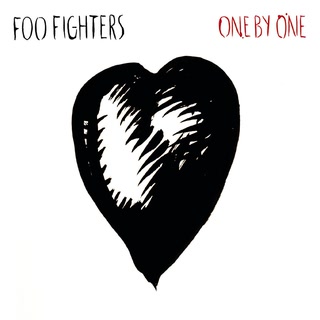
One by One (2002) is the flattest Foo Fighters album: about 10 cents flat on our CD, A ≈ 437.4.
Medicine at Midnight (2021) is about 5 cents sharp, A ≈ 441.2.
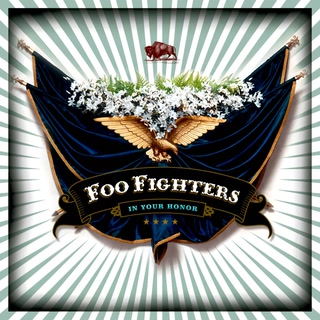
In Your Honor (2005) splits in two: ten songs sit within about 3 cents of A 440 and nine sit 5 to 8 cents flat. The album value falls between the two groups, about 3 cents flat, so its buttons open concert pitch.
Ten cents is small, but you can hear it as a slow wobble when a sustained chord rings against the record. If One by One sounds slightly sour while every fret is right, tap the Tune button on its album page: it sets the offset for you.
Three songs measured clearly apart from their albums and carry their own setting: The Deepest Blues Are Black on In Your Honor (about 7 cents sharp), A Matter of Time on Wasting Light (about 7 cents flat) and No Son of Mine on Medicine at Midnight (about 4 cents flat, against a slightly sharp album).
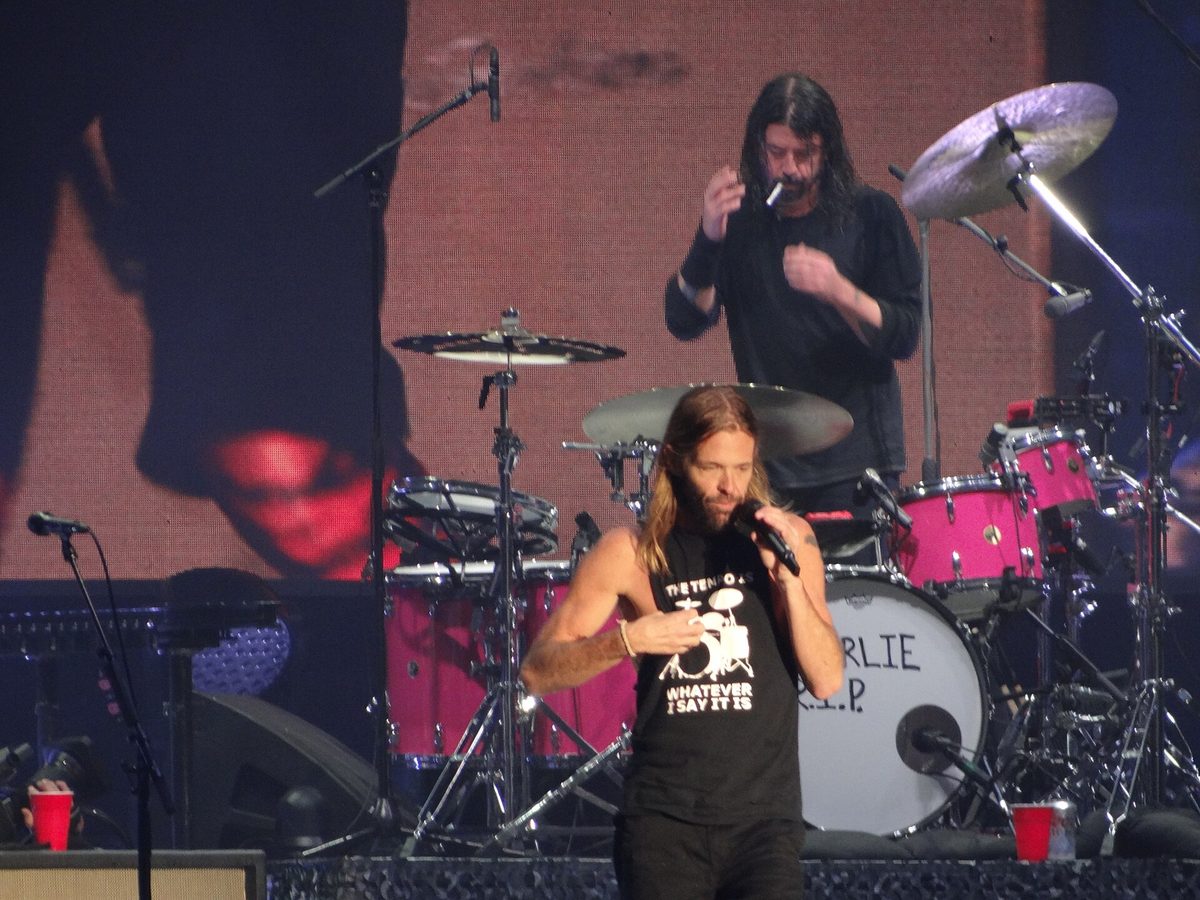
Taylor Hawkins singing at the front of the stage while Dave Grohl takes over the drums, Shaky Knees festival, Atlanta, 22 October 2021.
The story
Drop D: the second home
The one tuning trick every Foo Fighters guitarist needs is Drop D: tune the 6th string down a whole step, from E to D, and leave the other five strings alone (D A D G B E). Power chords then fit under one finger on the three lowest strings, and the open low D rings under everything.
The band's own story of Everlong starts here. Grohl has described finding its opening chord between takes of Monkey Wrench, a Drop D song, during the sessions for The Colour and the Shape, and then writing the whole song on an acoustic guitar in the same tuning. Both songs are still played that way: in Premier Guitar's Rig Rundowns, Chris Shiflett shows a guitar kept in Drop D for Monkey Wrench and Everlong, next to others that stay in standard.
Across the catalog, the tabs put seventeen songs in Drop D. They cluster on the early albums: three on the debut, four on The Colour and the Shape, two on There Is Nothing Left to Lose and five on One by One. After that Drop D becomes rare: Razor on In Your Honor, Shame Shame on Medicine at Midnight and Rest on But Here We Are. From Echoes, Silence, Patience & Grace on, nearly everything is plain E Standard.
To check Drop D by ear, play the 6th string at the 7th fret and the open 5th string together: both should give the same A. Or compare the open 6th string with the open 4th string, which should sound exactly an octave above it.
The story
The odd ones
A few songs need something other than E Standard or Drop D:
Weenie Beenie (1995): C G D G B E. The two lowest strings go down, the 6th string to C and the 5th to G, and the bass tab follows with C G D G. It is the only song here that drops both low strings.
X-Static (1995): E♭ Standard, every string a half step down. It is the only half-step-down song in the main tabs.
Stacked Actors (1999): A A D G B E. Only the 6th string changes, but it drops seven semitones, all the way to A, an octave below the 5th string. That octave is the sound of the riff. Expect the string to feel very loose; a heavier gauge helps.
See You (1997): E A D G B D. Grohl's acoustic part lowers only the top string, from E to D.
M.I.A. (1999): D A D G A E, an open, ringing tuning from the only full tab, so treat it as a good guess.
Weight on the bass: the bass tabs of Hell and Concrete and Gold drop the bass's low string to D while the guitars stay in E Standard, and TuneLit's audio check hears a strong low D on both.
Three more details are worth knowing. On Wasting Light and on two Sonic Highways songs the extra low end comes from a baritone guitar, played by Pat Smear (and by Rick Nielsen on Something from Nothing), not from tuning the regular guitars down. On The Teacher (2023), the tab gives Grohl a double-neck guitar, one neck in E Standard and the other with a capo at the 7th fret. And on Generator, the vowel sound on the riff comes from a talk box, not from a different tuning.
The story
How the tuning changed, era by era
1995: one man, many tunings. Grohl recorded the debut almost alone in a week of October 1994, playing guitar, bass and drums himself; several songs went back to his home demos from the Nirvana years. It is the most varied Foo Fighters album for tunings: E Standard for most songs, Drop D for Alone + Easy Target, Good Grief and Exhausted, E♭ Standard for X-Static and C G D G B E for Weenie Beenie.
1997 to 2002: E Standard and Drop D, side by side. With a full band and producer Gil Norton, The Colour and the Shape settles into two tunings: E Standard (My Hero, Walking After You) and Drop D (Monkey Wrench, Everlong). There Is Nothing Left to Lose, made by the trio of Grohl, Nate Mendel and Taylor Hawkins in Grohl's basement in Virginia, is mostly E Standard, with Stacked Actors' low A as the big exception. One by One is split almost evenly between E Standard (All My Life, Times Like These) and Drop D (Low, Halo, Overdrive, Burn Away).
2005 onward: E Standard as the rule. In Your Honor's two discs, one loud and one acoustic, are tabbed almost entirely in E Standard, with Razor in Drop D. From Echoes, Silence, Patience & Grace (2007) to But Here We Are (2023), the tabs give E Standard for nearly every song, with Drop D only for Shame Shame and Rest.
On stage. Shiflett's Rig Rundowns show standard and Drop D guitars side by side in his live rig, with the Drop D one named for Monkey Wrench and Everlong. TuneLit has not measured any live recording, so start from the studio setting and adjust by ear.
Main tuning: E Standard at concert pitch, measured by TuneLit on the CD (about 0 ¢).
Tabs put This Is a Call, I'll Stick Around, Big Me, Floaty, Oh, George, For All the Cows and Wattershed in plain E Standard. Alone + Easy Target, Good Grief and Exhausted drop the 6th string to D; on Alone + Easy Target and Exhausted the low D is the most common bass note on the record. For Good Grief the tabs mostly agree on Drop D, though one Guitar Pro file puts it in Drop C♯. X-Static is a half step down for every guitar and the bass; Greg Dulli of the Afghan Whigs plays the extra guitar, the only part Grohl did not play himself. Weenie Beenie lowers the two bottom strings to C and G, and the audio check hears that low C at the bottom of the mix.
The CD sits right on A 440, with the songs scattered within about 5 cents of it. Weenie Beenie reads about 13 cents sharp, but with low confidence, so it keeps the album value.
With TuneLit: E Standard for most songs, Drop D for tracks 4, 5 and 12, E♭ Standard for X-Static and a custom C G D G B E for Weenie Beenie. Everything at A 440.
Main tuning: E Standard at concert pitch, measured by TuneLit on the CD (about 2 ¢ sharp).
The first full-band album mixes two tunings. My Hero, Walking After You, Up in Arms, Doll and most of the album are tabbed in E Standard. Monkey Wrench, Everlong, Hey, Johnny Park! and February Stars are in Drop D. For Monkey Wrench and Everlong this comes from Grohl himself, and Shiflett still keeps a Drop D guitar for both. See You lowers only the top string to D for Grohl's acoustic part, while Pat Smear's electric part stays in E Standard.
One detail for Monkey Wrench: the open low D is rarely heard on the record, so the audio check alone could not confirm Drop D. The band's own account settles it.
With TuneLit: E Standard, Drop D for tracks 2, 3, 10 and 11, and E A D G B D for See You. All at A 440. Everlong's famous chord shape only works with the low D, so retune before track 11.
Main tuning: E Standard at concert pitch, measured by TuneLit on the CD (about 1 ¢ sharp).
Learn to Fly, Breakout, Generator, Aurora, Next Year, Gimme Stitches and Ain't It the Life are tabbed in E Standard. The opener is the album's strangest tuning: on Stacked Actors the 6th string drops all the way to A, an octave below the 5th string, and Wikipedia and the main tab agree on it. Live-In Skin and Headwires are in Drop D, and the audio hears their low D clearly. The only full tab of M.I.A. uses D A D G A E, which we list with a warning, since no second source confirms it.
The whole album measures within a few cents of A 440, one of the most consistent records in the catalog.
With TuneLit: E Standard, A A D G B E for track 1, Drop D for tracks 7 and 9 and D A D G A E for M.I.A. All at A 440.
Main tuning: E Standard −10 ¢ (A ≈ 437.4), measured by TuneLit on the CD.
All My Life, Have It All, Times Like These, Disenchanted Lullaby, Lonely as You and Come Back are tabbed in E Standard; Times Like These rides an open D chord shape rather than a dropped string. Low, Halo, Overdrive and Burn Away are in Drop D. On Tired of You, the tab puts Grohl's muted guitar in Drop D and the second guitar in E Standard; it is the one track kept from the album's first sessions, with Brian May as a guest.
This is the flattest Foo Fighters album. Its songs range from about 5 to 13 cents flat, and TuneLit uses 10 cents for the whole album (A ≈ 437.4), the middle of the E Standard songs. A measurement hears the result, not the cause: it cannot tell a slightly low tuning from a tape running a little slow.
With TuneLit: E Standard at −10 ¢, Drop D at −10 ¢ for tracks 2, 6, 7, 9 and 10.
Main tuning: E Standard at concert pitch, measured by TuneLit on the CD (about 3 ¢ flat, between two groups of songs).
A double album: a loud rock disc (tracks 1–10) and a quiet, mostly acoustic disc (tracks 11–20), recorded on analog tape. The tabs put almost all of it in E Standard: In Your Honor, Best of You, DOA, No Way Back and Resolve on the loud side; Still, Miracle, Friend of a Friend, On the Mend and Virginia Moon on the quiet one. Razor, the acoustic closer with Josh Homme on guitar, is in Drop D, and its low D is the most common bass note on the record.
Two loud songs hide a low D under E Standard guitars. The bass tab of Hell drops to D, and the audio agrees: the low D is by far the most common bass note. End Over End has no bass tab, but the audio never hears the open low E and hears a low D instead, so the bass probably drops there too.
The pitch is the album's puzzle. Ten songs, among them In Your Honor, No Way Back, DOA, Miracle and Razor, sit within about 3 cents of A 440. Nine others sit 5 to 8 cents flat: Hell, The Last Song, Free Me, Resolve, Friend of a Friend, Over and Out, On the Mend, Virginia Moon and Cold Day in the Sun. The groups cut across both discs, so it is not one disc against the other. TuneLit's album value lands between them, about 3 cents flat, which counts as concert pitch. The Deepest Blues Are Black stands apart at about 7 cents sharp (A ≈ 441.8), so it gets its own setting.
With TuneLit: E Standard at A 440, Drop D for Razor and E Standard +7 ¢ for The Deepest Blues Are Black. Bass players get Drop D for Hell. If one of the flatter songs sounds slightly sour, lower Fine-tune by about 5 cents.
Main tuning: E Standard at concert pitch, measured by TuneLit on the CD (about 0 ¢).
Every main tab is in E Standard: The Pretender, Let It Die, Long Road to Ruin, Erase/Replace, the acoustic Stranger Things Have Happened and Summer's End. One little-used tab of The Pretender is in Drop D, but the main tabs agree on standard. Ballad of the Beaconsfield Miners, the acoustic instrumental with the guitarist Kaki King, is tabbed in standard too. For Come Alive the most-viewed tab raises the top string a whole step to F♯ for the acoustic part, while a tab of the album version stays in E Standard; we list E Standard, the safer choice for your strings. Home is a piano ballad.
The record measures within a cent of A 440.
With TuneLit: E Standard at A 440 for the whole album.
Main tuning: E Standard at concert pitch, measured by TuneLit on the CD (about 2 ¢ sharp).
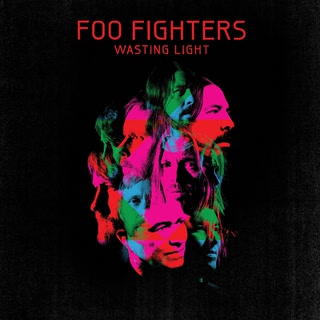
Recorded on analog tape in Grohl's garage with Butch Vig, and tabbed in E Standard from Bridge Burning to Walk, including Rope, White Limo, These Days and Arlandria. The heavy parts got their weight from Pat Smear, who often played a baritone guitar on top of the others. Bob Mould sings and plays guitar on Dear Rosemary, and Krist Novoselic plays bass and accordion on I Should Have Known.
The album measures about 2 cents sharp, concert pitch for any player. A Matter of Time is the exception at about 7 cents flat (A ≈ 438.2), 9 cents below the rest, so it has its own setting.
With TuneLit: E Standard at A 440, and E Standard −7 ¢ for A Matter of Time.
Main tuning: E Standard at concert pitch, measured by TuneLit on the CD (about 1 ¢ flat).
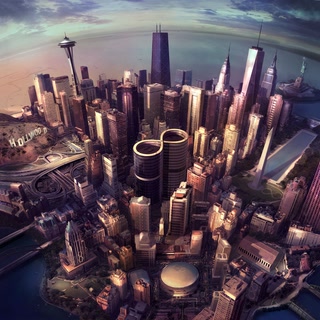
Eight songs, each recorded in a different American city with local guests, and all eight tabbed in E Standard. Rick Nielsen adds a baritone guitar on Something from Nothing, Pat Smear plays baritone on Congregation, Gary Clark Jr. guests on What Did I Do? / God as My Witness and Joe Walsh on Outside. Every song measures within about 4 cents of A 440.
With TuneLit: E Standard at A 440 throughout.
Saint Cecilia (2015, EP)
Main tuning: E Standard at concert pitch, measured by TuneLit on the download (about 2 ¢ sharp).
A free five-song EP recorded at the Hotel Saint Cecilia in Austin during the band's Austin City Limits weekends. Saint Cecilia, Savior Breath and The Neverending Sigh are tabbed in E Standard; Sean and Iron Rooster have no full tab, but the audio check hears the open low E on Sean, which fits.
With TuneLit: E Standard at A 440 for all five songs.
Main tuning: E Standard at concert pitch, measured by TuneLit on the CD (about 1 ¢ sharp).
Greg Kurstin's first album with the band sounds heavy but stays in E Standard in every main tab: Run, The Sky Is a Neighborhood, The Line, Dirty Water and the rest. Paul McCartney plays drums on Sunday Rain, sung by Taylor Hawkins. The title track is the one to watch: the bass tab drops to D under E Standard guitars, and the audio hears that low D clearly. Happy Ever After (Zero Hour) has no published tab, so it follows the album.
With TuneLit: E Standard at A 440 throughout, with a Drop D bass entry on Concrete and Gold.
Main tuning: E Standard +5 ¢ (A ≈ 441.2), measured by TuneLit on the CD.
Recorded in an old house in Encino that Grohl later called haunted; one of his complaints was finding the guitars out of tune the next morning. The tabs put the album in E Standard (Making a Fire, Waiting on a War, No Son of Mine, Cloudspotter), except Shame Shame, which is in Drop D. Love Dies Young is disputed: two tabs are in E Standard and a third in Drop C, and the audio never hears an open low E, so if the riff feels wrong, try Drop C.
The album sits about 5 cents sharp (A ≈ 441.2), a hair above concert pitch. No Son of Mine is lower, about 4 cents flat (A ≈ 438.9), so it has its own setting.
With TuneLit: E Standard +5 ¢, Drop D +5 ¢ for Shame Shame and E Standard −4 ¢ for No Son of Mine.
Main tuning: E Standard at concert pitch, measured by TuneLit on the CD (about 0 ¢).
The first album after Taylor Hawkins's death, with Grohl back on drums. Rescued, Under You, The Glass, Show Me How and most of the album are tabbed in E Standard. Rest, the closer, is in Drop D, and its low D is the most common bass note on the record. On the ten-minute The Teacher, the tab gives Grohl a double-neck guitar with one neck in E Standard and the other capoed at the 7th fret.
With TuneLit: E Standard at A 440, Drop D for Rest.
Dave Grohl and guitarist Pat Smear on stage at the Shaky Knees festival, Atlanta, 22 October 2021.
TuneLit lab
What TuneLit measured
TuneLit's Match-a-recording estimator takes a stretch of each song, finds the strongest notes and compares them with the equal-tempered grid. That pins the offset down to a few cents, but only within one semitone, so the tuning's name (E Standard, Drop D, E♭) still comes from the tabs and sources above. We measured the CD editions in our own library (the Saint Cecilia EP from its download). The audio itself is never uploaded or published; only the numbers appear here.
Album
Sources said
TuneLit measured
Equivalent A
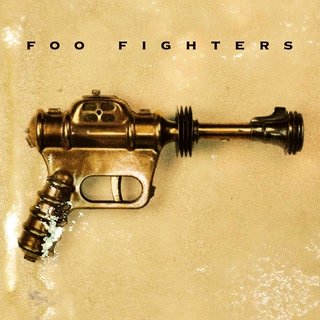
Foo Fighters (1995)
no offset reported
0 ¢
A 440
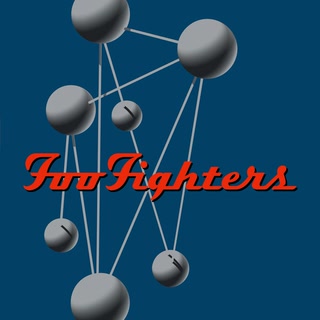
The Colour and the Shape (1997)
no offset reported
+2 ¢
A ≈ 440.5
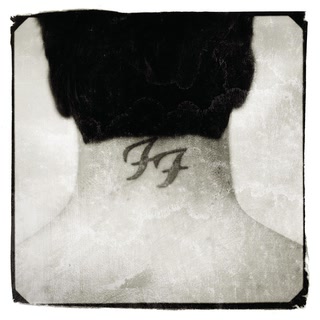
There Is Nothing Left to Lose (1999)
no offset reported
+1 ¢
A ≈ 440.3
One by One (2002)
no offset reported
−10 ¢
A ≈ 437.4
In Your Honor (2005)
no offset reported
−3 ¢ (two groups: 0 and −7)
A ≈ 439.2
Echoes, Silence, Patience & Grace (2007)
no offset reported
0 ¢
A 440
Wasting Light (2011)
no offset reported
+2 ¢
A ≈ 440.5
Sonic Highways (2014)
no offset reported
−1 ¢
A ≈ 439.8
Saint Cecilia (2015)
no offset reported
+2 ¢
A ≈ 440.6
Concrete and Gold (2017)
no offset reported
+1 ¢
A ≈ 440.2
Medicine at Midnight (2021)
no offset reported
+5 ¢
A ≈ 441.2
But Here We Are (2023)
no offset reported
0 ¢
A ≈ 440.1
Anything within ±4 ¢ counts as concert pitch and is stored as A 440, so most buttons open a clean E Standard or Drop D. Only One by One (−10 ¢) and Medicine at Midnight (+5 ¢), plus The Deepest Blues Are Black, A Matter of Time and No Son of Mine, carry an offset.
TuneLit also checked every measured song from the audio for the semitone of its lowest open string. Of the 133 songs, 104 agree with the tuning listed here and 16 give no clear answer. Nine more point a half step higher: on songs like The Pretender, Long Road to Ruin and Summer's End the open low E is simply never played, and that is the method's known blind spot, not a sign of a higher tuning. Four point a half step lower (Wattershed, Friend of a Friend, Virginia Moon and The Neverending Sigh). We kept the tabs' tuning for those four: no source names E♭, and for three of them the notes in the tabs line up with the record at E Standard pitch far better than a half step lower. If one of them still sounds off to you, try E♭ Standard by ear.
Evidence
How sure are these numbers?
Every tuning on the album pages carries a status label. Every entry now reads Measured by TuneLit, because its offset comes from our own analysis of the CD, but the tuning's name rests on other evidence:
Official: the band said it. Grohl's own account of Monkey Wrench and Everlong in Drop D.
Widely reported: trusted outlets agree, backed by tabs. Stacked Actors' low A is described on Wikipedia and in the main tab.
Community: community transcriptions, mostly Songsterr and Ultimate Guitar. Most Foo Fighters songs rest here, because the band rarely talks about tunings. Where the audio check or a second tab agrees, we say so in the song's note.
Disputed: the sources disagree. We show the most likely setting and name the other one. For Foo Fighters: Love Dies Young.
Measured by TuneLit: our pitch analysis of an original recording, giving the offset in cents.
If a song still sounds a touch off, move the reference a hertz or two; near 440 Hz, one hertz is about 4 cents.
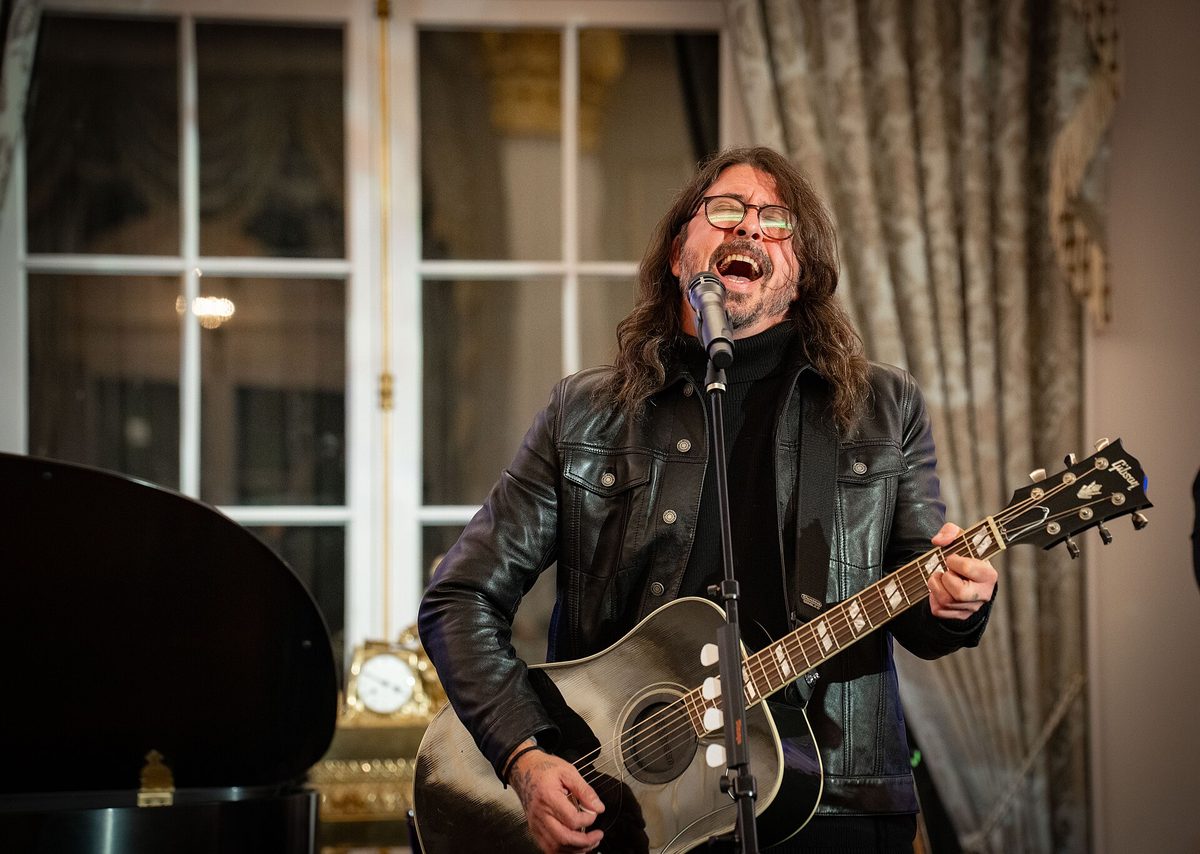
Dave Grohl playing an acoustic Gibson at the U.S. Department of State, Washington, D.C., 27 September 2023.
Cheat sheet
Quick reference
Foo Fighters (1995): E Standard at A 440. Drop D: Alone + Easy Target, Good Grief, Exhausted. E♭ Standard: X-Static. C G D G B E: Weenie Beenie.
The Colour and the Shape (1997): E Standard at A 440. Drop D: Monkey Wrench, Hey, Johnny Park!, February Stars, Everlong. E A D G B D: See You.
There Is Nothing Left to Lose (1999): E Standard at A 440. A A D G B E: Stacked Actors. Drop D: Live-In Skin, Headwires. D A D G A E: M.I.A.
One by One (2002): E Standard −10 ¢ (A ≈ 437). Drop D at −10 ¢: Low, Tired of You, Halo, Overdrive, Burn Away.
In Your Honor (2005): E Standard at A 440 (half the songs sit about 7 ¢ flat). Drop D: Razor. The Deepest Blues Are Black at +7 ¢. Bass in Drop D: Hell.
Echoes, Silence, Patience & Grace (2007): E Standard at A 440 throughout.
Wasting Light (2011): E Standard at A 440; A Matter of Time at −7 ¢.
Sonic Highways (2014) and Saint Cecilia (2015): E Standard at A 440 throughout.
Concrete and Gold (2017): E Standard at A 440. Bass in Drop D: Concrete and Gold.
Medicine at Midnight (2021): E Standard +5 ¢ (A ≈ 441). Drop D: Shame Shame. No Son of Mine at −4 ¢. Disputed: Love Dies Young (E Standard or Drop C).
But Here We Are (2023): E Standard at A 440. Drop D: Rest.
Golden rule: keep a second guitar in Drop D, or get quick at dropping the 6th string. For One by One, set the offset before you blame your ears.
Questions
What tuning does Foo Fighters use?
Mostly E Standard: 12 of 12 albums. Many albums also have songs in other tunings, and the album pages list them song by song.
Why does Foo Fighters sound out of tune when I play along?
Some records are not at concert pitch. One by One sits about 10 cents flat (A ≈ 437). A guitar tuned to A 440 clashes with them. Every Tune button on these pages sets the measured pitch for you.
How did TuneLit measure Foo Fighters's records?
We played original CDs and LPs through TuneLit's pitch analysis: the strongest notes of each song are compared with the A 440 grid, which gives the offset in cents. That cannot tell the semitone, so the tuning name comes from interviews, the press and tabs. The audio is never stored or published.
Colors and font
Font
Colors
Menu
Install the app
Android (Chrome): menu ⋮ → Install app or Add to Home screen.
Computer (Chrome, Edge): the install icon at the right end of the address bar.
iPhone: Safari → Share → Add to Home Screen.
It opens full screen and keeps tuning with no connection.