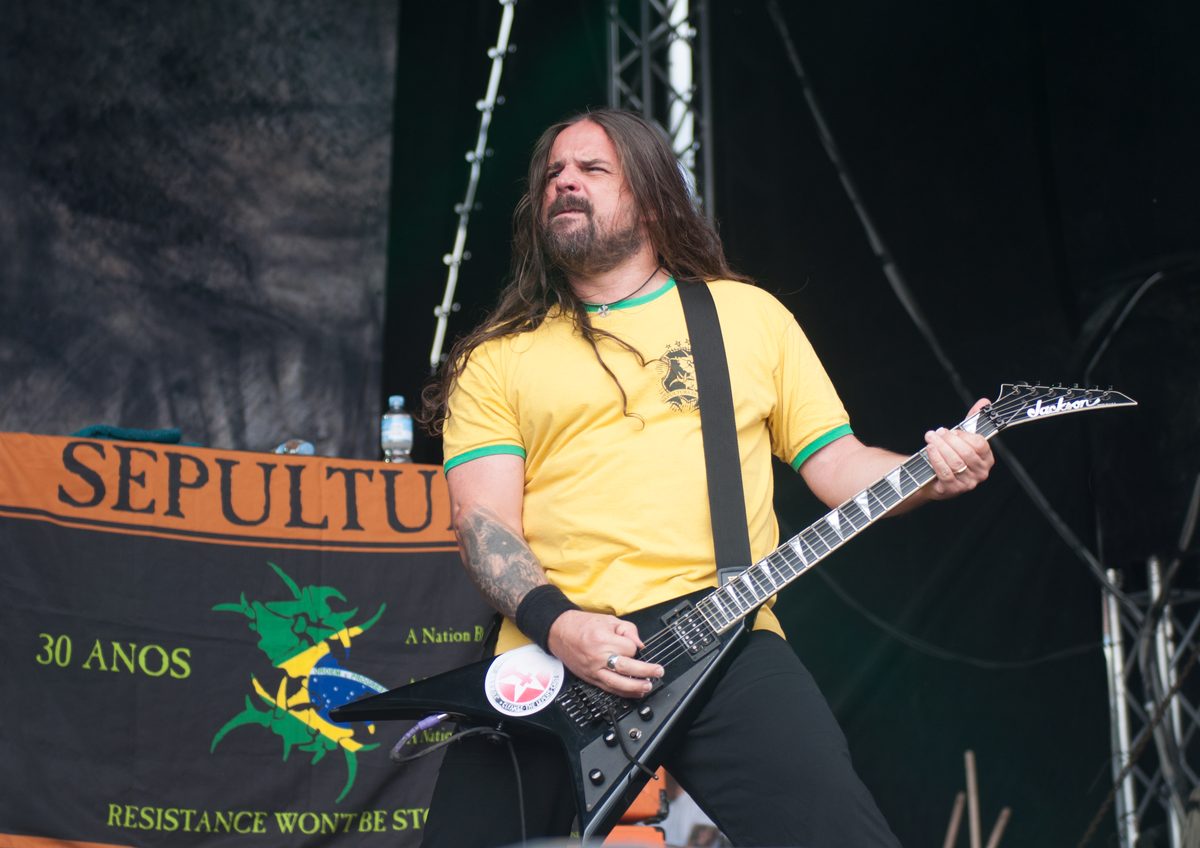
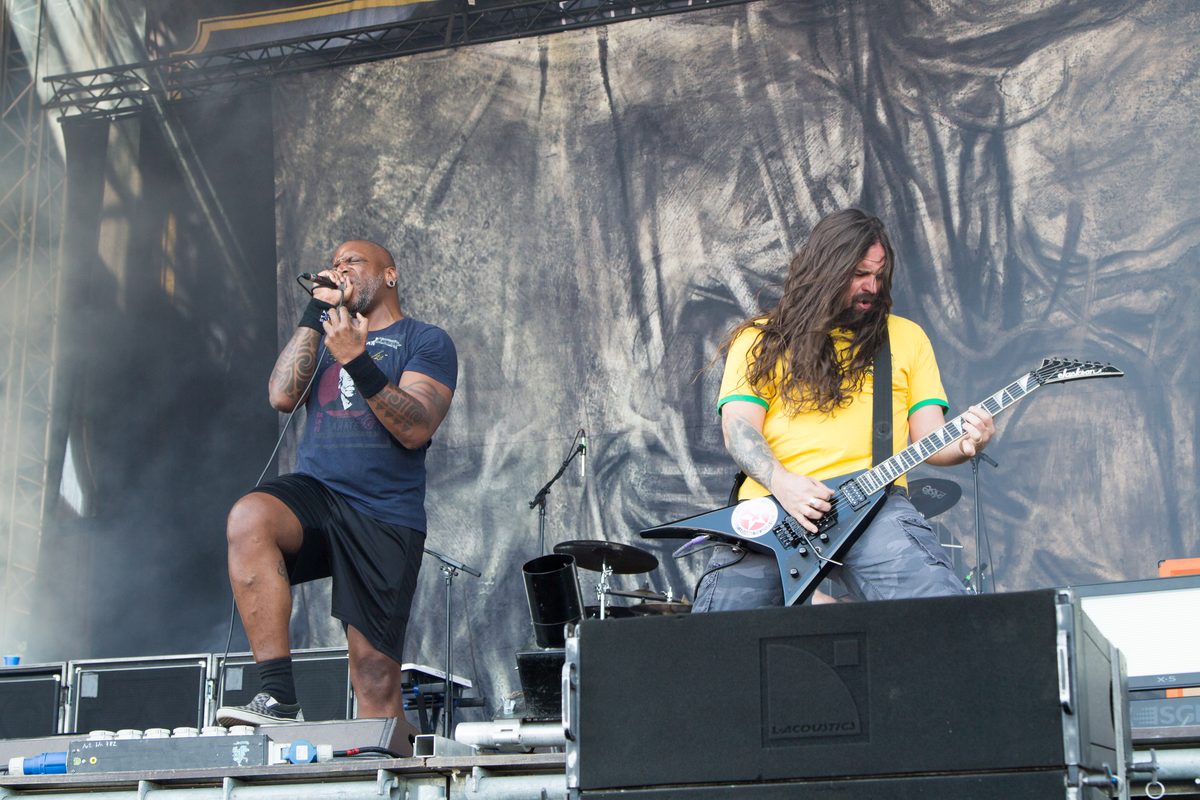
Andreas Kisser with his Jackson guitar in front of a Sepultura 30th-anniversary banner at Vainstream Rockfest, Münster, Germany, 5 July 2014.
In short
How Sepultura tunes
Sepultura tuned lower as their music changed. The Cavalera-era thrash records, Morbid Visions to Arise, are in plain E Standard, and Max Cavalera has said nothing before Chaos A.D. was tuned down; only the 1985 Bestial Devastation EP, cut in two days on borrowed instruments, already sits on a low D and C.
Read more
Chaos A.D. (1993) moved to D Standard with a handful of songs in E♭, and Roots (1996) went down to B, with B♭ and D songs around it. After Max left, Andreas Kisser kept two main tunings, D Standard and B♭ Standard, with Drop C, Drop D and a few others for single songs. TuneLit measured every studio album from the owner's CDs. Morbid Visions, Arise, A-Lex, Kairos and Quadra sit at concert pitch, Schizophrenia about 11 cents flat and Roots about 15 cents flat, while Beneath the Remains, Chaos A.D. and most Derrick Green albums sit 9 to 18 cents sharp (A 442 to 445). Every Tune button uses the measured pitch.
Few metal bands have changed their sound as much as Sepultura, and their tuning tells the same story. The thrash albums from Belo Horizonte are in plain E Standard. Chaos A.D. drops a whole step to D, Roots goes all the way down to B, and the albums with Derrick Green and Andreas Kisser settle on two working tunings, D Standard and B♭ Standard, with a few drop tunings around them. On top of that, many Sepultura CDs are not at concert pitch. TuneLit measured every studio album from the owner's own CDs, and several sit 10 to 18 cents sharp, enough to make a guitar tuned to a perfect A 440 sound slightly sour against the record.
This page covers every studio album from the 1985 Bestial Devastation EP to Quadra in 2020: the main tuning, the songs that break the pattern, what the tabs and the band say, and what the records measure. Each album page lists every song with a Tune button that opens the tuner in that tuning, measured pitch included.
The story
Reading the numbers
A tuner compares every note with a reference A, normally 440 Hz. When a record sits a little above or below that grid, the album pages add the offset to the tuning's name, such as "D Standard +12 ¢" for Chaos A.D. A cent is a hundredth of a semitone, so +12 ¢ is about an eighth of the way to the next note. You can think of the same offset as a different reference: +12 ¢ is A ≈ 443 Hz. Anything within 4 cents of concert pitch is shown as plain A 440, because a player cannot hear the difference and our measurement is not more precise than that.
The Tune buttons do this for you. To tune by hand, pick the tuning, tap the A 440 chip and type the album's value, for example 443 Hz for Chaos A.D.
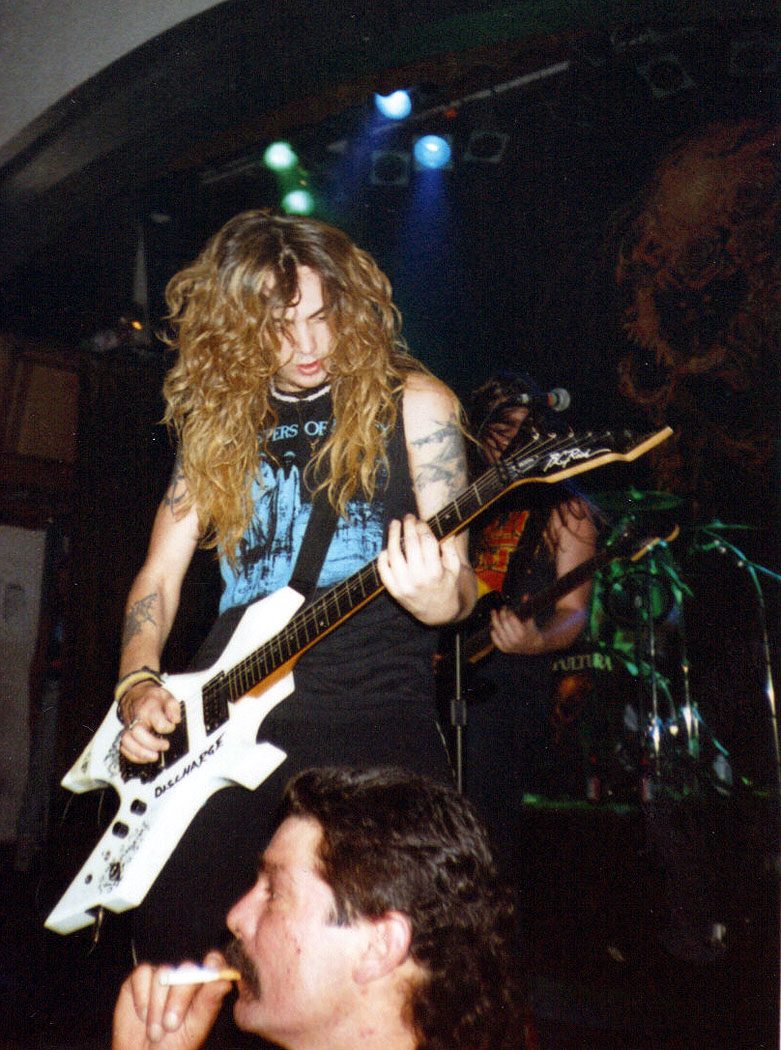
Sepultura on stage on the tour for Beneath the Remains (1989).
The story
How Sepultura's tuning changed, era by era
1985 to 1991: thrash in E. Max Cavalera has said that everything Sepultura wrote before Chaos A.D. was in standard tuning, and the community tabs agree for Morbid Visions, Schizophrenia, Beneath the Remains and Arise. The one exception is the oldest record of all. The Bestial Devastation EP of 1985, recorded in two days on borrowed instruments, is tabbed in D Standard and C Standard, and TuneLit's semitone check from the audio hears exactly those low notes. Max has also admitted that the band did not tune their guitars while making Morbid Visions; oddly, that album measures almost exactly at concert pitch. Andreas Kisser replaced Jairo Guedz in 1987, and Schizophrenia, Beneath the Remains and Arise all stay in E.
1993: down to D. Chaos A.D. is the first Sepultura album in a lower tuning. In a 2016 interview Max recalled that he had to fight Kisser to retune the guitars to D, and Kisser has said he was skeptical at first: he feared that slack low strings would cost the band its speed and its hard picking, until heavier strings solved the problem. Wikipedia, citing the 1994 songbook, says half of the album is in D Standard. The other half, according to the main tabs, sits a half step higher in E♭, and TuneLit's semitone check from the audio confirms that split song by song.
1996: Roots and the low B. Produced by Ross Robinson, Roots is the band's lowest record. The core songs are tabbed in B Standard, two and a half steps down, with three songs a half step lower in B♭ and five in D Standard. Max, credited on 4- and 6-string guitar, often played rhythm with only four strings, a habit he says began when two strings broke and he never replaced them. Community tabs give Paulo Jr. a 5-string bass, whose low B matches the guitars.
1998 to 2020: two guitars, two tunings. After Max left, Kisser became the only guitarist. On the 1999 Against tour his guitar tech described three tunings: B♭ Standard, D Standard, and a Drop C that Kisser described as D with the sixth string lowered to C, on heavy .013 to .056 strings. Wikipedia sums up his setup as D Standard and B♭ Standard, with two guitars for each tuning on tour, and the community tabs of every album from Against to Quadra follow that pattern: D Standard, B♭ Standard, and a few songs in Drop D, Drop C or Drop B♭. Many of those tabs have few views, so the per-song details on these albums are less certain than on the classic records.
What the CDs say. Beneath the Remains, Chaos A.D. and most of the Derrick Green albums are sharp, from about 9 cents (Dante XXI) to 18 cents (Beneath the Remains), while Schizophrenia and Roots sit flat. Nothing in our sources explains it, and a measurement cannot tell a tuning habit from a tape machine running a little fast.
Discography
Album by album
Bestial Devastation (EP, 1985)
Main tuning: D Standard +19 ¢ (A ≈ 445), measured by TuneLit on a Japanese CD that pairs the EP with Morbid Visions.
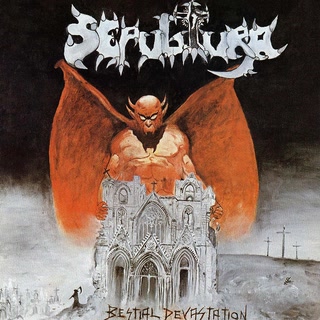
Sepultura's side of a split release with Overdose. The line-up was Max Cavalera, his brother Igor on drums and Jairo Guedz on lead guitar, and Wikipedia reports that they recorded and mixed it in two days on eight tracks, mostly with borrowed gear. The community tabs are surprising for a 1985 thrash record: the title track and Warriors of Death are in D Standard, Antichrist and Necromancer in C Standard. TuneLit's semitone check from the audio agrees with all four: the lowest notes really are D and C. The recording is rough and the measurement has low confidence, so treat the +19 ¢ as approximate.
With TuneLit: the buttons give D Standard +19 ¢ for The Curse, the title track and Warriors of Death, and C Standard +19 ¢ for Antichrist and Necromancer. If a song sounds off, nudge the reference by ear before changing the tuning.
Main tuning: E Standard at concert pitch (measured about 2 ¢ flat), on the same Japanese CD.
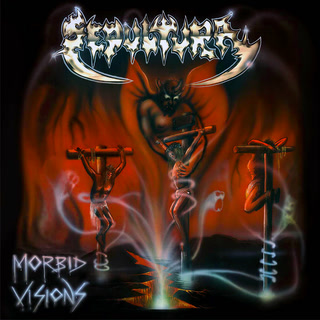
Every song is tabbed in E Standard. In the notes of a later Roadrunner reissue, Max admitted that the band did not bother to tune their guitars during the sessions, and its production has long been considered poor. The measurement is kinder than that story: the CD sits about 2 cents flat, and every song but one lands within a few cents of it. The title track reads about 20 cents flat, but with low confidence, so it keeps the album value.
With TuneLit: every button opens plain E Standard.
Main tuning: E Standard −11 ¢ (A ≈ 437), measured by TuneLit on the CD.
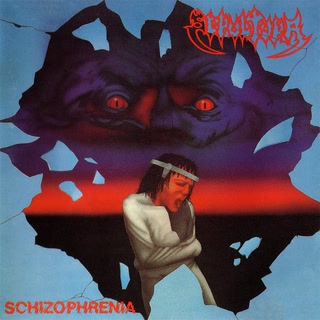
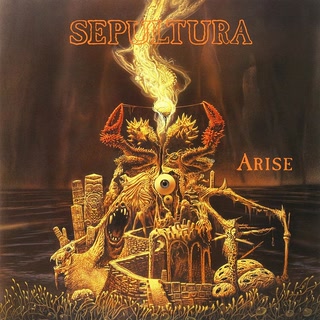
Andreas Kisser's first album with the band. The electric songs are all tabbed in E Standard and measure about 11 cents flat, closely grouped; remasters from 1990 and 1997 in the library read a few cents lower still. The odd one out is The Abyss, a one-minute acoustic instrumental. Its tab is in E♭ Standard, but TuneLit's semitone check from the audio hears E as the lowest open string, about 34 cents flat, and never the E♭ below it. Together with Max's word that nothing before Chaos A.D. was tuned down, that moved the song to E Standard at A ≈ 432. On this CD the short Intro is part of the first track.
With TuneLit: E Standard −11 ¢ for the album; The Abyss opens E Standard −34 ¢, with a second button for E♭ in case your ear disagrees.
Main tuning: E Standard +18 ¢ (A ≈ 445), measured by TuneLit on the CD.
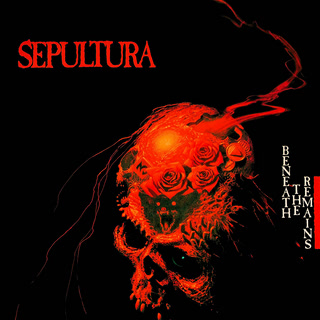
Recorded in Rio de Janeiro with Scott Burns, who brought drum gear and amplifiers to Brazil to improve the sound. Every song is tabbed in E Standard, and every song measures sharp: between 12 and 20 cents above concert pitch, about 18 on average. That is the sharpest album in the catalog. Remasters from 1997 and 2020 read a few cents lower, but still clearly sharp, so the offset is in the original tapes, not in one mastering.
With TuneLit: every button opens E Standard +18 ¢. A guitar tuned to a perfect A 440 will sound flat against this record.
Main tuning: E Standard at concert pitch (measured about 2 ¢ sharp), on a Japanese CD.
Recorded at Morrisound in Tampa, again with Scott Burns, and mixed by Andy Wallace. The main tabs of every song are in E Standard. Tabs in D Standard exist too, several of them for live versions from the mid-1990s, after the band had tuned down. The CD is one of the most consistent records we measured: every song sits within 4 cents of the album value. With TuneLit: every button opens plain E Standard.
Main tuning: D Standard +12 ¢ (A ≈ 443), measured by TuneLit on a Japanese CD.
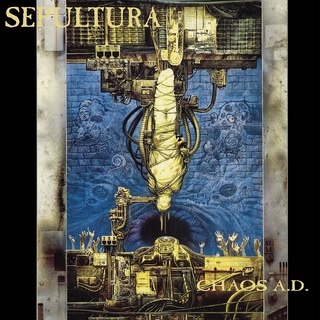
Recorded at Rockfield Studios in Wales with Andy Wallace, this is where Sepultura tuned down and slowed down. The album splits into two tunings. Refuse/Resist, Territory, Slave New World, Nomad, Manifest and the New Model Army cover The Hunt are tabbed in D Standard, a whole step down. Amen, Propaganda, Biotech Is Godzilla, We Who Are Not as Others and Clenched Fist are tabbed a half step higher, in E♭ Standard; Wikipedia, citing the 1994 songbook, names E♭ (D♯) for Propaganda too. TuneLit's semitone check from the audio agrees: it hears an open E♭ on the E♭ songs and an open D on most of the D songs. On Territory it leans towards a C♯ underneath, but the tab and Max's account say D, so it stays there.
The whole CD sits about 12 cents sharp, the D songs and the E♭ songs alike, so one reference serves the whole album. Kaiowas is different. This acoustic instrumental was recorded live in the ruins of Chepstow Castle, and Wikipedia gives Drop C♯ for it, while the community tab uses Drop D and D Standard. The record measures about 38 cents below D, right between the two, and the semitone check hears D as the lowest open string, so TuneLit lists Drop D at A ≈ 431 and keeps a second button for Drop C♯.
With TuneLit: D Standard +12 ¢ for the D songs and E♭ Standard +12 ¢ for Amen, Propaganda, Biotech Is Godzilla, We Who Are Not as Others and Clenched Fist. Kaiowas opens Drop D −37 ¢.
Main tuning: B Standard −15 ¢ (A ≈ 436), measured by TuneLit on CD 1 of the 2005 Deluxe Edition, with low confidence.
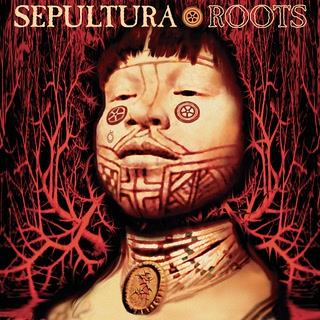
Max Cavalera's last album with the band, recorded in Malibu with Ross Robinson and inspired partly by the down-tuned guitars of Korn's first album. The tabs split it into several tunings. Roots Bloody Roots, Attitude, Lookaway, Dusted and Endangered Species are in B Standard, two and a half steps down. Cut-Throat, Ratamahatta and Spit are a half step lower, in B♭ Standard (one Ultimate Guitar tab puts Attitude in B♭ as well, but the main tab and our semitone check say B). Breed Apart, Straighthate, Born Stubborn, Ambush and Dictatorshit are in D Standard, and the two acoustic pieces, Jasco and Itsári, in Drop D. The semitone check from the audio confirms the B, B♭ and D songs it can read, with three exceptions it cannot settle: on Itsári it hears C♯ rather than D, and on Ambush and Dictatorshit E♭ rather than D. No tab or source names those notes, so they stay as tabbed; check them by ear.
The pitch is the hard part. Roots is a dense, very low mix, and the measurement is unsure of most songs: their readings scatter from about 42 cents flat to 31 cents sharp, and a 2017 remaster shows the same scatter, so it is in the recording. TuneLit uses the album value, about 15 cents flat, for nearly every song, and gives Born Stubborn its own, about 24 cents sharp (A ≈ 446). With TuneLit: B Standard −15 ¢ for the album, B♭ Standard and D Standard for the songs above, and Drop D for the acoustic pieces. The album entry also lists a 5-string bass in standard tuning. On this album more than any other, treat the Tune button as a starting point and fine-tune by ear. Canyon Jam, the long hidden track, is not listed.
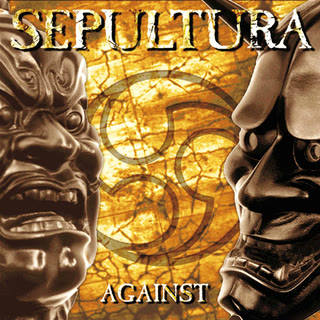
Main tuning: B♭ Standard +13 ¢ (A ≈ 443), measured by TuneLit on a Japanese CD.
The first album with Derrick Green and the first with Kisser as the only guitarist, produced by Howard Benson. The tunings come from the 1999 tour, when Kisser's tech listed B♭ Standard, D Standard and Drop C, and from tabs that are thin for this album. Choke, the single, is tabbed in B♭ Standard, and TuneLit's semitone check from the audio hears a low B♭ on most of the album, so B♭ is the default. Against and Rumors are tabbed in C Standard or Drop C (both start from a low C; TuneLit lists Drop C, the tuning Kisser named), Floaters in Mud in D Standard, Drowned Out in Drop D, Boycott and Common Bonds in Drop B♭ (B♭ F B♭ E♭ G C), Reza in B Standard and Hatred Aside, with Jason Newsted, in E Standard.
The CD measures about 13 cents sharp, and three songs sit higher still: Against about 23 cents, Common Bonds about 29 and T3rcermillennium about 31 (A ≈ 448). Old Earth and Tribus have no tab, but the semitone check confirms their low B♭. F.O.E., Unconscious and T3rcermillennium have no tab either and stay unconfirmed, so their buttons use the album's B♭; for F.O.E. the check hears a low D, so try D Standard if B♭ sounds wrong.
With TuneLit: B♭ Standard +13 ¢ for the album, with the songs above on their own buttons.
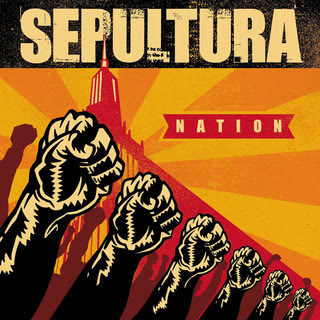
Main tuning: D Standard +17 ¢ (A ≈ 444), measured by TuneLit on a Japanese CD.
A long, mixed album with many guests. The default is D Standard, the tuning of Who Must Die? and Reject. Sepulnation is tabbed in Drop D, Vox Populi in Drop C, Border Wars in Drop B♭, One Man Army in E♭ Standard and Uma Cura in E Standard. Tribe to a Nation, Politricks, Human Cause and Saga are on a low B♭ (Saga's most-viewed tab uses a 7-string tuned a half step down, whose lowest string is the same B♭). Revolt, The Ways of Faith, Water and Valtio have no tab; on The Ways of Faith the semitone check hears E♭ rather than the album's D.
The CD sits about 17 cents sharp. Uma Cura is lower, about 7 cents sharp, Water at concert pitch and Valtio, the instrumental with Apocalyptica, about 10 cents flat.
With TuneLit: D Standard +17 ¢ for the album, with the songs above on their own buttons.
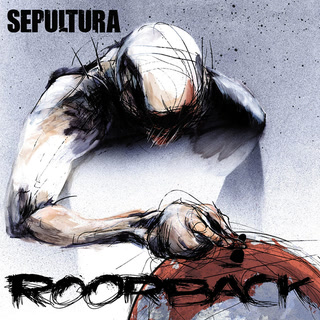
Main tuning: D Standard +17 ¢ (A ≈ 444), measured by TuneLit on CD 1 of the Limited Edition.
Produced by Steve Evetts. Urge, Mind War and Leech are tabbed in D Standard, Apes of God and As It Is in Drop D, and Activist in C♯ Standard. The other half of the album sits on a low B♭: Corrupted in B♭ Standard, Godless in Drop B♭, and Come Back Alive, More of the Same and Bottomed Out on tabs for a 7-string tuned a half step down, which share the same lowest note. The tabs of The Rift disagree (an older one says Drop B, a newer one D Standard), and the semitone check hears D. The CD measures about 17 cents sharp, and As It Is sits at concert pitch.
With TuneLit: D Standard +17 ¢ for the album, with the songs above on their own buttons.
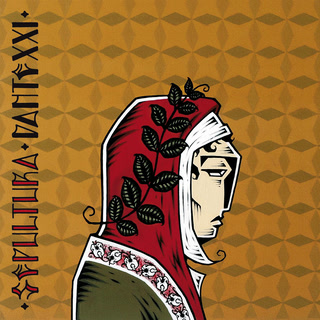
Main tuning: D Standard +9 ¢ (A ≈ 442), measured by TuneLit on a Japanese CD.
A concept album after Dante's Divine Comedy, with short intros between its parts, and Igor Cavalera's last album with the band. D Standard is the default (Ostia, Buried Words, Crown and Miter), with Dark Wood of Error and the acoustic Limbo in Drop D and Nuclear Seven and Repeating the Horror in Drop C. Convicted in Life, City of Dis, False and Fighting On are on a low B♭. Fighting On has three tabs that disagree (B♭, B and E Standard); TuneLit lists the B♭ one. Still Flame has no tab.
The CD measures about 9 cents sharp, with City of Dis and Fighting On higher, about 20 and 24 cents.
With TuneLit: D Standard +9 ¢ for the album, with the songs above on their own buttons.
Main tuning: B♭ Standard at concert pitch (measured about 2 ¢ sharp), on the CD.
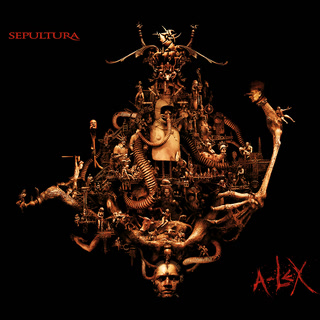
Based on A Clockwork Orange, and the first album with Jean Dolabella on drums. The tabs put most of it on a low B♭: B♭ Standard for A-Lex II, The Treatment, Metamorphosis, Conform and A-Lex III, Drop B♭ for We've Lost You! and The Experiment. Moloko Mesto, Sadistic Values, Strike, Enough Said and Paradox are in D Standard, and A-Lex I in Drop C♯. Two songs moved after our semitone check from the audio, each with a second tab agreeing: What I Do!, tabbed in Drop B, is listed in Drop B♭, and Forceful Behavior, tabbed in E♭, in E Standard. Ludwig Van, built on Beethoven, has one tab in E Standard, and the short A-Lex IV one in E♭.
The CD sits at concert pitch. A-Lex II reads about 9 cents flat and Ludwig Van about 10 cents sharp.
With TuneLit: B♭ Standard for the album, with the songs above on their own buttons.
Main tuning: D Standard at concert pitch (measured about 2 ¢ flat), on the Limited Edition CD.
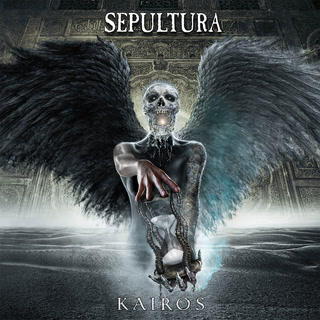
Produced by Roy Z. Spectrum, the title track, Relentless, the Ministry cover Just One Fix, Seethe and No One Will Stand are tabbed in D Standard, Mask in Drop D, and Dialog, Born Strong and Embrace the Storm in B♭ Standard. The four short interludes named after years have no tabs. The CD sits at concert pitch.
With TuneLit: D Standard for the album, B♭ Standard for the three songs above, Drop D for Mask.
Main tuning: D Standard +12 ¢ (A ≈ 443), measured by TuneLit on the CD.
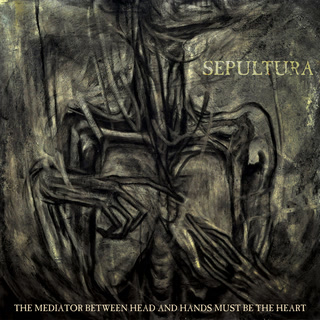
Ross Robinson produced again, seventeen years after Roots, and Eloy Casagrande made his debut on drums. Kisser picked the opener, Trauma of War, to explain how he learned to play fast in a low tuning with heavier strings; its main tab is in B Standard, a newer one in B♭, and the measurement has too little low-string data to choose. The Vatican, Impending Doom, Tsunami, Grief, Obsessed and the Chico Science & Nação Zumbi cover Da Lama ao Caos are tabbed in D Standard, The Bliss of Ignorants in B♭ and The Age of the Atheist in Drop B♭. Manipulation of Tragedy is tabbed in Drop C♯, but the semitone check hears D, as two other tabs have it, so it is listed in Drop D.
The CD measures about 12 cents sharp; The Age of the Atheist and Da Lama ao Caos sit close to concert pitch.
With TuneLit: D Standard +12 ¢ for the album, with the songs above on their own buttons.
Main tuning: B♭ Standard +10 ¢ (A ≈ 442.5), measured by TuneLit on the Limited Edition CD.
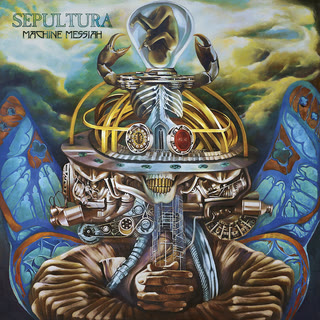
Produced by Jens Bogren. I Am the Enemy, Alethea and Resistant Parasites are tabbed in B♭ Standard, and Cyber God on a 7-string tuned a half step down, with the same low B♭. The title track, Sworn Oath, Silent Violence and Vandals Nest are in D Standard. Phantom Self is disputed: its most-viewed tab says E Standard, two others B♭ Standard and Drop B♭, and the semitone check does not confirm E. The instrumental Iceberg Dances has no tab. The CD sits about 10 cents sharp, Iceberg Dances about 9 cents flat.
With TuneLit: B♭ Standard +10 ¢ for the album, D Standard +10 ¢ for the four D songs.
Main tuning: D Standard at concert pitch, measured by TuneLit on CD 1 of the Limited Edition.
Also produced by Jens Bogren, at his studio in Örebro, Sweden. Isolation, Last Time, Ali, Raging Void, The Pentagram, Agony of Defeat and the acoustic title piece are tabbed in D Standard. Means to an End, Capital Enslavement and Autem are on a low B♭, and Guardians of Earth and Fear, Pain, Chaos, Suffering, with Emmily Barreto, in E Standard. The intro of Guardians of Earth is played on classical guitar and tabbed in Drop D, and the semitone check hears a low D on that song, so try Drop D if E sounds wrong. The CD sits at concert pitch.
With TuneLit: D Standard for the album, B♭ Standard and E Standard for the songs above.
Not covered: the 2014 soundtrack Minissérie Dupla Identidade and SepulQuarta (2021), which re-records older songs with guests, are not studio albums in the usual sense, so they have no page here.
TuneLit lab
What TuneLit measured
TuneLit's Match-a-recording estimator reads 90 seconds of each song, finds the strongest notes and compares them with the equal-tempered grid. That pins the offset down to a few cents, but only within one semitone, so the tuning's name (E, D, B♭) still comes from the tabs and sources. A second check listens for the lowest open string. It is a strong confirmation when it agrees and only a hint when it does not, so it moved a song only where a tab or source pointed the same way.
Album
Sources said
TuneLit measured
Equivalent A
Bestial Devastation (1985)
D and C Standard (tabs)
+19 ¢ (low confidence)
A ≈ 445
Morbid Visions (1986)
E Standard
−2 ¢
A 440
Schizophrenia (1987)
E Standard
−11 ¢
A ≈ 437
Beneath the Remains (1989)
E Standard
+18 ¢
A ≈ 445
Arise (1991)
E Standard
+2 ¢
A 440
Chaos A.D. (1993)
D and E♭ Standard
+12 ¢
A ≈ 443
Roots (1996)
B, B♭ and D Standard
−15 ¢ (low confidence)
A ≈ 436
Against (1998)
B♭, D, Drop C
+13 ¢
A ≈ 443
Nation (2001)
D and B♭
+17 ¢
A ≈ 444
Roorback (2003)
D and B♭
+17 ¢
A ≈ 444
Dante XXI (2006)
D and B♭
+9 ¢
A ≈ 442
A-Lex (2009)
B♭ and D
+2 ¢
A 440
Kairos (2011)
D and B♭
−2 ¢
A 440
The Mediator… (2013)
D and B♭
+12 ¢
A ≈ 443
Machine Messiah (2017)
B♭ and D
+10 ¢
A ≈ 442.5
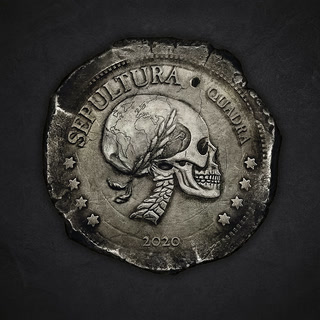
Quadra (2020)
D and B♭
+1 ¢
A 440
None of our sources mentions the pitch of a Sepultura record, so every offset here is new. Three things stand out. Beneath the Remains is sharp, about 18 cents, on the original CD and on two remasters. Chaos A.D. and most of the Derrick Green albums sit 9 to 17 cents sharp, enough to notice when you play along. And the band's most famous low album, Roots, is also its least consistent: the songs scatter across almost a whole semitone, so its single album value is only an average.
The semitone check confirmed most of the catalog: it agrees with 146 of the 189 songs it could read. It moved five, each with a second source: The Abyss up to E, Kaiowas up to Drop D, What I Do! down to Drop B♭, Forceful Behavior up to E and Manipulation of Tragedy up to Drop D. It disagrees with a few more where nothing else backs it up, mostly on Roots and on songs that have no tab, and those are named in the album notes as songs to check by ear.
Keep a few limits in mind. Heavy, low mixes are hard to read, so most songs use their album's value and only clear outliers get their own. Anything within ±4 ¢ counts as concert pitch. All numbers come from CDs in the owner's library, mostly Japanese and limited editions; the audio is never uploaded or published, only the numbers.
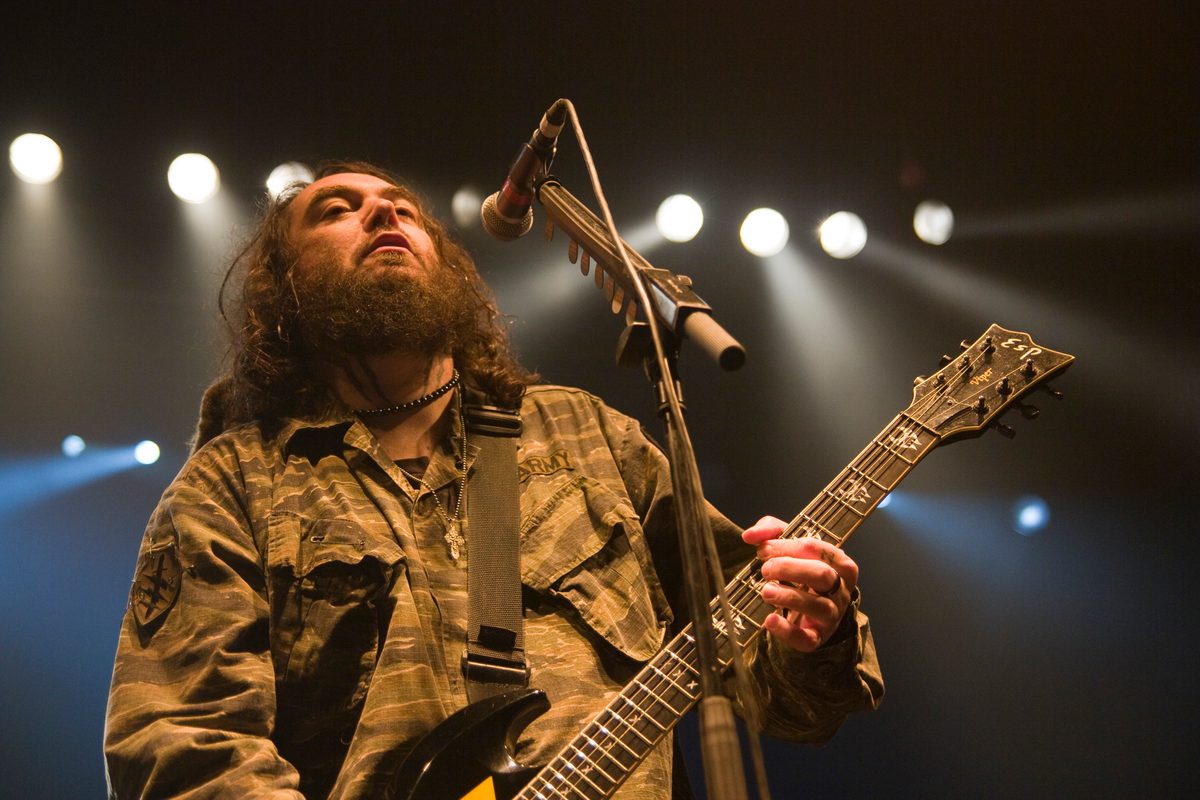
Sepultura co-founder Max Cavalera playing guitar with Cavalera Conspiracy, 2011.
Evidence
How sure are these numbers?
Every tuning on the album pages carries a status label. The offset in cents now comes from our own measurement, so every album shows Measured by TuneLit. The tuning's name rests on the other kinds of evidence:
Official: the band said it. For Sepultura that is Max Cavalera's account of retuning to D for Chaos A.D.
Widely reported: trusted outlets or reference works agree, such as Wikipedia citing the 1994 Chaos A.D. songbook, or Kisser's tech listing his tunings in a 1999 interview.
Community: community transcriptions, mostly Songsterr. This covers most song-level details, and many tabs of the later albums have few views.
Disputed: the sources disagree, for example Fighting On or Phantom Self. We list the most likely tuning and say what the others are.
Measured by TuneLit: our own pitch analysis of the CD, giving the offset in cents.
If a song still sounds a touch off, move the reference a hertz or two; near 440 Hz, one hertz is about 4 cents.
Derrick Green and Andreas Kisser on stage at Nova Rock, Austria, 13 June 2014.
Cheat sheet
Quick reference
Bestial Devastation (1985): D Standard +19 ¢; C Standard for Antichrist and Necromancer.
Morbid Visions (1986): E Standard.
Schizophrenia (1987): E Standard −11 ¢; The Abyss E Standard −34 ¢.
Beneath the Remains (1989): E Standard +18 ¢.
Arise (1991): E Standard.
Chaos A.D. (1993): D Standard +12 ¢; E♭ Standard +12 ¢ for Amen, Propaganda, Biotech Is Godzilla, We Who Are Not as Others, Clenched Fist; Kaiowas Drop D −37 ¢.
Roots (1996): B Standard −15 ¢; B♭ for Cut-Throat, Ratamahatta, Spit; D for Breed Apart, Straighthate, Born Stubborn (+24 ¢), Ambush, Dictatorshit; Drop D for Jasco and Itsári.
Against (1998): B♭ Standard +13 ¢; Drop C for Against and Rumors; D or Drop D for Floaters in Mud and Drowned Out; E for Hatred Aside.
Nation (2001): D Standard +17 ¢; B♭ for Tribe to a Nation, Politricks, Human Cause, Saga.
Roorback (2003): D Standard +17 ¢; a low B♭ for Come Back Alive, Godless, More of the Same, Corrupted, Bottomed Out.
Dante XXI (2006): D Standard +9 ¢; B♭ for Convicted in Life, City of Dis, False, Fighting On.
A-Lex (2009): B♭ Standard; D for Moloko Mesto, Sadistic Values, Strike, Enough Said, Paradox.
Kairos (2011): D Standard; B♭ for Dialog, Born Strong, Embrace the Storm.
The Mediator… (2013): D Standard +12 ¢; B Standard for Trauma of War.
Machine Messiah (2017): B♭ Standard +10 ¢; D for the title track, Sworn Oath, Silent Violence, Vandals Nest.
Quadra (2020): D Standard; B♭ for Means to an End, Capital Enslavement, Autem; E for Guardians of Earth and Fear, Pain, Chaos, Suffering.
Golden rule: pick the tuning first, then the reference. On the sharp albums a perfect A 440 sounds flat against the record.
Questions
What tuning does Sepultura use?
Mostly D Standard: 8 of 16 albums. Morbid Visions, Schizophrenia, Beneath the Remains and Arise are in E Standard; Against, A-Lex and Machine Messiah are in B♭ Standard; Roots is in B Standard. Many albums also have songs in other tunings, and the album pages list them song by song.
Why does Sepultura sound out of tune when I play along?
Some records are not at concert pitch. Bestial Devastation sits about 19 cents sharp (A ≈ 445); Beneath the Remains sits about 18 cents sharp (A ≈ 445); Nation sits about 17 cents sharp (A ≈ 444). A guitar tuned to A 440 clashes with them. Every Tune button on these pages sets the measured pitch for you.
How did TuneLit measure Sepultura's records?
We played original CDs and LPs through TuneLit's pitch analysis: the strongest notes of each song are compared with the A 440 grid, which gives the offset in cents. That cannot tell the semitone, so the tuning name comes from interviews, the press and tabs, and for 5 songs from TuneLit's semitone check from the audio, backed by a tab or source. The audio is never stored or published.
Colors and font
Font
Colors
Menu
Install the app
Android (Chrome): menu ⋮ → Install app or Add to Home screen.
Computer (Chrome, Edge): the install icon at the right end of the address bar.
iPhone: Safari → Share → Add to Home Screen.
It opens full screen and keeps tuning with no connection.