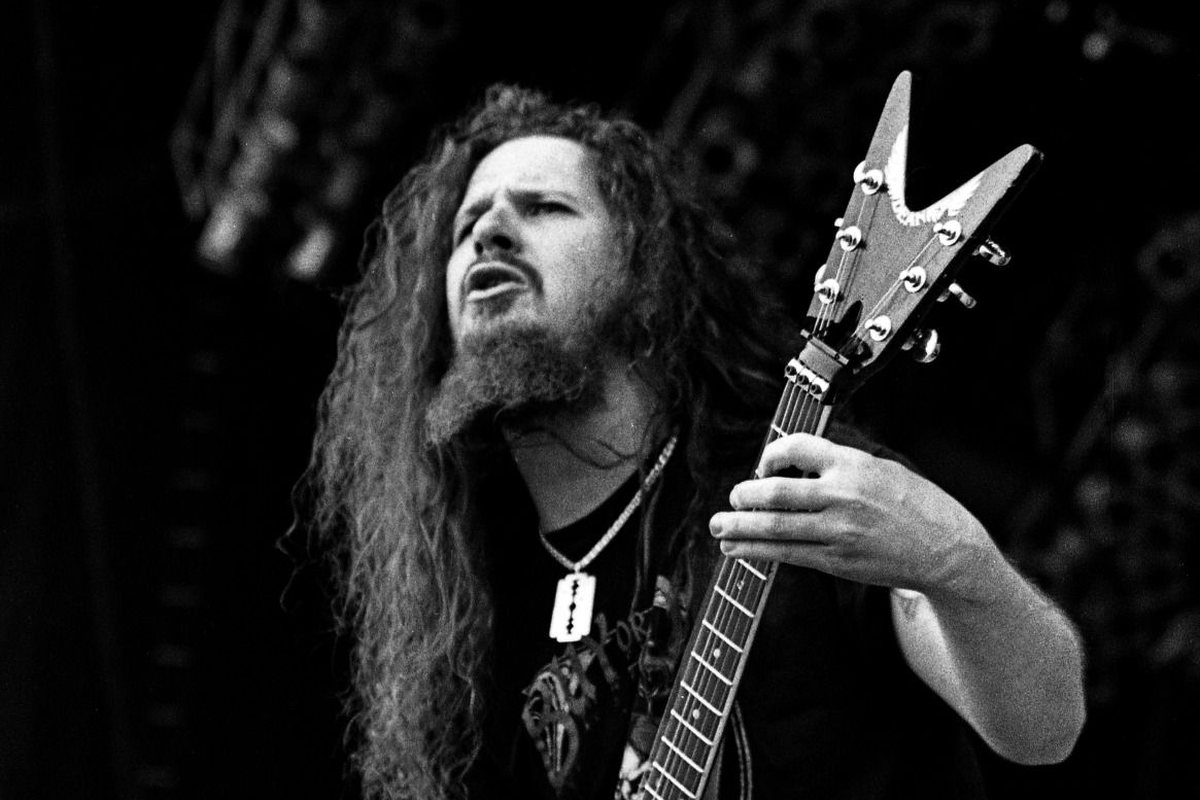
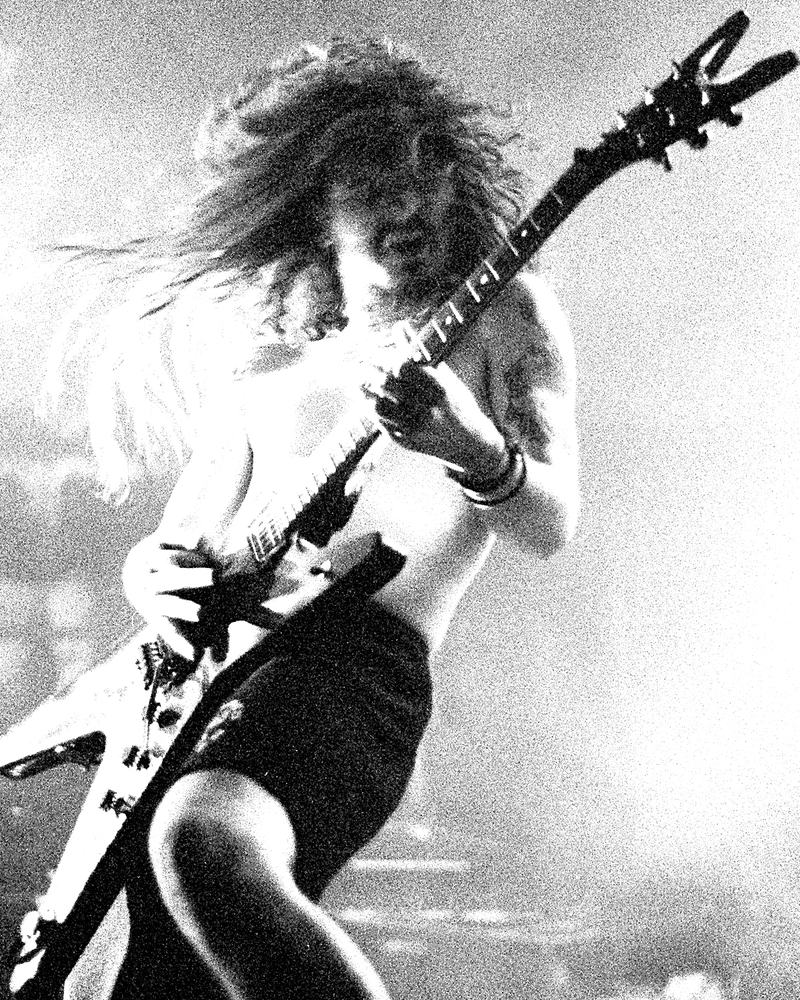
Dimebag Darrell with his Dean ML at Monsters of Rock, Castle Donington, England, 1994, the year of Far Beyond Driven.Photo: Martyn Goodacre · CC BY 4.0 · credits
In short
How Pantera tunes
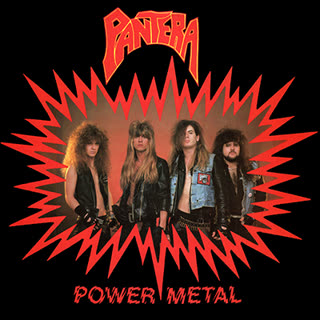
In the 1980s Pantera played glam-leaning heavy metal on four albums released through their own Metal Magic label, and tabs place those records in plain E Standard. TuneLit's measurements show the 1983 debut about 15 cents sharp, but from Projects in the Jungle (1984) on the records already sit 30 to 36 cents flat.
Read more
Dimebag Darrell's tech later described his tuning as about 60 cents flat, which is E Standard with the reference A near 425 Hz. Vulgar Display of Power matches that almost exactly, while Cowboys from Hell is only about 21 cents flat (A 435) and Far Beyond Driven, The Great Southern Trendkill and Reinventing the Steel land between A 428 and A 431. The band also tuned lower: whole-step-down D Standard arrived with Walk on Vulgar Display of Power and stayed through Reinventing the Steel. The Great Southern Trendkill is usually called C♯ Standard, but the record sits between C♯ and D: D tuned about 50 to 60 cents flat, Dime's usual. Because the real pitch falls between semitones, tabs of the same song often disagree by a half step, so set the reference A to the album's measured value before reaching for a different tuning.
Have you ever tuned to a perfect E, pressed play on a Pantera record and felt that something was slightly wrong? You are not imagining it. Almost every Pantera album sits well below concert pitch, and the gap changes from record to record. Dimebag Darrell's guitar tech described his tuning as about 60 cents flat, a little more than a quarter step, so a normal tuner set to A 440 reads his low E as D♯ +40. TuneLit's own measurements confirm that figure on Vulgar Display of Power. They also show the band already playing about 35 cents flat in 1984, and only about 21 cents flat on Cowboys from Hell. That flat habit is why Pantera tabs so often disagree by a half step, why one tab calls a song E Standard and another calls it E♭, and why playing along can sound sour even when every fret is right.
This page collects what is actually known about Pantera's tunings, from the 1983 debut Metal Magic to Reinventing the Steel in 2000. For each studio album you get the main tuning, the measured pitch of the record, the songs that break the pattern, recording and live notes, and how to set it up in TuneLit. The album list above opens every album, where each song has a Tune button that opens the tuner in exactly that tuning, reference pitch included.
The story
The famous number: A = 425
A tuner judges every note against a reference A, normally 440 Hz. Lower that reference by 60 cents and you land almost exactly on 425 Hz. So Dime's flat E Standard, as his tech described it, is simply E Standard against A = 425 Hz, and the same goes for his D Standard, C♯ Standard and Drop D.
That number fits Vulgar Display of Power almost perfectly: we measured the CD about 57 cents flat, A ≈ 426. It does not fit every album. Cowboys from Hell measures closer to A 435, Far Beyond Driven to A 429, The Great Southern Trendkill to A 428 and Reinventing the Steel to A 431. So think of A 425 as the Vulgar number, not a rule for the whole catalog.
Set TuneLit's reference A to the album's value, then tune as usual. The display will call your low string a clean E, while a 440 tuner would place it somewhere between D♯ and E. For the 1980s albums the album pages show the offset in cents, such as "E Standard −35 ¢". From Cowboys from Hell on they show the reference pitch instead, such as "E Standard · A 426". Both describe the same thing.
The Tune buttons do this for you. To do it by hand, choose the tuning, tap the A 440 chip and type the album's value, for example 426 Hz for Vulgar Display of Power.
Dimebag Darrell live at The Bayou in Washington, D.C., 25 September 1990, on the Cowboys from Hell tour.Photo: Rik Goldman · CC BY 2.0 · credits
The story
How Pantera's tuning changed, era by era
The 1980s: E Standard, already flat. In the 1980s Pantera were a glam-leaning heavy metal band and released four albums on their own Metal Magic label. Community tabs put nearly all of that music in plain E Standard, with a handful of Drop D songs. No source says anything about the pitch of these records, so TuneLit measured them: original LPs, plus a CD of Power Metal. The 1983 debut sits about 15 cents sharp. Every album after it, from Projects in the Jungle (1984) to Power Metal (1988), sits 30 to 36 cents flat, around A 431–432. A measurement cannot tell whether the young Darrell Abbott tuned low or the tape ran slow; it only hears the result.
1990: the flat E gets a name. In the sources, the offset starts with Cowboys from Hell. According to Grady "Dragon" Champion, who looked after Dime's guitars for years, the 60-cent drop came on top of whatever tuning was in use, so E♭ Standard, Drop D and Drop C♯ were all flattened by the same amount. On his Korg tuner each string read as the note a semitone below plus 40 cents, a little more than a quarter step down; a Guitar World lesson compares this with the first two Van Halen albums. In his own column Dime described his guitar as always sitting a hair more than a quarter step below concert pitch, and said the extra looseness helped with his biggest bends. Guitar World names this offset as the reason so many players struggle to tune to Pantera songs. None of our sources mention tape-speed tricks; the offset is described as the way the guitars themselves were tuned. The Cowboys from Hell CD itself, though, measures only about 21 cents flat (A ≈ 435). The full 60 cents shows up on the next album.
1992 to 1994: going down to D. Guitar World marks Vulgar Display of Power as the record where Dime first tuned the whole guitar a whole step down, on Walk and A New Level. It is also the album that matches the famous figure: about 57 cents flat, A ≈ 426. In 1994 Dime said Far Beyond Driven mixed regular tuning with tracks down to D, and that he had moved up to a .046 low string. That album measures about 44 cents flat (A ≈ 429), with a few songs down at 60 to 66 cents.
1996: D that reads as C♯, and a low G. Guitar World calls tuning down 1½ steps (C♯ F♯ B E G♯ C♯) Dime's favorite on The Great Southern Trendkill and links it to Tony Iommi, and the tabs agree; it later became his standard tuning in Damageplan. The record tells a slightly different story. It sits about 50 cents below D (A ≈ 428), right between C♯ and D. TuneLit lists it as D, tuned flat as usual. A 440 tuner reads that as C♯ +50, which is where the C♯ name comes from. The album ends with Pantera's lowest tuning: D Standard with the 6th string dropped to a low G.
2000: settling on D. For Reinventing the Steel, Dime told Guitar World that most of the album was a whole step down, and that the slacker strings made huge bends and a wide vibrato easier. It measures about 38 cents flat (A ≈ 431).
From 1984 to 2000 the records never come back to concert pitch, apart from one song. The depth moves from album to album, between about 21 and 57 cents, and a few songs sit lower still. Check the album's A value before you reach for a different tuning.
On stage. Grady's description covers every tuning Dime used, so live releases such as Official Live: 101 Proof (1997) are probably flat too. TuneLit has not measured any live recording, so start from the matching studio album and adjust by ear. The photos on this page show Dimebag Darrell on stage in 1990 and 1994 and off stage in 2004, plus the reunion line-up from 2022 on, with Zakk Wylde and Charlie Benante; we have no tuning data for those reunion shows.
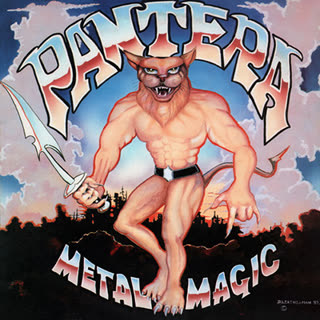
Main tuning: E Standard +15 ¢ (A ≈ 444), measured by TuneLit on the original LP.
The self-released debut features singer Terry Glaze and a 16-year-old Darrell Abbott, credited under his real name; he was billed as Diamond Darrell from Projects in the Jungle on and only became Dimebag in the 1990s. Community tabs read the whole record as plain E Standard. No source says anything about its pitch, and our measurement holds a surprise: the LP sits about 15 cents sharp. It is the only Pantera album above concert pitch.
With TuneLit: every Tune button opens E Standard at +15 ¢. The value comes from a needle drop, so if the record still sounds a touch off, nudge Fine-tune by ear instead of changing the tuning.
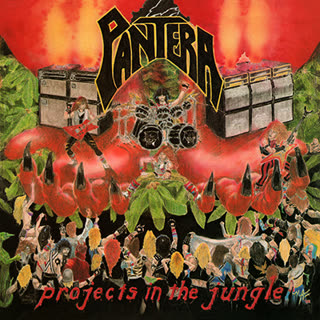
Main tuning: E Standard −35 ¢ (A ≈ 431), measured by TuneLit on the original LP.
Most songs, Like Fire for example, are tabbed in E Standard. Tabs assume concert pitch, but the LP sits about 35 cents flat. That is the earliest sign of Pantera's flat tuning, six years before Cowboys from Hell. The exception in the tabs comes first: every guitar part of the opener, All Over Tonight, is tabbed in Drop D.
With TuneLit: every button uses the album's −35 ¢. The All Over Tonight button gives Drop D (only the low string goes down to D); bring it back up to E for the rest.
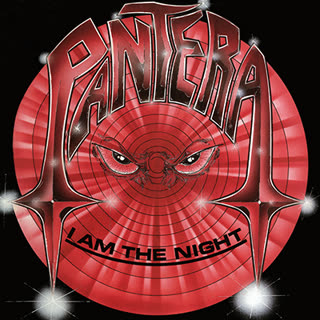
Main tuning: E Standard −36 ¢ (A ≈ 431), measured by TuneLit on the original LP.
The record sits about 36 cents flat, in line with Projects in the Jungle. Onward We Rock! measures lower, about 46 cents flat (A ≈ 429), so it gets its own setting. The short instrumental D*G*T*T*M is tabbed in Drop D, but only one hand-made transcription exists, so treat it as a good guess. Come-On Eyes mixes tunings: one guitar part is tabbed in Drop D and the other in E Standard. Its row stays on E Standard, so lower the low string to D yourself for the Drop D part.
With TuneLit: D*G*T*T*M opens Drop D at −36 ¢, Onward We Rock! opens E Standard at −46 ¢, and everything else is E Standard at −36 ¢.
Main tuning: E Standard −30 ¢ (A ≈ 432), measured by TuneLit on the CD and the original LP.
Phil Anselmo's first album with the band, and their heaviest of the 1980s, mixes glam, traditional and thrash metal. The main tabs put every song in E Standard, including the closer P*S*T*88. The sources only document Dime's flat tuning from Cowboys from Hell onward, so whether this album is flat too used to be an open question. It is: the CD and the LP both measure about 30 cents flat. Four songs differ, and both sources agree on them. The title track, Power Metal, sits right at concert pitch (−1 ¢). Down Below is lower, about 39 cents flat (A ≈ 430), while Over and Out and P*S*T*88 are higher, about 22 cents flat (A ≈ 435).
With TuneLit: every button opens E Standard at −30 ¢, except those four songs, which use their own measured values.
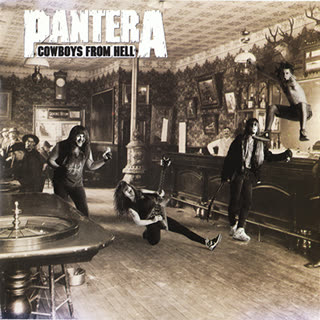
Main tuning: E Standard at A 435 (about 21 ¢ flat), measured by TuneLit on the CD. Sources say A 425.
The sources start Dime's 60-cent flat tuning here, but the CD measures only about 21 cents flat, so the Tune buttons use A 435 rather than 425. Most of the album is tabbed in E Standard. Dime himself named Primal Concrete Sledge as one of Pantera's Drop D songs. Guitar World adds that on this album the dropped string really sat at C♯ +40, Drop D plus his usual offset; on the CD the song measures about 25 cents flat instead, close to the rest of the album. Community tabs put Medicine Man in Drop D too.
Cemetery Gates shows why Pantera tabs disagree. The main tab is in E Standard and an alternate one is in E♭, because the record sits between the two. We measured it about 32 cents flat (A ≈ 432), lower than the rest of the album but still closer to E than to E♭, so E Standard at A 432 matches the record. Domination is tabbed in E as well.
With TuneLit: the Tune button gives "E Standard · A 435", and Cemetery Gates has its own "E Standard · A 432". For the Drop D songs, keep the reference at 435 and lower only the low string. TuneLit will call it D; a 440 tuner would say D −21.
Live: Domination opened their shows in 1990–91. From 1992 the band also played it as a medley with Hollow, the version heard on Official Live: 101 Proof (1997), and the medley's tab stays in E throughout.
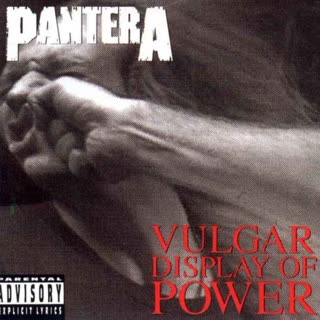
Main tuning: E Standard at A 426 (about D♯ +43 on a 440 tuner), measured by TuneLit on the CD, close to the widely reported A 425.
This is the album where the famous "60 cents flat" holds: the CD measures about 57 cents flat, A ≈ 426. Mouth for War, Fucking Hostile and Rise all stay in Dime's flat E. Dime used Mouth for War in his column to show Iommi-style power-chord slides. Tune it to A 426, or the riff will sound sharp against the record.
This is also where Pantera first went a whole step down. Dime wrote that the band tuned the whole guitar down a whole step (D G C F A D) for Walk. With his offset on top it sounds as C♯ +40, which is why Guitar World calls it a little more than a whole step down. Tabs of Walk in Drop D or E exist, but the documented tuning is D Standard. Guitar World names A New Level as the other early whole-step-down song, and the main tab agrees. No Good (Attack the Radical) is in Drop D, again named by Dime himself.
This Love used to be disputed. Its main tab is in E♭ Standard, other transcriptions use E, and Grady Champion lists E♭ Standard among Dime's real tunings. Our measurement leans toward the E♭ camp: This Love sits about 73 cents below E (A ≈ 422), some 15 cents lower than the rest of the album. Hollow, also tabbed in E♭, measures about 70 cents flat (A ≈ 422.5). Both land on the same pitch as E♭ tuned 27 to 30 cents sharp, so either way of thinking works once the reference is right. The tab of the live Domination and Hollow medley still stays in E.
With TuneLit: you need E Standard, D Standard and Drop D, all at A 426, plus E Standard at A 422 for This Love and A 423 for Hollow. A New Level and Walk are tracks 2 and 3, so stay in D for both.
Live: the Domination and Hollow medley on Official Live: 101 Proof stays in flat E throughout.
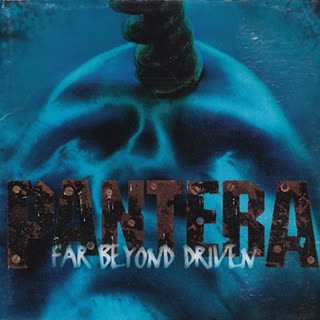
Main tuning: D Standard at A 429 (about 44 ¢ flat), measured by TuneLit on the CD. Sources say A 425.
A mixed album: as Dime explained in 1994, some tracks kept regular tuning and others went down to D. The default here is D Standard, the tuning of the best-documented songs: Becoming, 5 Minutes Alone and I'm Broken. The sources give it Dime's usual 60 cents, but the CD measures about 44 cents flat, so the default sits at A 429. Wikipedia places Becoming between C♯ and D, and our measurement agrees: about 49 cents flat, right in the middle. Wikipedia also says Dime built its riffs and solo around his first DigiTech Whammy pedal; the pitch-shifted sounds come from that pedal, not from a different tuning. Guitar World lists 5 Minutes Alone among his whole-step-down songs; C♯ versions probably exist because the record sounds between C♯ and D. I'm Broken has alternate tabs too, but the main tab and Guitar World both say D.
Five songs are tabbed in E Standard, which fits Dime's remark about regular tuning: Strength Beyond Strength, Good Friends and a Bottle of Pills, Slaughtered, 25 Years (a later, less-used tab is in D) and Shedding Skin. Most of them sit near the album value, but Shedding Skin measures about 66 cents flat (A ≈ 424). The Black Sabbath cover Planet Caravan is tabbed mainly in E♭ with an alternate in E, the same split as This Love. It measures about 63 cents below E (A ≈ 424), the same pitch as E♭ +37, so its button opens E Standard at A 424.
Hard Lines, Sunken Cheeks, the lowest song here, is in C♯ Standard according to Wikipedia and the community tab. It measures about 60 cents flat (A ≈ 425), right on Grady's figure. The measurement fixes the cents but not the semitone, so if it sounds a semitone low, try D at A 425, since a tab may have rounded C♯ +40 down. Use My Third Arm and Throes of Rejection are tabbed in D Standard, the album default.
With TuneLit: be ready to retune: E at A 429 for track 1, D for tracks 2–4, E for track 5, C♯ at A 425 for track 6, E for tracks 7–8, E at A 424 for Shedding Skin, D again for tracks 10–11 and E at A 424 for Planet Caravan. The Hard Lines bass tab needs a low G♯ string, so its entry also includes a 5-string bass tuned down 1½ steps at A 425.
Live: not measured. Start from the studio setting and adjust by ear.
Main tuning: D Standard at A 428 (about 50 ¢ flat, halfway between C♯ and D on a 440 tuner), measured by TuneLit on the CD. Sources say C♯ Standard at A 425.
This album is the clearest case of a record between two notes. Guitar World uses Drag the Waters as its example of Dime's down-1½-steps tuning, the community tabs put the title track and Drag the Waters in C♯, and War Nerve, Pt. II of Suicide Note and Living Through Me (Hells' Wrath) in D. The CD measures about 50 cents below D (A ≈ 428), right in the middle, so both names sound almost right. TuneLit lists the title track, War Nerve, Living Through Me and Floods in D, tuned 42 to 64 cents flat. The tabs' C♯ names the note below, a half step under the strings Dime actually used. So you do not retune around War Nerve after all: the whole album sits in one flat D, apart from the low-G closers and one song. That song is Drag the Waters, the one Guitar World chose for C♯. TuneLit's semitone check from the audio hears C♯ as its lowest open string: C♯ is its most common low note, and the C under it never sounds. With the tab saying C♯ too, Drag the Waters is listed in C♯ Standard at A 428, a half step below the rest. Suicide Note Pt. I is an acoustic piece that the community transcription plays on a 12-string in Drop D.
Floods sits lower than the rest, about 64 cents below D (A ≈ 424). Songsterr's original tab says C♯ Standard, later versions D Standard or Drop C (whose upper five strings match D Standard): a 440 tuner reads the record as C♯ +36. TuneLit lists it as D Standard at A 424, Dime's D about 60 cents flat. Earlier versions of this page listed it, and the whole album, a semitone too low.
The album closes with Pantera's lowest tuning. On The Underground in America and (Reprise) Sandblasted Skin, the guitar is in D Standard with the 6th string slackened to a low G, an octave below the 5th string. Wikipedia puts it at about A 425, and Metal Hammer also says Sandblasted Skin is tuned down to G. Tabs split by a semitone (G G C F A D on the main Sandblasted Skin tab, F♯ F♯ B E G♯ C♯ on the Underground in America tab). At the measured A 428 the low note sits about 50 cents below G, almost exactly halfway between G and F♯, which explains the split.
For bassists, community tabs of 10's and 13 Steps to Nowhere need a fifth string below the low D, which points to Rex Brown playing a 5-string bass down a whole step, A D G C F at A 428 (the tabs, written for C♯ guitars, call it G♯ C♯ F♯ B E). No interview confirms it, and Drag the Waters is tabbed on a 4-string.
With TuneLit: the default opens D Standard at A 428, Floods D Standard at A 424 and Drag the Waters C♯ Standard at A 428, and the album entry also lists the 5-string bass tuning. The last two tracks open a custom tuning, G1 G2 C3 F3 A3 D4 at A 428. That low G is seven semitones below D Standard's low D, so expect a very loose string.
Live: not measured. Start from the studio setting and adjust by ear.
Main tuning: D Standard at A 431 (about 38 ¢ flat), measured by TuneLit on the CD. Sources say A 425.
As Dime told Guitar World in early 2000, most of this album is a whole step down. The sources still give it his 60-cent offset, but the CD measures only about 38 cents flat. Two songs stand apart: Uplift is the least flat, at about 24 cents (A ≈ 434), and Yesterday Don't Mean Shit is lower, at about 46 cents (A ≈ 428). His column shows the bent-note opening riff of Revolution Is My Name in whole-step-down tuning; an alternate tab in C♯ exists, but at 38 cents flat the record sits closer to D. When he explained the whole-step power-chord bends in We'll Grind That Axe for a Long Time, he put the two lowest strings at D and G and said that his always-flat tuning, plus the whole step down, loosened the strings enough to help with those bends.
It Makes Them Disappear and I'll Cast a Shadow are tabbed in Drop C (C G C F A D), the lowest bottom string on the album; Guitar World notes that Dime sometimes used Drop D lowered by a whole step. Songsterr's main Hellbound tab is in C♯ Standard, while a little-viewed tab of a Hellbound and A New Level medley uses D. On its own the song measures about 54 cents below D (with low confidence), which a 440 tuner reads as C♯ +46: the same rounding that once put Floods in C♯. TuneLit's semitone check from the audio hears D as its lowest open string, and never the C♯ under it, so Hellbound is listed in D at A 431 like the rest of the album. If it sounds a half step high, its page still has a button for C♯. Goddamn Electric is disputed: the main tab, which also covers Kerry King's guest solo, is in C♯, but a solo transcription marked as correct is in D, and Dime used the song's verse slide in his whole-step-down lesson. It measures about 35 cents flat, closer to D than to C♯, and we list it in D. You've Got to Belong to It is tabbed in E Standard on Songsterr, which nothing else confirms.
With TuneLit: the default opens D Standard at A 431, with Uplift at A 434 and Yesterday Don't Mean Shit at A 428. For Drop C, lower only the 6th string one more whole step, from D to C.
Live: not measured. Start from the studio setting and adjust by ear.
TuneLit lab
What TuneLit measured
TuneLit's Match-a-recording estimator takes a stretch of each song, finds the strongest notes and compares them with the equal-tempered grid. That pins the offset down to a few cents, but only within one semitone, so the semitone itself (E, D or C♯) still comes from the tabs and sources above. That is a weak spot for Pantera: a record about 50 cents flat sits between two notes, and tabs name either one. A second check listens to the audio for the lowest open string. It is usually right, but on its own it is not proof, so it moved only two songs, each where a tab pointed the same way: Drag the Waters down to C♯ and Hellbound up to D.
We measured CD editions and needle drops of original LPs from our own library. The audio itself is never uploaded or published; only the numbers appear on this page.
Album
Sources said
TuneLit measured
Equivalent A
Metal Magic (1983)
not documented
+15 ¢ (LP)
A ≈ 444
Projects in the Jungle (1984)
not documented
−35 ¢ (LP)
A ≈ 431
I Am the Night (1985)
not documented
−36 ¢ (LP)
A ≈ 431
Power Metal (1988)
not documented
−30 ¢ (CD and LP)
A ≈ 432
Cowboys from Hell (1990)
−60 ¢
−21 ¢
A ≈ 435
Vulgar Display of Power (1992)
−60 ¢
−57 ¢
A ≈ 426
Far Beyond Driven (1994)
−60 ¢
−44 ¢ (D songs)
A ≈ 429
The Great Southern Trendkill (1996)
−60 ¢
−50 ¢
A ≈ 428
Reinventing the Steel (2000)
−60 ¢
−38 ¢
A ≈ 431
The biggest surprise is the start date. Sources tie the flat tuning to Cowboys from Hell, but the records were flat long before that. Only the 1983 debut is sharp. From Projects in the Jungle (1984) to Power Metal (1988), every album sits 30 to 36 cents below concert pitch, and on Power Metal the CD and the LP agree to within a cent. The one exception is the Power Metal title track, which sits right at concert pitch.
The second surprise is Cowboys from Hell itself. It measures only about 21 cents flat, far less than the 60 cents usually quoted. Cemetery Gates is lower, at about 32 cents (A ≈ 432).
Vulgar Display of Power is where Grady Champion's "60 cents flat" fits almost exactly. This Love and Hollow sit another 13 to 15 cents lower (A ≈ 422–423), which fits the tabs that put them in E♭. Far Beyond Driven and The Great Southern Trendkill sit around 45 to 65 cents flat: about 44 for the D-tuned songs on Far Beyond Driven, 60 to 66 for Shedding Skin, Planet Caravan and Hard Lines, Sunken Cheeks, and 64 for Floods. Reinventing the Steel comes back up to about 38, with Uplift at 24 and Yesterday Don't Mean Shit at 46. So "A 425" describes Vulgar and parts of Far Beyond Driven and Trendkill, not the whole catalog.
Keep a few limits in mind. A turntable that runs 0.3 % fast or slow moves a needle drop by about 5 cents, so the first three albums, measured from LPs only, may sit a few cents off. Heavily distorted mixes are harder to read than clean ones, so single songs scatter; most songs therefore use their album's value, and only clear outliers get their own. Anything within ±4 ¢ counts as concert pitch. And a measurement hears the result, not the cause: it cannot tell a low-tuned guitar from a slow tape.
You do not need to type any of these numbers. Every song's Tune button already uses the measured value, so tap it and play.
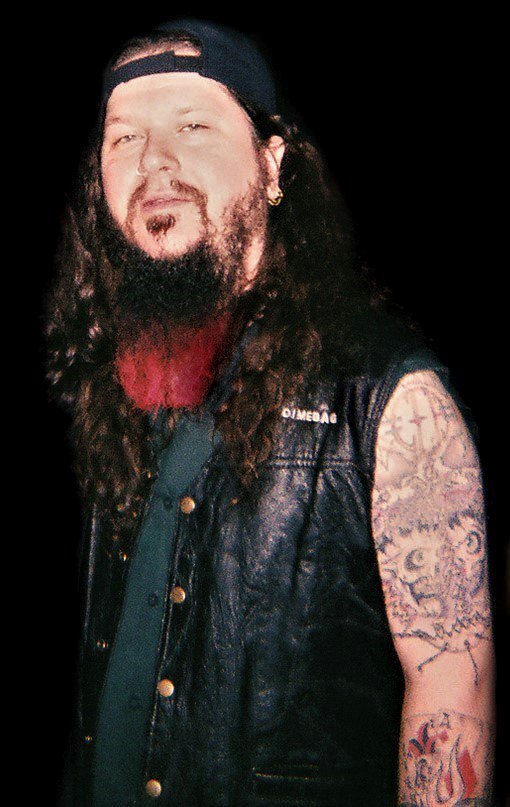
Dimebag Darrell in 2004, the year he died.Photo: April Ashford-Forsythe · CC BY 2.0 · credits
Evidence
How sure are these numbers?
Every tuning on the album pages carries a status label. Every guitar entry on this page now carries Measured by TuneLit, because its offset comes from our own analysis of a CD or an original LP. The tuning name (E, D, C♯, Drop D) still rests on the other kinds of evidence, since a measurement only knows the offset within one semitone:
Official: the musician said it himself, here in Dime's Guitar World columns or his 1994 interview, as with Walk or Primal Concrete Sledge.
Widely reported: trusted outlets such as Guitar World, Wikipedia or Metal Hammer agree, usually backed by tabs, but the band did not say it directly. Before we measured it, Cowboys from Hell sat here: the offset came from Dime's tech, the E Standard from press and tabs.
Community: from community transcriptions, mostly Songsterr tabs. Tabs name tunings in whole semitones, so with Pantera's offset they can land a half step away. The tunings of all four 1980s albums rest on tabs at this level.
Disputed: the sources disagree. We show the most likely setting and explain the other option. For Pantera: This Love, Planet Caravan, Floods and Goddamn Electric.
Measured by TuneLit: our own pitch analysis of an original recording, giving the offset in cents. Only the result is published; the audio is never stored or shared.
If a song still sounds a touch off, move the reference a hertz or two; near 430 Hz, one hertz is about 4 cents.
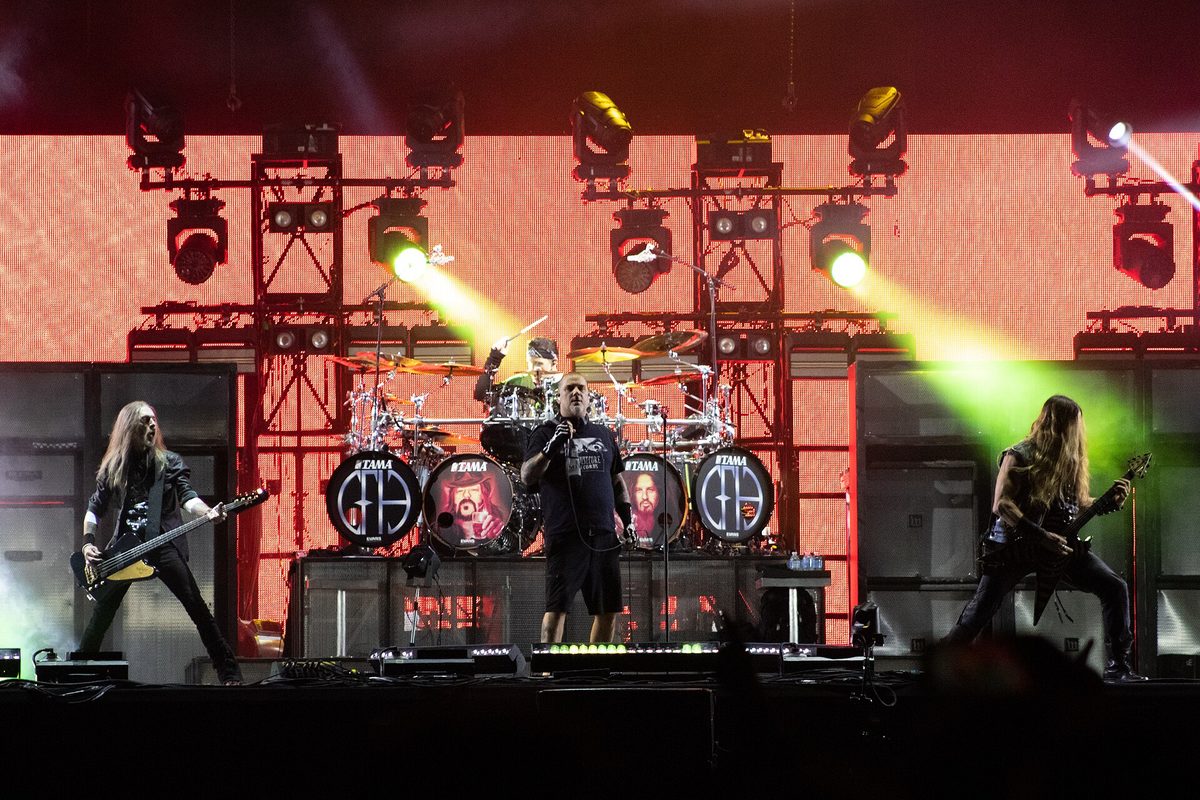
Pantera at their reunion show in Mexico, December 2022, with Zakk Wylde on guitar and Charlie Benante on drums alongside Phil Anselmo and Rex Brown.Photo: DiegoVigueras · CC BY-SA 4.0 · credits
Cheat sheet
Quick reference
Metal Magic (1983): E Standard +15 ¢ (A ≈ 444).
Projects in the Jungle to Power Metal (1984–1988): E Standard about 30–36 ¢ flat (A ≈ 431–432). Drop D: All Over Tonight, D*G*T*T*M, one guitar part of Come-On Eyes. Own values: Onward We Rock! (A ≈ 429), the Power Metal title track (A 440), Down Below on Power Metal (A ≈ 430), Over and Out and P*S*T*88 (A ≈ 435).
Cowboys from Hell (1990): E Standard at A 435; Cemetery Gates at A 432. Drop D at A 435: Primal Concrete Sledge, Medicine Man.
Vulgar Display of Power (1992): E Standard at A 426. D Standard: A New Level, Walk. Drop D: No Good (Attack the Radical). Tabbed in E♭: This Love and Hollow, set as E Standard at A 422 and A 423.
Far Beyond Driven (1994): D Standard at A 429: Becoming, 5 Minutes Alone, I'm Broken, Use My Third Arm, Throes of Rejection. E Standard at A 429: Strength Beyond Strength, Good Friends and a Bottle of Pills, Slaughtered, 25 Years. E Standard at A 424: Shedding Skin, Planet Caravan (disputed). C♯ Standard at A 425: Hard Lines, Sunken Cheeks.
The Great Southern Trendkill (1996): D Standard at A 428, tabbed as C♯. Floods: D Standard at A 424. Drag the Waters: C♯ Standard at A 428. Drop D: Suicide Note Pt. I. Low G (G G C F A D): The Underground in America, (Reprise) Sandblasted Skin. Bass: 5-string A D G C F.
Reinventing the Steel (2000): D Standard at A 431; Uplift at A 434; Yesterday Don't Mean Shit at A 428. Drop C: It Makes Them Disappear, I'll Cast a Shadow. Tabbed in C♯ but listed in D: Hellbound. Disputed: Goddamn Electric (listed in D). Tabbed in E: You've Got to Belong to It.
Golden rule: from 1984 on, check the album's A value before you change anything else. Nearly everything is flat from then on, but not always by the same amount.
Questions
What tuning does Pantera use?
Mostly E Standard: 6 of 9 albums. Far Beyond Driven, The Great Southern Trendkill and Reinventing the Steel are in D Standard. Many albums also have songs in other tunings, and the album pages list them song by song.
Why does Pantera sound out of tune when I play along?
Some records are not at concert pitch. Vulgar Display of Power sits about 57 cents flat (A 426); The Great Southern Trendkill sits about 50 cents flat (A 428); Far Beyond Driven sits about 44 cents flat (A 429). A guitar tuned to A 440 clashes with them. Every Tune button on these pages sets the measured pitch for you.
How did TuneLit measure Pantera's records?
We played original CDs and LPs through TuneLit's pitch analysis: the strongest notes of each song are compared with the A 440 grid, which gives the offset in cents. That cannot tell the semitone, so the tuning name comes from interviews, the press and tabs, and for 2 songs from TuneLit's semitone check from the audio, backed by a tab or source. The audio is never stored or published.
Background
Menu
Install the app
Android (Chrome): menu ⋮ → Install app or Add to Home screen.
Computer (Chrome, Edge): the install icon at the right end of the address bar.
iPhone: Safari → Share → Add to Home Screen.
It opens full screen and keeps tuning with no connection.