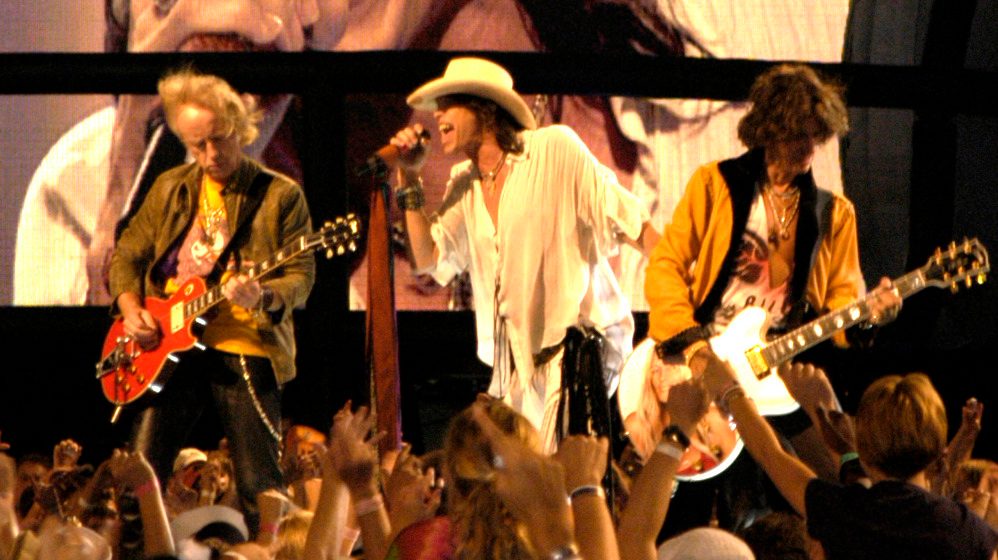
Brad Whitford, Steven Tyler and Joe Perry (left to right) playing the NFL Kickoff concert on the National Mall, Washington, D.C., 4 September 2003.
In short
How Aerosmith tunes
Aerosmith played almost everything in E Standard. The big exception is Rocks (1976), where the tabs put seven of nine songs a half step down in E♭ Standard; TuneLit's audio check agrees, and also confirms that Sick as a Dog, the song Tom Hamilton played on guitar, stays in E.
Read more
Drop D turns up on single songs from Make It (1973) to Livin' on the Edge and three Just Push Play tracks, Joe Perry plays a few songs in open tunings of his own (No More No More, Draw the Line, Let the Music Do the Talking, Monkey on My Back), and Janie's Got a Gun is tuned a half step up. TuneLit measured an early CD of every studio album. The 1973 debut runs about 14 cents sharp (A ≈ 443.6), Get Your Wings and Night in the Ruts about 10 cents flat, and the other 1970s albums move a little from song to song: Sick as a Dog sits about 28 cents sharp. From Done with Mirrors (1985) on, the records sit within about 5 cents of A 440, apart from a few songs such as Angel (+25 ¢) and What It Takes (−34 ¢).
What tuning does Aerosmith use? Mostly plain E Standard, the tuning on your guitar when it comes out of the case. Joe Perry and Brad Whitford built fifty years of riffs on it, from Mama Kin to Legendary Child. The exceptions are what make this band interesting to play along with: an entire album a half step down (Rocks), a handful of Drop D songs, slide parts in open tunings, and 1970s records whose pitch moves a little from song to song, so a guitar tuned perfectly to A 440 can sound slightly sour next to them.
This page goes through every Aerosmith studio album, from the 1973 debut to Music from Another Dimension! in 2012, plus the 2025 EP with Yungblud, with the tuning of each song. The album list above opens every album, and each song there has its own Tune button: one tap opens the TuneLit tuner already set to that tuning, including the small offset the record needs. TuneLit measured that offset on CDs from our own library, one early pressing per album. Below: how the tuning changed over the years, a section for each album, what we measured and how sure each number is.
The story
How Aerosmith tuned, era by era
1973–1977: E Standard, at a pitch that moves. The first five albums are built on E Standard (E A D G B E), with Tom Hamilton's bass tuned to match. The odd songs out are few: Make It on the debut drops its low string to D, Joe Perry plays No More No More and the Draw the Line title track in open tunings of his own, and Rocks goes a half step down. What the tabs cannot tell you is where the records actually sit. TuneLit measured an early CD of every album, and the 1970s results move around: the debut runs about 14 cents sharp, Get Your Wings is split between songs about 5 cents sharp and songs 8 to 18 cents flat, and Toys in the Attic has its title track 9 cents sharp and Sweet Emotion 13 cents flat. Where the reference A matters, the Tune buttons set it for you.
1976: Rocks, a half step down. Rocks is the one Aerosmith album the tabs put almost entirely in E♭ Standard: seven of nine songs, from Back in the Saddle to Lick and a Promise. The exceptions are Sick as a Dog, which Tom Hamilton wrote and played on guitar while Joe Perry took the bass, and the closing ballad Home Tonight. TuneLit's semitone check from the audio confirms E♭ wherever the open low string is played, and E on Sick as a Dog, which is also the sharpest song we measured, about 28 cents above A 440.
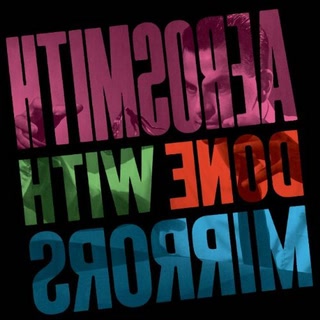
1979–1985: line-up changes, same tuning. Joe Perry left during the Night in the Ruts sessions and Brad Whitford soon after, so Rock in a Hard Place was made with Jimmy Crespo on guitar. The tabs keep both albums in E Standard. Night in the Ruts measures about 10 cents flat, like most of Get Your Wings. Perry and Whitford came back for Done with Mirrors in 1985, which sits right at concert pitch, and Perry brought along the open G riff of Let the Music Do the Talking from his solo years.
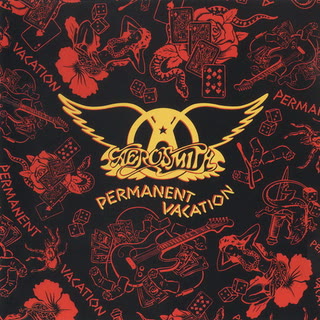
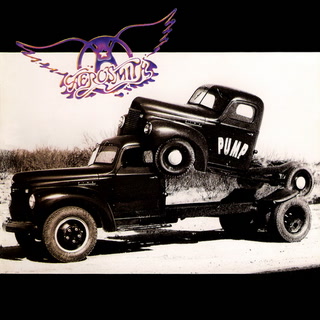
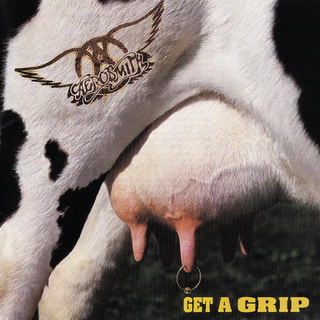
1987–1993: the Fairbairn albums. With producer Bruce Fairbairn, Permanent Vacation, Pump and Get a Grip sit within a few cents of A 440. Drop D appears more often (Hangman Jury, St. John, Livin' on the Edge), Joe Perry's slide turns up on lap steel in Rag Doll and in open A on Monkey on My Back, Janie's Got a Gun goes a half step up instead of down, and two big singles sit away from their albums: Angel about 25 cents sharp and What It Takes about 34 cents flat.
1997–2012: concert pitch. Nine Lives, Just Push Play, the blues covers of Honkin' on Bobo and Music from Another Dimension! all measure within about 5 cents of concert pitch. Drop D now serves the heavier songs (Attitude Adjustment, Beyond Beautiful, Just Push Play, Under My Skin). Two slide songs on Honkin' on Bobo, Back Back Train and Jesus Is on the Main Line, hardly touch the open low E, and nobody has published a reliable tab of either.
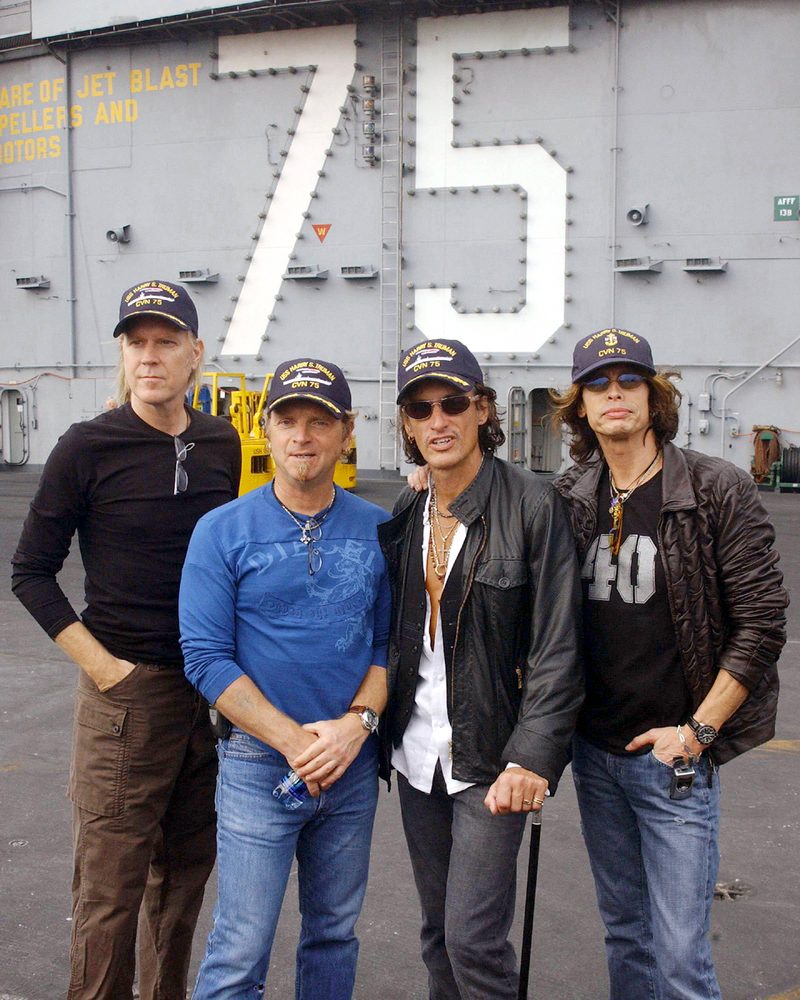
Tom Hamilton, Joey Kramer, Joe Perry and Steven Tyler (left to right) aboard the aircraft carrier USS Harry S. Truman at Norfolk, Virginia, 9 October 2002.
Main tuning: E Standard +14 ¢ (A ≈ 443.6), measured by TuneLit on the CD.
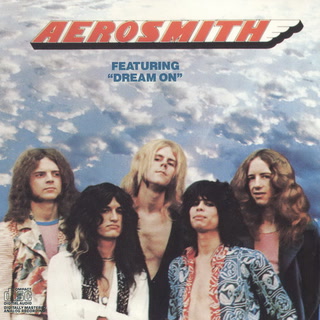
The debut was cut in Boston in October 1972 with producer Adrian Barber, and the tabs put it in plain E Standard: Mama Kin, Movin' Out, Walkin' the Dog and Dream On all start from a normal guitar. Dream On is in F minor, so its open low E hardly ever sounds. The surprise is the pitch. The CD sits about 14 cents sharp, and the songs agree with each other closely, from about 10 to 17 cents sharp, with Dream On at the top. A guitar tuned to A 440 sounds noticeably flat against this record, so this is the Aerosmith album where setting the reference A matters most.
The opener Make It is tabbed in Drop D, and TuneLit's audio check agrees that D is its lowest open string. Its pitch is another matter: our readings are uncertain and sit well below the rest of the album, so its button keeps the album's +14 ¢. If it sounds sharp against you, lower the reference a few hertz.
Main tuning: E Standard about 10 ¢ flat (A ≈ 437.4), measured by TuneLit on the CD, with three songs about 5 ¢ sharp.
The first album with producer Jack Douglas, recorded at the Record Plant in New York. Every song is tabbed in E Standard. Session guitarists Steve Hunter and Dick Wagner play the leads on Train Kept A Rollin' (Hunter the first, Wagner the second), and Wagner also plays on Same Old Song and Dance. Seasons of Wither is the one question mark. Steven Tyler wrote it on a discarded acoustic strung with only four strings, in a tuning he thought he had invented, and he plays the acoustic on the record. The tabs play it in standard, with the 12-string parts in Drop D in one of them, and TuneLit's audio check cannot confirm the open low E: the record's low notes centre on D and G. Treat the standard tab as an approximation.
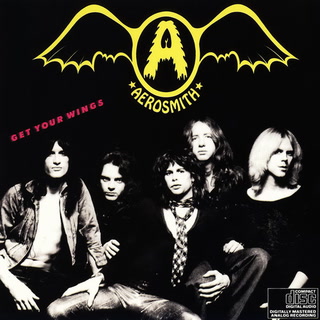
The measurement splits the album in two. Same Old Song and Dance, Spaced and Woman of the World sit about 5 cents sharp; S.O.S. (Too Bad), Train Kept A Rollin', Pandora's Box and Lord of the Thighs sit 8 to 18 cents flat, which sets the album value at about 10 cents flat. The Japanese CD shows exactly the same pattern, so it is in the tapes. One fan tab suggests the band tuned Lord of the Thighs down; its notes match the record in standard tuning, just a little flat.
Main tuning: E Standard at concert pitch (−4 ¢), measured by TuneLit on the CD.
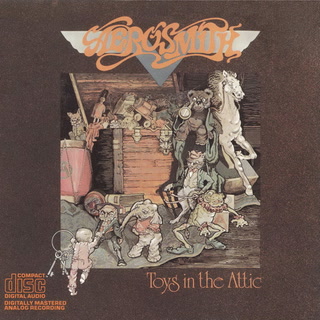
The breakthrough album, again with Jack Douglas at the Record Plant. Nearly every song is tabbed in E Standard, including Walk This Way and Sweet Emotion, two of the most-played Aerosmith tabs anywhere. Perry has said the Walk This Way riff moves from the key of C to E and back, all in standard tuning. On Sweet Emotion he plays the talk box line over Tom Hamilton's bass riff, and on Uncle Salty Hamilton plays rhythm guitar as well. No More No More is the exception: Guitar World and Perry's own gear list put it in his E5 tuning, E B E E B E, on a Telecaster kept for that song. Two strings go up a whole step and the 3rd string drops to E, so every string is an E or a B; the Songsterr tab plays it in standard instead.
The CD sits a few cents flat overall, but two songs stand apart: the title track about 9 cents sharp (A ≈ 442.3) and Sweet Emotion about 13 cents flat (A ≈ 436.7).
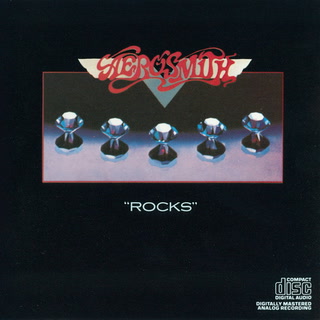
Main tuning: E♭ Standard at concert pitch (+2 ¢), measured by TuneLit on the CD.
Rocks is Aerosmith's half-step-down album. Seven of its nine songs are tabbed in E♭ Standard (E♭ A♭ D♭ G♭ B♭ E♭), from Back in the Saddle and Last Child to Nobody's Fault and Lick and a Promise, and TuneLit's semitone check from the audio confirms E♭ on five of them; on Rats in the Cellar and Get the Lead Out the riffs rarely touch the open low string, so the check has little to go on, but the tabs' notes match the record. The backing tracks were cut in the band's own rehearsal room, the Wherehouse, with the Record Plant's mobile truck, and finished at the Record Plant in New York. Back in the Saddle opens with Joe Perry's riff on a Fender Bass VI, a six-string bass tuned an octave below a guitar; the popular tab arranges that part for a normal guitar, also in E♭.
The two songs in E Standard have a story. Sick as a Dog was written by Tom Hamilton on guitar; he plays guitar on the record while Perry plays bass. It is also the sharpest song we measured anywhere in the catalogue, about 28 cents above A 440 (A ≈ 447), and the audio check confirms E as its lowest string. Home Tonight, the closing ballad with Tyler on piano and Perry on lap steel, is tabbed in E Standard; its tab hardly ever uses the open low string, so the audio cannot settle the semitone, but the tab's notes match the record.
The E♭ songs scatter around concert pitch: Combination about 15 cents sharp, Last Child about 8 and Lick and a Promise about 10 cents flat, the rest within a few cents of A 440.
Main tuning: E Standard about 4 ¢ sharp (effectively A 440), measured by TuneLit on the CD.
Recorded with Jack Douglas in an abandoned convent outside New York, the Cenacle, and finished at the Record Plant. Most songs are tabbed in E Standard. The title track is the exception. Perry has said he wrote it in an open tuning, deliberately played against the usual Keith Richards moves and adjusted to his taste, and Guitar World spells it out: open A on a Dan Armstrong guitar, with the 6th string dropped all the way to a low A (A A E A C♯ E). TuneLit's audio check agrees that low A is the bottom string. Fan tabs vary, and the popular Songsterr tab stays in standard, but if you want the growl of the record, this is the tuning. Get It Up is slide all the way and also centres on A. Kings and Queens adds Jack Douglas on mandolin and Paul Prestopino on banjo guitar, with Brad Whitford on lead; Perry sings Bright Light Fright and plays slide on the Kokomo Arnold cover Milk Cow Blues.
The CD measures about 4 cents sharp, effectively concert pitch, with I Wanna Know Why about 7 cents flat and The Hand That Feeds about 14 cents sharp (A ≈ 443.5).
Main tuning: E Standard about 10 ¢ flat (A ≈ 437.5), measured by TuneLit on the CD.
Joe Perry left in 1979 with his parts finished on six songs, and Brad Whitford, Richie Supa, Neil Thompson and the new man Jimmy Crespo covered the rest; Crespo's first Aerosmith solo is on Three Mile Smile. The tabs keep everything in E Standard, including the covers Remember (Walking in the Sand) and the Yardbirds' Think About It. Cheese Cake is Perry's slide feature, and no tab names its tuning; it centres on A, so open A is worth a try, but that is our guess. The CD sits about 10 cents flat and the songs agree with each other, except Mia, Steven Tyler's piano lullaby, at about 4 cents sharp.
Main tuning: E Standard at concert pitch (+4 ¢), measured by TuneLit on the CD.
Jimmy Crespo plays nearly all the guitars; Whitford appears only on Lightning Strikes, and Rick Dufay is credited but joined after the sessions. The few tabs are in E Standard. Two fan tabs claim otherwise and the record does not back them: Bitch's Brew measures at the album's pitch with E as its lowest string, and Push Comes to Shove, a piano song in D♭, needs no C♯ tuning, since standard with barre chords plays the same notes. The title track sits about 11 cents flat.
Main tuning: E Standard at concert pitch, measured by TuneLit on the CD.
The reunion album, produced by Ted Templeman. Most songs are tabbed in E Standard and the CD measures right at A 440. The exception is the opener, first the title song of the Joe Perry Project's 1980 album. Perry has said he wrote and played that riff in the open "Robert Johnson" tuning, G or A, with a bass string fitted on the guitar an octave below the 5th string. The song is in G, so that means G G D G B D, and G is by far the most common low note on the record. The popular Songsterr tab plays it in standard, so we mark it disputed; plain open G (D G D G B D) is a good substitute. She's on Fire opens with slide over low notes on D, with no reliable tab. Darkness closes the CD and cassette; the original US LP ends with The Hop.
Main tuning: E Standard at concert pitch (+3 ¢), measured by TuneLit on the CD.
The comeback, produced by Bruce Fairbairn in Vancouver with outside writers such as Desmond Child and Jim Vallance. The tabs keep the album in E Standard, and the official bass transcription of Dude (Looks Like a Lady) is in standard tuning too. St. John and Hangman Jury, whose riff came to Perry on an old Silvertone guitar, drop the 6th string to D, and the audio check agrees on both. On Rag Doll, Whitford's rhythm part is in E Standard while Perry's slide is a lap steel tuned to an E chord (E B E G♯ B E). Angel stands apart at about 25 cents sharp (A ≈ 446). The ballad is in E♭ major; its tabs play the electric parts in E Standard and the acoustic intro in E♭ Standard, and the electric part hardly ever uses the open low E, so either works once the reference is set.
Main tuning: E Standard at concert pitch, measured by TuneLit on the CD.
Fairbairn's second Aerosmith album links songs with short instrumental pieces: the spoken Going Down, Water Song on glass harmonica, Dulcimer Stomp and Hoodoo on a Thai khaen. Most songs are in E Standard; the official bass transcription of Love in an Elevator confirms it for that one. Three songs need something else.
Janie's Got a Gun goes up, not down. Joe Perry tunes the whole guitar up a half step, to F B♭ E♭ A♭ C F, so the open strings ring in the song's key of F, and the official bass transcription tunes a 5-string bass up a half step as well. The popular Songsterr tab writes it in E Standard, but its notes sit a half step above the record, and TuneLit's audio check agrees with the F tuning, measured about 12 cents flat (A ≈ 437). Monkey on My Back is Perry's showcase for his Ozark slide guitar, which his 2014 gear list shows in open A (E A E A C♯ E); a fan tab agrees, and the low-string riff fingers the same in standard. On F.I.N.E., Whitford plays in standard, and one fan tab puts Perry's slide in open A with an extra-low A string.
What It Takes is the surprise: about 34 cents flat (A ≈ 431), a third of a semitone below the rest of the album. Its tab barely touches the 6th string, so tune by the reference rather than by ear on the open E.
Main tuning: E Standard at concert pitch, measured by TuneLit on the CD.
The third Bruce Fairbairn album stays in E Standard for almost everything: Eat the Rich, Cryin', Crazy, Amazing and the album tracks are all tabbed that way. The CD measures right on A 440 and no song strays more than about 7 cents, which makes this the easiest Aerosmith album to play along with. The exception is Livin' on the Edge, which Guitar World says was recorded in Drop D; the tabs and the audio check agree. Joe Perry sings Walk On Down, and the short Intro has nothing to tune to.
Main tuning: E Standard at concert pitch, measured by TuneLit on the CD.
After shelving the first sessions with Glen Ballard, the band re-recorded the album with Kevin Shirley. The tabs keep it in E Standard, with Attitude Adjustment in Drop D (the audio check agrees); one slide part in the Pink tab uses open G. The CD sits at concert pitch, except The Farm, about 13 cents flat, and Kiss Your Past Good-Bye, about 12 cents flat, which get their own setting.
Main tuning: E Standard about 5 ¢ sharp (A ≈ 441.3), measured by TuneLit on the CD.
Self-produced with Marti Frederiksen and Mark Hudson, and the album that leans most on Drop D: Beyond Beautiful, the title track and Under My Skin all drop the 6th string, and the audio check agrees on all three. Jaded and the rest are in E Standard. Our one reading of the title track is about 21 cents below the album at low confidence, so its button keeps the album value; if it sounds flat against you, try A 436. One guitar part in the Trip Hoppin' tab lowers only the 6th string to E♭, and the audio check hears E♭ as that song's lowest note too. Joe Perry sings Drop Dead Gorgeous.
Main tuning: E Standard about 4 ¢ sharp (A ≈ 441), measured by TuneLit on the CD.
Blues covers plus one new song, The Grind, recorded at Joe Perry's place near Boston with Jack Douglas producing again. The few human-made tabs (Road Runner, Baby, Please Don't Go, The Grind) are in E Standard. Perry told Vintage Guitar he played several songs without a pick, Jesus Is on the Main Line with fingerpicks, and overdubbed the slide answers on You Gotta Move. Two slide songs have no reliable tab at all. Back Back Train, sung by Perry and about 15 cents sharp, sits on C, and Jesus Is on the Main Line drones on E♭ from start to finish; in both the open low E hardly ever sounds, and the lowest notes we hear could come from the bass. A slide tuning built on the song's key is possible, but nobody has documented one, so use the button for the pitch and find the tuning by ear.
Main tuning: E Standard at concert pitch, measured by TuneLit on the CD.
The last studio album so far, with Jack Douglas. The few tabs are in E Standard and the CD sits at concert pitch, with three exceptions: Beautiful about 13 cents flat, Legendary Child about 11 cents sharp and Street Jesus about 14 cents sharp. Legendary Child dates from the 1991 Get a Grip sessions and was reworked for this album. Joe Perry sings Freedom Fighter and Something, and Can't Stop Lovin' You is a duet with Carrie Underwood.
One More Time (EP, 2025)
Five songs with Yungblud, not in our library and so not measured. The tabs of the new songs are in E Standard; the closing remix of Back in the Saddle keeps the E♭ tuning of Rocks.
TuneLit lab
What TuneLit measured
TuneLit's Match-a-recording estimator takes 90 seconds of each song, finds the strongest notes and compares them with the equal-tempered grid around A 440. That pins the offset down to a few cents, but only within one semitone, so the tuning name (E Standard, E♭, Drop D) still comes from the tabs and sources above. A second check listens for the lowest open string. It agreed with the sources on 125 songs, including the E♭ songs of Rocks, every Drop D song, the open tunings and Janie's Got a Gun a half step up. Five of the six songs where it disagreed have tabs that rarely or never play the open low string, a known weak spot of the method; the sixth, Trip Hoppin', has one guitar part with its 6th string lowered to E♭. It moved no song on its own.
We measured one early CD of every studio album from our own library: the 1987 Columbia CDs of the 1970s albums, a 1991 Austrian CD of Night in the Ruts, and first Geffen and Columbia CDs of the later albums. For the five albums from 1973 to 1977 we also measured the Japanese CBS/Sony CDs of 1987–88: every song agreed with the US CD within 2 cents, so the offsets below are in the master tapes, not in one CD transfer. The audio itself is never uploaded or published; only the numbers appear on this page.
Album
Sources said
TuneLit measured
Equivalent A
Aerosmith (1973)
E Standard
+14 ¢
A ≈ 443.6
Get Your Wings (1974)
E Standard
−10 ¢ (three songs +5 ¢)
A ≈ 437.4
Toys in the Attic (1975)
E Standard
−4 ¢ (title track +9, Sweet Emotion −13)
A 440
Rocks (1976)
E♭ Standard
+2 ¢ (Sick as a Dog, in E, +28)
A 440
Draw the Line (1977)
E Standard
+4 ¢
A ≈ 441
Night in the Ruts (1979)
E Standard
−10 ¢
A ≈ 437.5
Rock in a Hard Place (1982)
E Standard
+4 ¢
A 440
Done with Mirrors (1985)
E Standard
−3 ¢
A 440
Permanent Vacation (1987)
E Standard
+3 ¢ (Angel +25)
A 440
Pump (1989)
E Standard
0 ¢ (What It Takes −34)
A 440
Get a Grip (1993)
E Standard
0 ¢
A 440
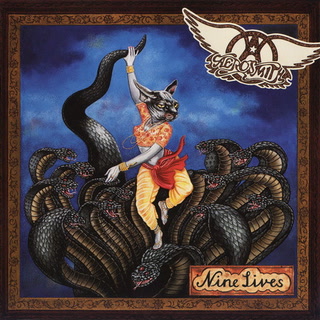
Nine Lives (1997)
E Standard
+1 ¢
A 440
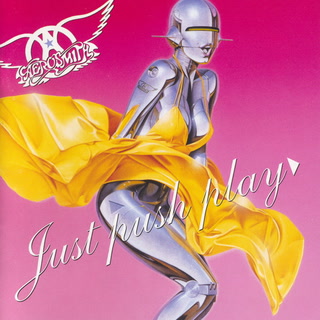
Just Push Play (2001)
E Standard
+5 ¢
A ≈ 441.3
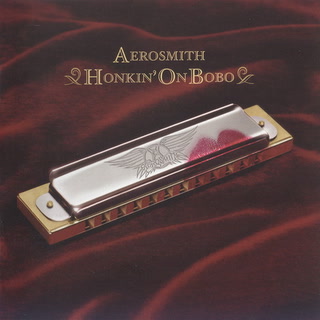
Honkin' on Bobo (2004)
E Standard
+4 ¢
A ≈ 441
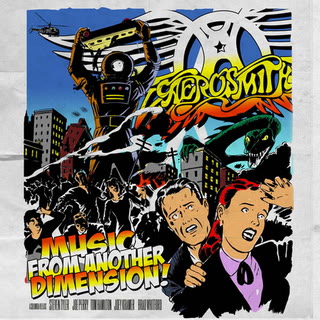
Music from Another Dimension! (2012)
E Standard
+1 ¢
A 440
The headline is how close to concert pitch Aerosmith usually is: twelve of the fifteen albums sit within about 5 cents of A 440. The exceptions are all from the 1970s. The debut is the only clearly sharp album, at about 14 cents, and its songs agree with each other, so it is the album where setting the reference A matters most. Get Your Wings and Night in the Ruts sit about 10 cents flat.
On the 1970s albums the pitch also changes from song to song, by up to 28 cents on Rocks. A measurement cannot tell whether a tape machine ran a little fast, a song was recorded on another day, or the band tuned to an instrument that was off, and no source we found explains it. From 1987 on, only a few songs stand apart: Angel at +25 cents, What It Takes at −34, and 11 to 15 cents on Janie's Got a Gun, The Farm, Kiss Your Past Good-Bye, Back Back Train, Beautiful, Legendary Child and Street Jesus.
Keep a few limits in mind. Dense mixes are harder to read, so single songs scatter a little; most songs therefore use their album's value, and only clear outliers (8 cents or more, measured with good confidence) get their own. Anything within ±4 ¢ counts as concert pitch. A few readings were too uncertain to use, such as Make It and the Just Push Play title track; their song notes say what we found. You do not need to type any of these numbers: every Tune button already uses the measured value.
Aerosmith guitarist Brad Whitford playing a Les Paul in 2025.
Evidence
How sure are these numbers?
Every tuning on the album pages carries a status label.
Official: the band or its crew described the tuning. For Aerosmith this is rare; Janie's Got a Gun, from Joe Perry's own words and the official bass transcription, is the clearest case.
Widely reported: several independent sources agree, as with Rocks in E♭, where the human-made tabs on two sites agree, or the open tunings of Draw the Line and No More No More, which a Guitar World lesson and Perry's gear lists describe.
Community: the tuning comes from tabs made by players, mostly on Songsterr. Most Aerosmith songs are at this level. Tabs generated by software rather than written by people did not count.
Disputed: sources disagree; we show the reading with the most support and explain the other, as with Seasons of Wither, Let the Music Do the Talking and Angel.
Measured by TuneLit: our own pitch analysis of an original CD. Every album in our library carries this label; the tuning name still rests on the sources, because a measurement only fixes the offset within one semitone.
If a record still sounds a hair off after you tap Tune, move Fine-tune a few cents and let your ears decide.
Cheat sheet
Quick reference
Aerosmith (1973): E Standard +14 ¢ (A ≈ 443.6). Drop D: Make It.
Get Your Wings (1974): E Standard −10 ¢ (A ≈ 437.4); Same Old Song and Dance, Spaced and Woman of the World +5 ¢. Seasons of Wither: tabbed in standard, written in Tyler's own tuning (disputed).
Toys in the Attic (1975): E Standard at A 440; the title track +9 ¢, Sweet Emotion −13 ¢. No More No More: Perry's E5 tuning, E B E E B E.
Rocks (1976): E♭ Standard at A 440 (+2 ¢); Combination +15 ¢, Last Child −8 ¢, Lick and a Promise −10 ¢. E Standard: Sick as a Dog (+28 ¢, A ≈ 447) and Home Tonight (−8 ¢).
Draw the Line (1977): E Standard +4 ¢; I Wanna Know Why −7 ¢, The Hand That Feeds +14 ¢. Draw the Line: open A with a low A string, A A E A C♯ E.
Night in the Ruts (1979): E Standard −10 ¢ (A ≈ 437.5); Mia +4 ¢.
Rock in a Hard Place (1982): E Standard +4 ¢; the title track −11 ¢.
Done with Mirrors (1985): E Standard at A 440. Open G with a low G string (G G D G B D): Let the Music Do the Talking.
Permanent Vacation (1987): E Standard at A 440; Angel +25 ¢. Drop D: St. John, Hangman Jury. Lap steel in open E on Rag Doll.
Pump (1989): E Standard at A 440. Janie's Got a Gun: F Standard, a half step up, at A 437. Monkey on My Back: open A. What It Takes: A 431.
Get a Grip (1993): E Standard at A 440. Drop D: Livin' on the Edge.
Nine Lives (1997): E Standard at A 440; The Farm −13 ¢, Kiss Your Past Good-Bye −12 ¢. Drop D: Attitude Adjustment.
Just Push Play (2001): E Standard +5 ¢. Drop D: Beyond Beautiful, Just Push Play, Under My Skin.
Honkin' on Bobo (2004): E Standard +4 ¢; Back Back Train +15 ¢. Back Back Train and Jesus Is on the Main Line: slide, tuning undocumented (find it by ear).
Music from Another Dimension! (2012): E Standard at A 440; Beautiful −13 ¢, Legendary Child +11 ¢, Street Jesus +14 ¢.
One More Time (2025): E Standard (not measured); the Back in the Saddle remix in E♭.
Golden rule: for the 1970s albums, set the reference A before anything else; from 1985 on, the albums sit at concert pitch and only a few songs need their own setting.
Questions
What tuning does Aerosmith use?
Mostly E Standard: 15 of 16 albums. Rocks is in E♭ Standard. Many albums also have songs in other tunings, and the album pages list them song by song.
Why does Aerosmith sound out of tune when I play along?
Some records are not at concert pitch. Aerosmith sits about 14 cents sharp (A ≈ 444); Get Your Wings sits about 10 cents flat (A ≈ 437); Night in the Ruts sits about 10 cents flat (A ≈ 437). A guitar tuned to A 440 clashes with them. Every Tune button on these pages sets the measured pitch for you.
How did TuneLit measure Aerosmith's records?
We played original CDs and LPs through TuneLit's pitch analysis: the strongest notes of each song are compared with the A 440 grid, which gives the offset in cents. That cannot tell the semitone, so the tuning name comes from interviews, the press and tabs. The audio is never stored or published.
Colors and font
Font
Colors
Menu
Install the app
Android (Chrome): menu ⋮ → Install app or Add to Home screen.
Computer (Chrome, Edge): the install icon at the right end of the address bar.
iPhone: Safari → Share → Add to Home Screen.
It opens full screen and keeps tuning with no connection.