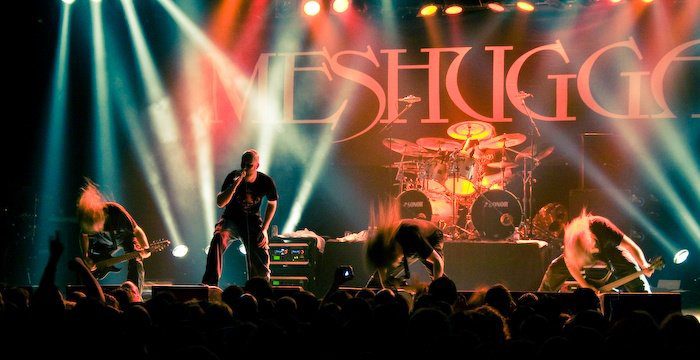
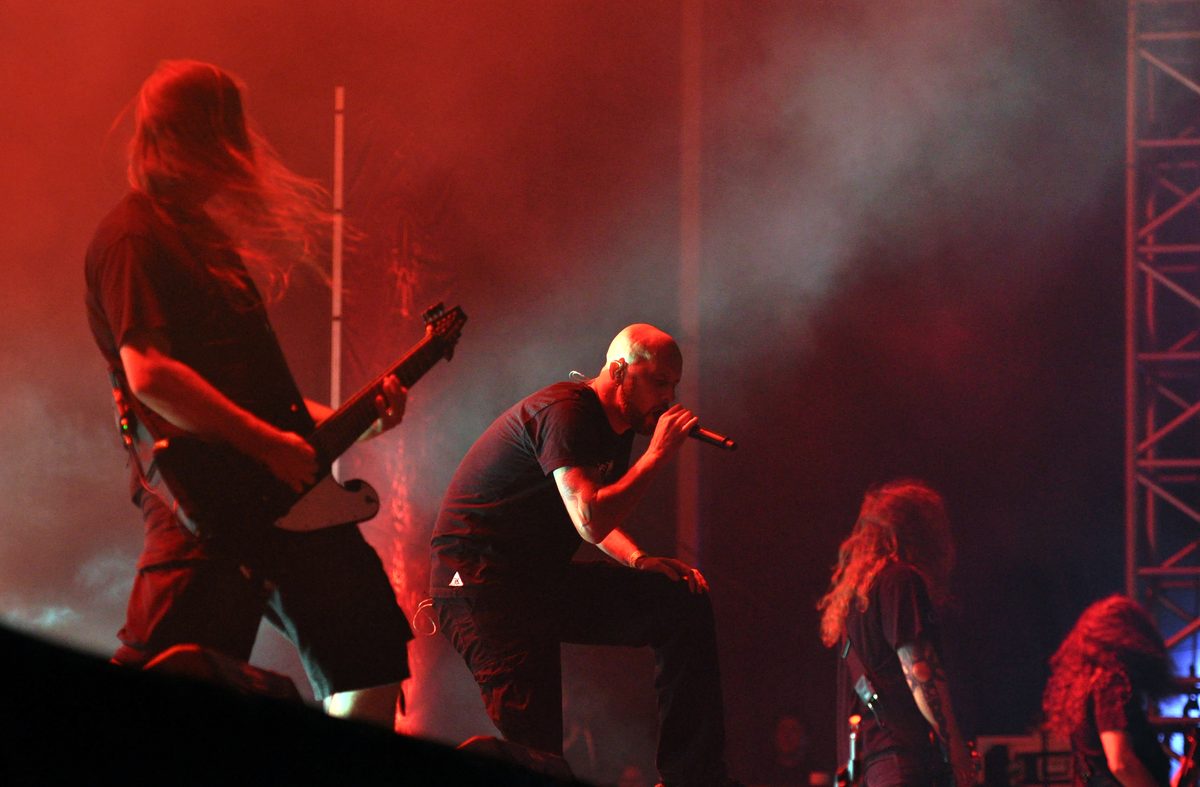
Meshuggah on stage under their MESHUGGAH backdrop in Melbourne on 15 October 2008, on the obZen tour, with Jens Kidman at the mic, Tomas Haake on drums and the three string players headbanging.
In short
How Meshuggah tunes
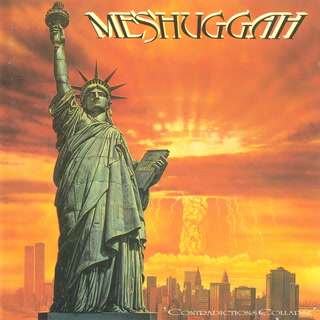
Meshuggah tuned a half step down from the start and kept adding strings underneath. The 1991 debut, Contradictions Collapse, is tabbed in E♭ Standard on six strings.
Read more
From the None EP (1994) to Chaosphere (1998) both guitarists played seven-strings in B♭ (B♭ E♭ A♭ D♭ G♭ B♭ E♭), as Mårten Hagström told Guitar World, and since Nothing (2002) the band has used eight strings tuned F B♭ E♭ A♭ D♭ G♭ B♭ E♭, eight-string standard a half step down. Nothing itself was recorded on seven-strings tuned down into that range because the band's eight-strings were not ready; the 2006 reissue re-recorded the guitars. The exceptions mostly lower the bottom string: to E on four Nothing songs, to D on Obsidian, an octave down on Spasm, to E♭ on Shed and on Immutable's Phantoms and Armies of the Preposterous, while Nebulous sits a whole step below its album. TuneLit measured the CDs and found no flat record: Destroy Erase Improve, The Violent Sleep of Reason and Immutable are within 5 ¢ of A 440, Nothing, Catch Thirtythree, obZen and Koloss sit 10 to 12 ¢ sharp, Chaosphere about 16 ¢ and Contradictions Collapse about 21 ¢. TuneLit's semitone check from the audio agrees with the tabs on 43 songs, including the low E♭ of Nebulous, and flags four for an ear check.
Meshuggah took the metal guitar down into bass territory. Over three decades the Swedes went from six strings to seven to eight, and each step added a lower string instead of changing the ones above it. That makes their tunings easier to follow than they sound: the top six strings have sat at the same notes, E♭ A♭ D♭ G♭ B♭ E♭, since the first album. In the 1990s a low B♭ was added underneath, and from 2002 on a low F below that. The rest is detail: which songs drop the lowest string further, how the 2002 version of Nothing was made, and where the records really sit against A 440. On that last point TuneLit's measurements hold a small surprise: not one Meshuggah album is flat, and several run 10 to 20 cents sharp.
This page covers every studio album from Contradictions Collapse (1991) to Immutable (2022), plus the None and I EPs. For each record you get the tuning the band and the tabs give, what TuneLit measured on the original CDs, the songs that break the pattern and how to set it up in TuneLit. The album list above opens every album, where each song has a Tune button that opens the tuner in exactly that tuning, record pitch included.
Popular songs
How to tune for Meshuggah's best-known songs
Each song has its own page: the exact tuning, the record's pitch, how to get there string by string, and how to move the record into your own tuning.
1991, Contradictions Collapse: six-string guitars in E♭ Standard (E♭ A♭ D♭ G♭ B♭ E♭), by the tabs. The CD sits about 21 ¢ sharp.
1994–1998, None, Destroy Erase Improve, Chaosphere: seven-string guitars a half step down, B♭ E♭ A♭ D♭ G♭ B♭ E♭. Mårten Hagström spelled this out to Guitar World himself. Destroy Erase Improve sits about 5 ¢ sharp, practically concert pitch, Chaosphere about 16 ¢ sharp.
2002 on, Nothing to Immutable: eight strings a half step down, F B♭ E♭ A♭ D♭ G♭ B♭ E♭. The band's techs described it to Premier Guitar in 2013, and Hagström's Ibanez signature model leaves the factory tuned this way. Nothing, Catch Thirtythree, obZen and Koloss sit 10 to 12 ¢ sharp; The Violent Sleep of Reason and Immutable are within 5 ¢ of A 440.
Exceptions are almost always the lowest string going further down: to E on four songs of Nothing, to D on Obsidian, an octave down to B♭ on Spasm, to E♭ on Shed, Phantoms and Armies of the Preposterous. Nebulous is a whole step below everything else, and two Immutable songs drop the two lowest strings.
Fredrik Thordendal (left) and singer Jens Kidman leading Meshuggah's set at Wacken Open Air, Germany, on 3 August 2013, the year after Koloss.
The story
One tuning, extended downwards
Six strings, E♭. Meshuggah formed in Umeå, in the north of Sweden, in 1987. On the debut album Jens Kidman still played rhythm guitar next to Fredrik Thordendal, and the music was fast, technical thrash. Every tab of Contradictions Collapse puts the guitars in E♭ Standard, a half step below normal tuning. No interview from the time names the tuning, so that rests on the transcriptions, and on TuneLit's check from the audio, which hears the open E♭ on eight of the nine songs.
Seven strings, B♭. Thordendal told Guitar World that he bought one of the first Ibanez seven-strings, a Universe, as soon as it came out, and that he had played it since 1991. Mårten Hagström joined as rhythm guitarist, Kidman stopped playing guitar, and from the None EP (1994) both guitarists play seven-strings. Asked whether they ever dropped the low B to A for one-finger power chords, Hagström said no: they always tuned a half step down, B♭ E♭ A♭ D♭ G♭ B♭ E♭ from low to high, with fairly light .009–.052 strings. That tuning carries None, Destroy Erase Improve and Chaosphere. On the 1999 American tour with Slayer, he added, the only spare guitar the two of them had was a six-string strung like a seven-string with the top E left off, which says a lot about where Meshuggah's riffs live.
Eight strings, F. After Chaosphere the band wanted to go lower still. A small guitar maker, Nevborn, offered them eight-string prototypes, but the guitars were not usable when Nothing had to be recorded in 2002, so Thordendal and Hagström tuned their seven-strings down into eight-string range instead. Hagström later called Nothing an eight-string album recorded on seven-string guitars, and remembered having to retune every few bars because the slack strings would not stay in pitch. Real eight-strings were in use by Catch Thirtythree (2005), Ibanez supplied the ones used to re-record Nothing in 2006, and the tuning has stayed put since: eight-string standard a half step down, F B♭ E♭ A♭ D♭ G♭ B♭ E♭. In 2013 the band's techs told Premier Guitar that both guitarists keep their eight-strings a half step down, and Hagström's signature Ibanez (the M8M, today the M80M) is set up at the factory to exactly these notes, with an extra-long 29.4-inch scale to keep the low F tight.
Put the three tunings side by side and the pattern jumps out. The six strings of 1991 are the top six of the seven-string tuning, and the seven strings of the 1990s are the top seven of the eight-string tuning. A guitarist in E♭ Standard can play the upper parts of any Meshuggah song; the riffs that sit on the B♭ and F strings need the extra range.
The story
When the low string goes lower
The exceptions follow one rule: the lowest string drops, the rest stays. On Nothing, Stengah, Perpetual Black Second, Glints Collide and Organic Shadows lower the eighth string a half step to E, Obsidian takes it down to D, and Spasm drops it a full octave below the seventh string, to a B♭ around 29 Hz that a tuner can barely read. Nebulous is the one song that moves every string: it is tabbed a whole step below the rest of the album, eight-string standard down three half steps (E♭ A♭ D♭ G♭ B E A♭ D♭). On Catch Thirtythree, Shed lowers the eighth string to E♭, and Mind's Mirrors, an ambient interlude, is said to slacken it all the way to E0. On Immutable, Phantoms and Armies of the Preposterous drop the eighth string to E♭, while God He Sees in Mirrors and Kaleidoscope lower the two bottom strings, to E♭ and A♭. On Koloss, the only tab of The Hurt That Finds You First puts the whole guitar a half step below the album, in E Standard for eight strings (E A D G C F A D).
Most of these exceptions come from single tabs, so treat them as good guesses rather than gospel. TuneLit's audio check confirms three of them (Stengah, Nebulous and Shed), and the song notes say where it could not tell.
TuneLit lab
What TuneLit measured
TuneLit measured CDs of all nine studio albums: the first pressing wherever the library has one, otherwise the Japanese edition, and for Nothing the original 2002 release rather than the 2006 reissue. Every other edition on the shelf was measured too, as a cross-check. The headline is simple: no Meshuggah album is flat.
Practically concert pitch, within about 5 ¢: Destroy Erase Improve (+5 ¢), The Violent Sleep of Reason (+4 ¢) and Immutable (+4 ¢).
About 10 to 12 ¢ sharp, A ≈ 442.6 to 443.2: Nothing (+10 ¢), Catch Thirtythree (+12 ¢), obZen (+12 ¢) and Koloss (+10 ¢).
Clearly sharp: Chaosphere (+16 ¢, A ≈ 444) and Contradictions Collapse (+21 ¢, A ≈ 445).
Ten or twenty cents never puts a song on another note, but it is enough to make a perfectly tuned guitar sound a hair flat against the record, especially on long, ringing low notes. A measurement hears the finished record, not the guitar, so it cannot say whether the guitars were tuned a little high, whether thick strings struck hard ring sharp, or whether something happened along the way. The reissues answer one question at least: a 1991 repress and the 1995 Japanese CD of Contradictions Collapse, the American, Japanese and 2008 Reloaded editions of Destroy Erase Improve, the Japanese CD, the Reloaded edition and the 2024 remaster of Chaosphere, and the 2023 remaster of obZen all play the same songs within a cent or two of the first pressing. Nobody sped these records up or slowed them down.
A handful of songs sit apart from their albums and get their own setting: Choirs of Devastation (+7 ¢), Elastic (+7 ¢), Obsidian (concert pitch), Shed (concert pitch), The Last Vigil (concert pitch), Born in Dissonance (−6 ¢), Light the Shortening Fuse (+15 ¢) and Past Tense (−8 ¢). A few more lean the same way without the confidence the measurement needs for a value of their own. New Millennium Cyanide Christ reads about 29 ¢ sharp on all five Chaosphere CDs, We'll Never See the Day about 9 ¢ on all three Contradictions Collapse CDs, and Bleed about 2 ¢ on both obZen CDs. Their buttons use the album value; if they sound off, nudge Fine-tune by ear.
Which semitone? A pitch measurement only knows where the record sits within one half step, so the note itself comes from the tabs and the band. TuneLit also checks it from the audio by listening for the open low string, which the bass and guitars hit constantly, and for the note just under it, which they almost never play. That check agrees with the tabs on 43 songs, among them all ten songs of Destroy Erase Improve, the low F of Rational Gaze, Closed Eye Visuals and Straws Pulled at Random, the dropped E of Stengah, the dropped E♭ of Shed and, most usefully, the low E♭ of Nebulous: the original 2002 Nothing really has that song a whole step below the rest. It is unsure on most eight-string songs, whose lowest note, around 44 Hz, is hard to follow under the bass. It disagrees on four songs: Choirs of Devastation (it hears D rather than E♭), The Paradoxical Spiral and The Last Vigil (F♯ rather than F, its known mistake on parts that rarely use the open low string) and Phantoms (E rather than E♭ for the dropped eighth string). No other source backs any of those readings, so the songs stay as tabbed; they are the ones worth checking by ear.
Lead guitarist Fredrik Thordendal with his eight-string guitar at Rock am Ring, Germany, on 3 June 2023, on the Immutable tour.
Main tuning: E♭ Standard +21 ¢ (A ≈ 445), measured by TuneLit on the original Nuclear Blast CD.
The debut is fast, technical thrash on ordinary six-string guitars, with Jens Kidman on rhythm guitar for the only time on a Meshuggah album. All the tabs agree on E♭ Standard, and the audio check confirms the open E♭ on eight of the nine songs. The CD is the sharpest record in the catalogue, about 21 cents above A 440; a 1991 repress and the 1995 Japanese CD match it within a cent. Choirs of Devastation sits lower, about 7 cents sharp, and gets its own setting. We'll Never See the Day leans the same way (about 9 cents) on all three CDs, but not firmly enough for a value of its own. One little-used tab puts Internal Evidence in E Standard; the main tab and the audio check say E♭.
With TuneLit: every button opens E♭ Standard at +21 ¢, Choirs of Devastation at +7 ¢. The audio check heard a D under Choirs of Devastation rather than the open E♭; nothing else supports that, so the song stays in E♭, but it is worth a listen.
None (EP, 1994)
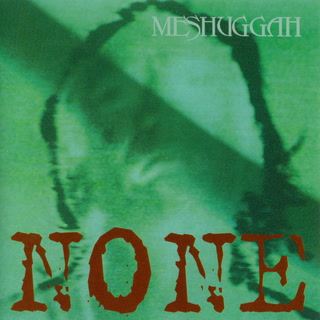
Main tuning: B♭ Standard on seven strings (B♭ E♭ A♭ D♭ G♭ B♭ E♭), from the band and the tabs; not measured.
Mårten Hagström's first release with the band and the first on seven-strings. The five songs (Humiliative, Sickening, Ritual, Gods of Rapture and Aztec Two-Step, which ends in a long silence and a short hidden piece) are all tabbed in the B♭ tuning Hagström described. TuneLit has not measured the EP, so its buttons use A 440; going by the albums either side, expect it to sit at or a little above concert pitch.
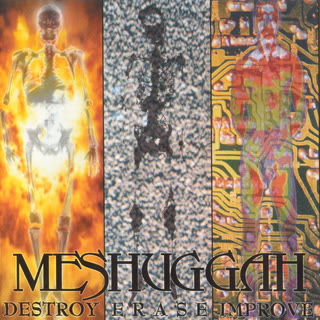
Main tuning: B♭ Standard on seven strings +5 ¢ (A ≈ 441), measured by TuneLit on the original German CD.
The first full album on seven-strings, and the record where the band's trademark interlocking rhythms took shape on songs like Future Breed Machine and Soul Burn. Hagström's own description of the tuning, a half step down and never a dropped low string, matches every tab, and the audio check hears the open B♭ on all ten songs. The CD sits about 5 cents sharp, which a normal tuner at A 440 treats as in tune; the American and Japanese CDs of 1995 and the 2008 Reloaded edition read the same within a cent or two.
With TuneLit: every button opens B♭ Standard at +5 ¢. On an eight-string in F, the same notes are your top seven strings.
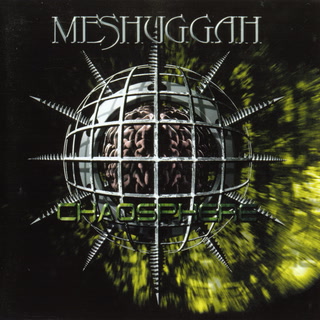
Main tuning: B♭ Standard on seven strings +16 ¢ (A ≈ 444), measured by TuneLit on the original German CD.
The last seven-string album, from the years when Hagström gave Guitar World the tuning string by string. Everything is tabbed in B♭, and the audio check agrees on six of the eight songs (it is unsure on Neurotica and Sane). The measurement is less certain than usual, because the dense, compressed mix gives the estimator little to hold on to, but the Japanese CD, the 2008 Reloaded edition and the 2024 remaster land on the same songs within a cent or two: about 16 cents sharp. Elastic, the long closer, sits lower at about 7 cents sharp and gets its own setting. New Millennium Cyanide Christ goes the other way, about 29 cents sharp on all five editions measured; its button stays on the album value, so tune it a little higher by ear if your guitar sounds flat against the record.
With TuneLit: B♭ Standard at +16 ¢, Elastic at +7 ¢.
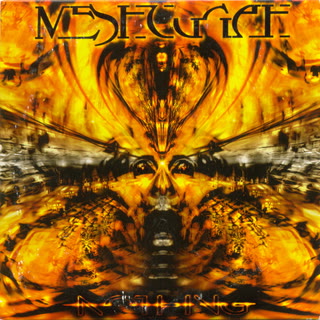
Main tuning: F Standard on eight strings +10 ¢ (A ≈ 443), measured by TuneLit on the original 2002 CD.
Nothing was written for eight strings in F but played on seven-strings tuned down to F B♭ E♭ A♭ D♭ G♭ B♭, the lowest seven notes of that tuning, because the band's eight-strings were not usable in time. In 2006 the album came out again with the guitars re-recorded on real eight-strings, the drums rebuilt with drum software from the original performance, Nebulous slowed down and Obsidian almost twice as long. The two versions are different recordings, and TuneLit measured the 2002 one.
This is the album with the most tunings. Rational Gaze, Closed Eye Visuals and Straws Pulled at Random use the plain F tuning, and the audio check confirms the low F on all three. Stengah, Perpetual Black Second, Glints Collide and Organic Shadows drop the bottom string to E; the check confirms it on Stengah and cannot decide on the others. The only tab of Glints Collide also lowers the upper strings a half step, which nothing else supports, so TuneLit keeps the album's upper strings. Spasm drops the bottom string an octave below the next one, to B♭ at about 29 Hz, too low for the audio check to judge. Obsidian takes it down to D and measures at concert pitch, about 10 cents below the rest. And Nebulous is tabbed a whole step below the album, E♭ standard on eight strings; the check hears exactly that low E♭ on the 2002 CD.
With TuneLit: the buttons use +10 ¢ throughout, except Obsidian at A 440. Retune the eighth string between songs and come back to F for the plain ones. On a seven-string, the band's own 2002 approach works: F B♭ E♭ A♭ D♭ G♭ B♭ with much heavier strings.
I (EP, 2004)
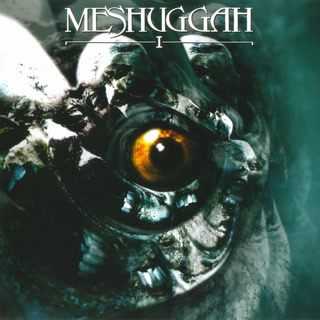
Main tuning: F Standard on eight strings, from the tabs; not measured.
One 21-minute piece, assembled bar by bar in the studio with Thordendal also playing bass. The main tab is in F throughout, with one clean passage on a low E. TuneLit has not measured the EP, so the button uses A 440.
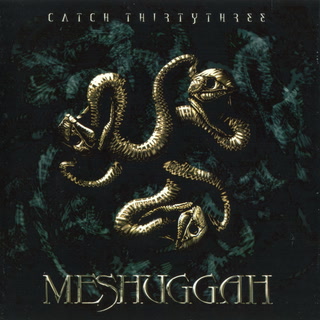
Main tuning: F Standard on eight strings +12 ¢ (A ≈ 443), measured by TuneLit on the Japanese CD.
A 47-minute piece in thirteen tracks, played over programmed drums. It is the first full album on eight-strings, and Hagström said at the time that power chords turn to mush that low, and the riffs lean on single notes. Everything is tabbed in F, and the audio check confirms the low F on five tracks, among them Autonomy Lost and Sum. Shed drops the bottom string a whole step to E♭; the check hears that E♭, and the song measures at concert pitch, about 15 cents below the rest. Mind's Mirrors, an ambient interlude, is said to take the eighth string down to E0, far below anything a tuner can follow, so treat that button as a curiosity. The check says F♯ rather than F on The Paradoxical Spiral, the usual mistake on parts that lean on fretted notes; the song stays in F.
With TuneLit: F Standard at +12 ¢, Shed at A 440 with the eighth string on E♭.
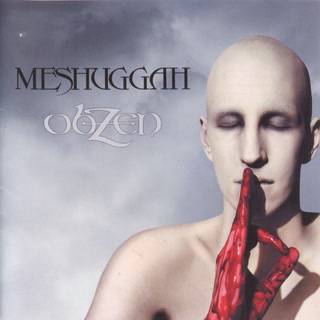
Main tuning: F Standard on eight strings +12 ¢ (A ≈ 443), measured by TuneLit on the original Japanese CD.
Tomas Haake back on a real drum kit, Dick Lövgren's first album on bass, and Meshuggah's best-known song: Bleed, whose relentless riff is built on the open low F. Every song is tabbed in F. The album measures about 12 cents sharp, and the 2023 remaster agrees within a cent. Bleed itself reads close to A 440 on both CDs, about 10 cents below the album, but not firmly enough for its own setting. The audio check confirms the low F on This Spiteful Snake and is unsure on the rest, where the bass dominates the bottom octave.
With TuneLit: F Standard at +12 ¢. For Bleed, start there and lower Fine-tune a little if the open F sounds sharp against the record.
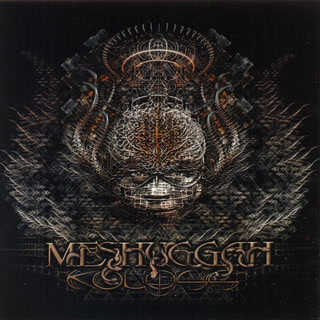
Main tuning: F Standard on eight strings +10 ¢ (A ≈ 443), measured by TuneLit on the Japanese CD.
A slower, groove-heavy record by Hagström's own account, and the tour on which Premier Guitar's rig rundown found both guitarists' eight-strings a half step down. The tabs agree, and the audio check confirms the low F on Do Not Look Down. The exception is The Hurt That Finds You First, the fast thrash song of the album, which its only tab puts a half step lower in E Standard for eight strings. The audio check could not settle that one, so it stays as tabbed. The clean closer The Last Vigil measures at concert pitch, about 13 cents below the album; the check's F♯ reading there is its known mistake on a part that hardly touches the open low string.
With TuneLit: F Standard at +10 ¢, The Hurt That Finds You First in E Standard at +10 ¢, The Last Vigil at A 440.
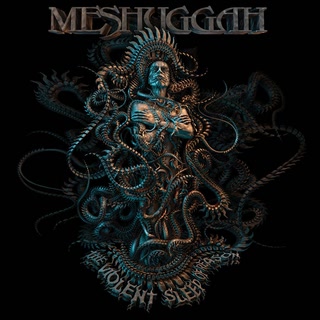
Main tuning: F Standard on eight strings +4 ¢ (A ≈ 441), measured by TuneLit on the Japanese CD.
Recorded live in the studio, all five members playing together, and close to concert pitch: about 4 cents sharp, which a normal tuner treats as in tune. Hagström played a custom 28-inch-scale eight-string after shoulder trouble, but the tuning did not change, and every song is tabbed in F. The audio check confirms the low F on Clockworks, By the Ton, the title track and Nostrum. Born in Dissonance reads about 6 cents flat and gets its own setting.
With TuneLit: F Standard at +4 ¢, Born in Dissonance at −6 ¢.
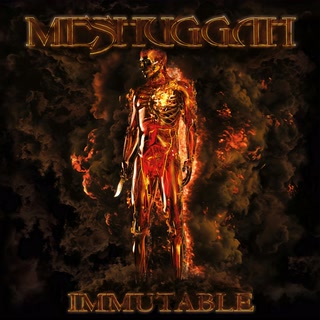
Main tuning: F Standard on eight strings +4 ¢ (A ≈ 441), measured by TuneLit on the Japanese CD.
Thirteen songs, and after Nothing the most variety in the low end of any Meshuggah album. The F tuning carries most of it, and the audio check confirms the low F on They Move Below and Black Cathedral. Phantoms and Armies of the Preposterous drop the eighth string to E♭, and God He Sees in Mirrors and Kaleidoscope lower the two bottom strings to E♭ and A♭; all four rest on single tabs. On Phantoms the audio check hears E rather than E♭ for the dropped string, so check that one by ear. Light the Shortening Fuse reads about 15 cents sharp and the clean outro Past Tense about 8 cents flat; both get their own setting. God He Sees in Mirrors gave the measurement almost nothing to work with, so its button uses the album value.
With TuneLit: F Standard at +4 ¢, the four exceptions with their lowered strings at the same pitch, Light the Shortening Fuse at +15 ¢ and Past Tense at −8 ¢.
The story
The bass
Meshuggah's bass follows the guitars down. In the tabs of the seven-string years the bass is tuned B♭ E♭ A♭ D♭ (with a fifth string on G♭ in some), an octave under the guitars' four lowest strings. From obZen on, most of Dick Lövgren's parts are tabbed on a five-string tuned B♭ F B♭ E♭ A♭, which puts his lowest note a fifth below the guitars' low F, and Premier Guitar's 2013 rundown says he played Bleed on a four-string Warwick Stryker tuned down a step and a half. None of this changes how a guitarist tunes, but it explains why the records feel lower than the guitar notes alone, and why TuneLit's audio check, which listens to the bottom octave, is so often unsure on the eight-string albums.
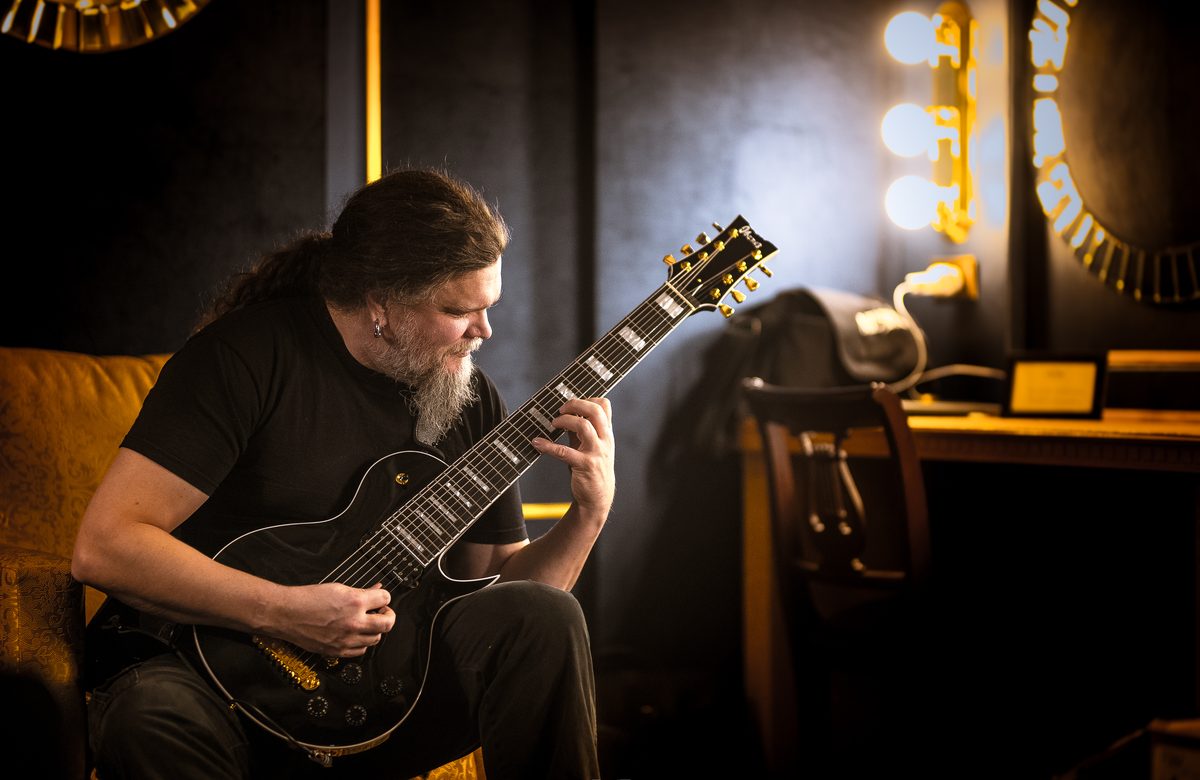
Rhythm guitarist Mårten Hagström warming up backstage on an eight-string guitar, January 2018.
The story
Practical advice
Pick the right instrument in TuneLit. The tuner has 7-string and 8-string guitars. Meshuggah's F tuning is eight-string standard (F♯ B E A D G B E) a half step down; the seven-string B♭ tuning is seven-string standard a half step down. The Tune buttons choose the instrument, the tuning and the record's pitch for you.
Tune the low F by its harmonic. The open F on an eight-string vibrates at about 44 Hz, low enough that phone microphones and small speakers barely pick up the fundamental. If the needle wanders, play the harmonic at the 12th fret, an octave higher and much easier for any tuner to read, or tune the seventh string first and match the eighth to it at the 5th fret.
Strings and scale. Hagström has used DR .010–.075 sets on his eight-strings, and his signature Ibanez has a 29.4-inch scale; for The Violent Sleep of Reason he moved to a 28-inch custom version for comfort, without changing the tuning. A shorter-scale guitar tuned this low needs a heavier bottom string to keep the F from flapping and going sharp when you pick hard.
Seven-string songs on an eight-string. The B♭ tuning of the 1990s is the top seven strings of the F tuning, so an eight-string in F plays None, Destroy Erase Improve and Chaosphere as they are: just leave the eighth string alone.
Eight-string songs on a seven-string. Do what the band did on Nothing: tune the seven-string down to F B♭ E♭ A♭ D♭ G♭ B♭, the lowest seven notes of the eight-string tuning, with a much heavier set, and expect it to drift. Most riffs live on the two lowest strings anyway.
On a six-string. E♭ Standard covers Contradictions Collapse completely and the upper parts of everything after it. The riffs on the B♭ and F strings simply are not there on six strings.
Mind the record's pitch. Most albums sit 10 to 20 cents sharp. Set the reference with the Tune button rather than tuning to a plain A 440, or your perfectly tuned guitar will sound a touch flat against the CD.
Retune for the exceptions. On Nothing and Immutable the lowest string moves between songs. Use each song's button, then bring the eighth string back to F for the next one.
Questions
What tuning does Meshuggah use?
Mostly F Standard: 7 of 11 albums. None, Destroy Erase Improve and Chaosphere are in B♭ Standard; Contradictions Collapse is in E♭ Standard. Many albums also have songs in other tunings, and the album pages list them song by song.
Why does Meshuggah sound out of tune when I play along?
Some records are not at concert pitch. Contradictions Collapse sits about 21 cents sharp (A ≈ 445); Chaosphere sits about 16 cents sharp (A ≈ 444); obZen sits about 12 cents sharp (A ≈ 443). A guitar tuned to A 440 clashes with them. Every Tune button on these pages sets the measured pitch for you.
How did TuneLit measure Meshuggah's records?
We played original CDs and LPs through TuneLit's pitch analysis: the strongest notes of each song are compared with the A 440 grid, which gives the offset in cents. That cannot tell the semitone, so the tuning name comes from interviews, the press and tabs. The audio is never stored or published.
Colors and font
Font
Colors
Menu
Install the app
Android (Chrome): menu ⋮ → Install app or Add to Home screen.
Computer (Chrome, Edge): the install icon at the right end of the address bar.
iPhone: Safari → Share → Add to Home Screen.
It opens full screen and keeps tuning with no connection.