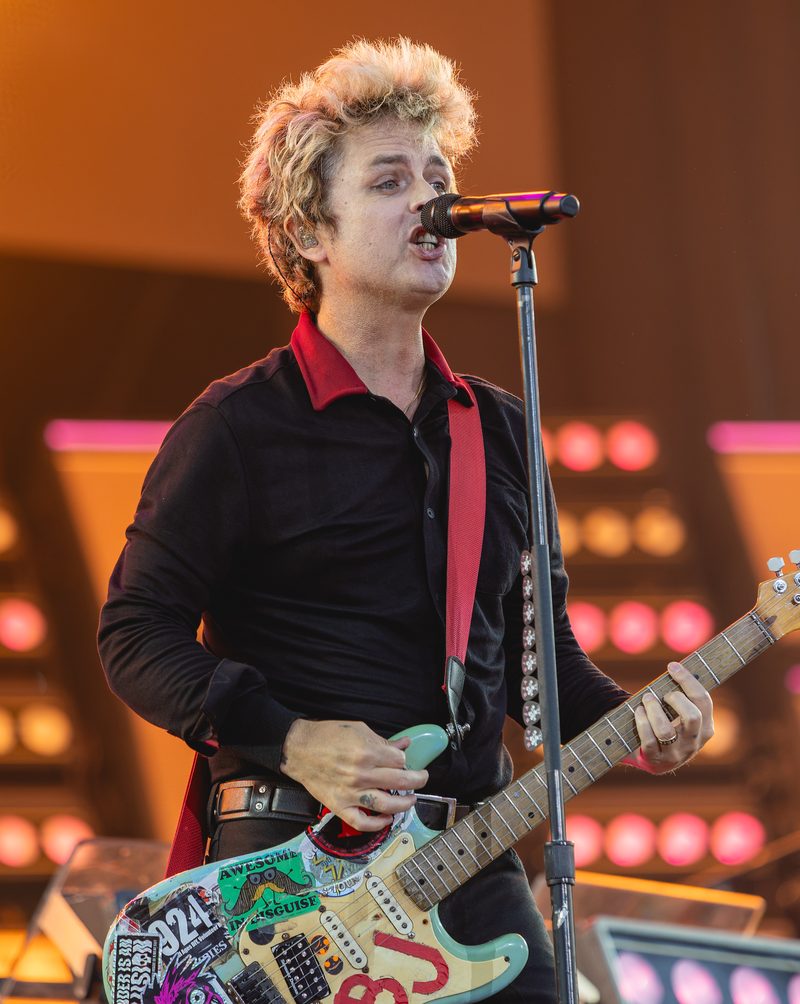
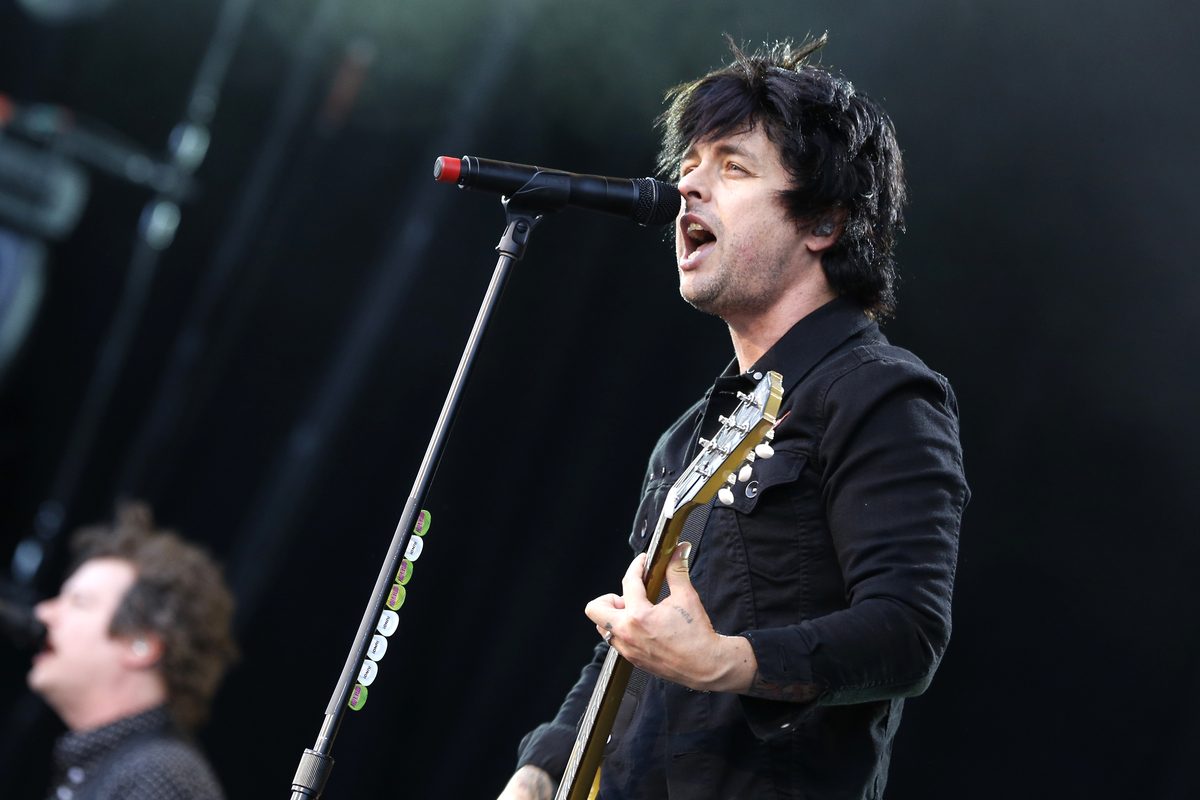
Billie Joe Armstrong singing and playing Blue, his sticker-covered Stratocaster-style guitar, at the Isle of Wight Festival, 23 June 2024.
In short
How Green Day tunes
Green Day tuned down a half step, to E♭ Standard, for Kerplunk, Dookie and Insomniac: Dookie's engineer said they detuned everything to E♭, and every tab agrees. The debut, 39/Smooth, and everything from Nimrod (1997) to Saviors (2024) are in plain E Standard, with exceptions on most of them: songs in flat keys such as Misery, Waiting, 21st Century Breakdown, Say Goodbye, Youngblood, I Was a Teenage Teenager, The American Dream Is Killing Me and Corvette Summer are half a step down, and Whatsername and Dilemma are in Drop D.
Read more
TuneLit measured all fourteen studio albums and checked each song's low string from the audio. The 1990s records are not at concert pitch: 39/Smooth and Kerplunk sit about 15 cents flat, Dookie about 15 and Insomniac about 18 cents sharp, Nimrod 8 cents sharp. The modern albums sit within a few cents of A 440. The audio check also puts American Idiot and Jesus of Suburbia in E♭, though the most-viewed tabs say E.
Green Day's catalogue splits neatly in two. The early records, Kerplunk, Dookie and Insomniac, were made with every string tuned down a half step, to E♭ Standard. From Nimrod (1997) on, Billie Joe Armstrong and Mike Dirnt went back to plain E Standard, and that is where most of the band's songs have stayed ever since. The debut, 39/Smooth, sits in E Standard too, before the drop.
The half-step habit never quite went away, though. Most albums after Nimrod have a song or two tabbed in E♭, and they have something in common: they sit in "flat" keys like A♭, D♭ or G♭, which is exactly what familiar chord shapes give you a half step down. TuneLit measured the owner's copies of all fourteen studio albums, 185 songs, and checked each one's low string from the audio. This page goes through all of it, album by album. Every song on the album pages has a Tune button that opens the tuner in exactly the right tuning, with the measured offset already applied.
Popular songs
How to tune for Green Day's best-known songs
Each song has its own page: the exact tuning, the record's pitch, how to get there string by string, and how to move the record into your own tuning.
E♭ Standard (E♭ A♭ D♭ G♭ B♭ E♭): Kerplunk (1991), Dookie (1994) and Insomniac (1995). Dookie's engineer confirmed the band tuned everything down to E♭.
E Standard (E A D G B E): 39/Smooth (1990), and Nimrod (1997) through Saviors (2024).
Half step down on the later albums: Misery and Waiting (Warning); American Idiot and Jesus of Suburbia (American Idiot, listed in E♭ after TuneLit's audio check, though the most-viewed tabs say E); 21st Century Breakdown (the title track); Say Goodbye and Youngblood (Revolution Radio); I Was a Teenage Teenager (Father of All Motherfuckers); The American Dream Is Killing Me and Corvette Summer (Saviors).
Drop D: Whatsername (American Idiot) and Dilemma (Saviors). D Standard: Restless Heart Syndrome (21st Century Breakdown).
Pitch: the 1990s records are not at concert pitch. 39/Smooth and Kerplunk sit about 15 cents flat, Dookie about 15 cents sharp, Insomniac about 18 cents sharp and Nimrod 8 cents sharp. From American Idiot on, the albums sit within a few cents of A 440, Father of All Motherfuckers (7 cents flat) aside.
Live: the band's crew has kept guitars in E♭ for the older songs; on the 2024 tour even later songs such as Minority were played a half step down. Live versions can sit a half step below the record.
Billie Joe Armstrong singing with his guitar on the main stage at Rock im Park, Nuremberg, Germany, 8 June 2013.
The story
How Green Day tune
Billie Joe Armstrong sings and plays rhythm and lead guitar; Mike Dirnt plays bass; Tré Cool has played drums since Kerplunk (John Kiffmeyer drums on 39/Smooth). On stage the band has long added a second guitarist, Jason White, and more players later on. On the records, though, the guitar parts are Billie Joe's, and the bass follows the guitars' tuning: the main community tab of every song puts Mike Dirnt in the same tuning as the guitars.
The half-step drop came early. Songsterr tabs every Kerplunk song but one in E♭ Standard, and TuneLit's audio check agrees on most of them. For Dookie there is a first-hand account: Neill King, who engineered the album at Fantasy Studios in Berkeley in 1993, told Sound On Sound that they detuned everything down to E♭. He liked the extra low end, but said it made the guitars harder to keep in tune and in tune with each other once the parts were double-tracked. Insomniac, recorded a year later, is tabbed in E♭ throughout.
Nimrod changed that. Its tabs are in E Standard from the opener to Good Riddance (Time of Your Life), and TuneLit's audio check agrees on all but three songs. The same goes for Warning, American Idiot, 21st Century Breakdown, the ¡Uno! ¡Dos! ¡Tré! trilogy, Revolution Radio, Father of All Motherfuckers and Saviors: E Standard by default.
What survives is a pattern. When a later Green Day song sits in A♭, D♭, E♭ or G♭, there is a good chance it was played with A, D, E or G shapes on a guitar tuned down a half step, and the tabs often say so. Say Goodbye, Youngblood, I Was a Teenage Teenager, The American Dream Is Killing Me and Corvette Summer are all tabbed that way, and TuneLit's check hears an E♭ low string in each. For a few songs the tabs disagree, and those are the ones discussed album by album below.
Here is the useful part for players: for a song in a flat key, both readings put the same notes on the record. An E Standard tab of American Idiot plays A♭ power chords at the fourth fret; a half-step-down tab plays the same sound with A shapes at the fifth. Either works, as long as your tuning matches your tab. The tuning only decides which shapes you use.
On stage
Two Premier Guitar rig rundowns show how the crew handles this. In 2013 Billie Joe's famous sticker-covered guitar, Blue, was kept in E♭ for the older songs (Basket Case, Longview, Brain Stew and Hitchin' a Ride were named), while his other guitars stayed in E Standard, and Jason White kept a Les Paul in E♭ for the 1990s material. In 2024 the crew described a bass in Mike Dirnt's rig dropped to C♯ for Dilemma and raised to E♭ for Minority: the band was playing those songs a half step below the records. Hitchin' a Ride is the classic trap. It is in E Standard on Nimrod, but played on Blue it can sound a half step lower in concert. When a live video sounds a semitone off, try the other tuning.
TuneLit lab
What TuneLit measured
TuneLit measured one copy of each studio album from the owner's library: a needle drop of the first pressing of 39/Smooth, and MP3 copies of the CDs for the other thirteen. The method reads 90 seconds of each song and finds how far its notes sit from the A 440 grid. It only knows the offset within one semitone; the semitone itself (E or E♭) comes from the tabs, checked against the audio.
Album
Sources said
TuneLit measured
Equivalent A
39/Smooth (1990)
E Standard
−14.2 ¢ (LP)
A ≈ 436.4
Kerplunk (1991)
E♭ Standard
−16.5 ¢
A ≈ 435.8
Dookie (1994)
E♭ Standard
+14.5 ¢
A ≈ 443.7
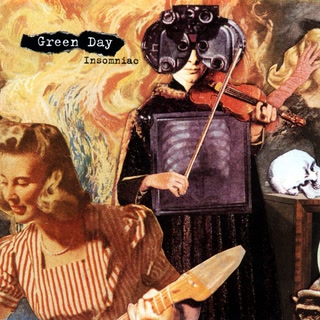
Insomniac (1995)
E♭ Standard
+18.3 ¢
A ≈ 444.7
Nimrod (1997)
E Standard
+8.0 ¢
A ≈ 442
Warning (2000)
E Standard
+4.4 ¢
A ≈ 441.1
American Idiot (2004)
E Standard
+1.7 ¢, concert pitch
A 440
21st Century Breakdown (2009)
E Standard
−1.1 ¢, concert pitch
A 440
¡Uno! (2012)
E Standard
−3.1 ¢, concert pitch
A 440
¡Dos! (2012)
E Standard
−3.0 ¢, concert pitch
A 440
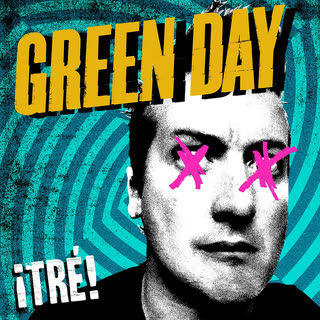
¡Tré! (2012)
E Standard
−3.6 ¢, concert pitch
A 440
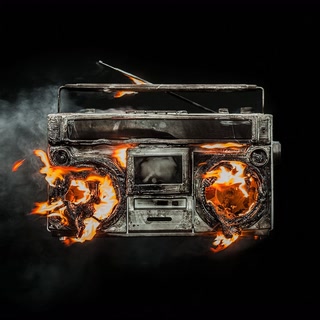
Revolution Radio (2016)
E Standard
−1.4 ¢, concert pitch
A 440
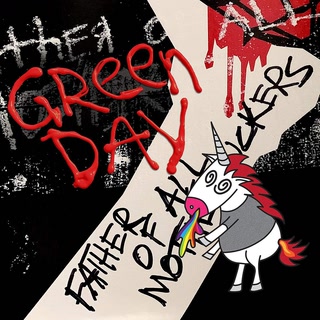
Father of All Motherfuckers (2020)
E Standard
−6.8 ¢
A ≈ 438.3
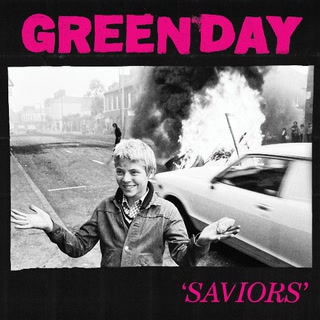
Saviors (2024)
E Standard
+1.7 ¢, concert pitch
A 440
The sources say nothing about pitch, so all of this is new. A few things stand out:
The 1990s drift. The two Lookout! records sit about 15 cents flat, Dookie and Insomniac 15 to 18 cents sharp, Nimrod 8 cents sharp. That is a third of the way to the next note at the extremes, enough to hear when you play along on headphones. Whether it comes from tuning by ear, tape speed or mastering, the record is what it is, and the Tune buttons follow it.
The modern albums are on the money. From American Idiot on, every album but one sits within 4 cents of A 440, which TuneLit counts as concert pitch.
Kerplunk varies most. Its songs range from about 26 cents flat (Private Ale, One of My Lies) to dead on concert pitch (Tré Cool's Dominated Love Slave), and the closing Words I Might Have Ate, with Billie Joe on acoustic guitar, sits a quarter tone above the rest, right between E♭ and E.
Insomniac comes in two groups. About half the songs sit near 17 cents sharp, the other half near 28: Brat, Panic Song and Stuart and the Ave. clearly so, Geek Stink Breath, Brain Stew and Westbound Sign probably too, but with less confidence.
Songs that stray. On Dookie, Chump and Longview sit near concert pitch, 12 to 13 cents below the album, while When I Come Around is 29 cents sharp. On Warning, the title track is 20 cents sharp and Jackass 15 cents flat. Each has its own Tune button.
A measurement hears the result, not the cause: it cannot tell a guitar tuned slightly sharp from a tape that ran slightly fast. For 39/Smooth there is an extra caveat, since a turntable can run a little fast or slow; Kerplunk, from the same studio and producer, sits at a similar pitch on CD, which suggests the LP is close.
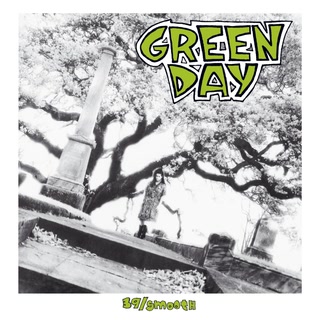
Main tuning: E Standard, about 14 ¢ flat (A ≈ 436.4), measured on the first Lookout! LP.
The debut, recorded at Art of Ears in San Francisco around New Year 1990 with Andy Ernst, is the only Green Day album with John Kiffmeyer on drums. Every Songsterr tab is in E Standard, guitar and bass, and TuneLit's audio check agrees on six of the ten songs; three leave the question open. I Was There sits in C and barely touches the open low E, which is why the check guesses a half step high there; nothing else supports that. Rest reads closer to concert pitch than the other songs, about 4 cents flat.
With TuneLit: E Standard with the reference at about A 436, or simply 14 cents flat.
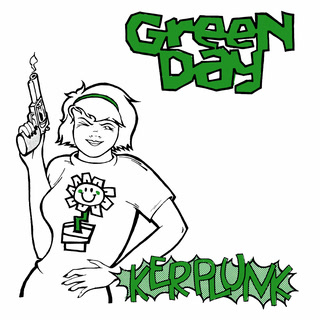
Main tuning: E♭ Standard, about 16 ¢ flat (A ≈ 435.8), measured on the CD.
The first album with Tré Cool, and the first tabbed a half step down. Eleven of its twelve songs are in E♭ Standard on Songsterr, including the first version of Welcome to Paradise, re-recorded for Dookie in the same tuning. The pitch moves around more than on any other Green Day record: Private Ale and One of My Lies sit about 25 cents flat, Who Wrote Holden Caulfield? about 6 flat, and Dominated Love Slave, Tré Cool's country send-up, right at concert pitch.
The odd one out is Words I Might Have Ate, the acoustic closer. Songsterr tabs it in E Standard, while an Ultimate Guitar transcriber could not decide between standard and a half step down, and the record explains why: it sits about 52 cents below E, a quarter tone above the rest of the album, halfway between E♭ and E. Its Tune button sets E Standard at A 427, which puts the strings exactly where the record is.
TuneLit's audio check hears E rather than E♭ on One for the Razorbacks, a song in B where the open E sounds often. No tab agrees, so it stays in E♭ with the album; it is worth a check by ear. The CD adds the four songs of the 1990 Sweet Children EP; they are not part of the album and are not listed here.
With TuneLit: E♭ Standard about 16 cents flat for most songs; check the song buttons for the ones that stray.
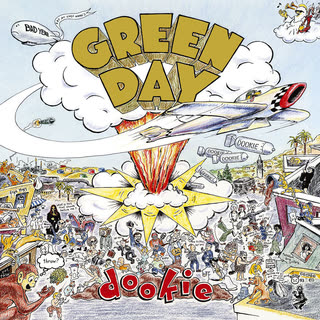
Main tuning: E♭ Standard, about 15 ¢ sharp (A ≈ 443.7), measured on the CD.
The breakthrough. This is the one album where the tuning comes from the people in the room: Neill King, who engineered it, said they detuned everything to E♭, and every Songsterr tab, a whole-album Dookie tab on Ultimate Guitar and Wikipedia's article on Welcome to Paradise agree. TuneLit's audio check confirms E♭ on thirteen of the fourteen songs, Basket Case and Longview included; She, whose low notes sit on F♯, B and C♯, is the one it cannot decide.
The record sits about 15 cents above E♭ Standard, and quite evenly so, with three exceptions. Chump and Longview sit within 3 cents of a plain E♭ at A 440, about 12 cents below the rest; When I Come Around is about 29 cents sharp, the highest reading on the album. If you play along with Basket Case at a plain E♭ you will sound a little flat; at A 444 you are right on it.
With TuneLit: E♭ Standard about 15 cents sharp, with the reference near A 444. Use the song buttons for Chump, Longview and When I Come Around.
Main tuning: E♭ Standard, about 18 ¢ sharp (A ≈ 444.7), measured on the CD.
Recorded at Hyde Street Studios in San Francisco and tabbed in E♭ Standard from start to finish (every Songsterr tab, and Ultimate Guitar's whole-album tab). Brain Stew, the album's best-known riff, was still being played on Billie Joe's E♭ guitar in 2013. The audio check confirms E♭ on all but Geek Stink Breath, a song centred on E that leaves the question open.
This is the sharpest Green Day album TuneLit measured, and the least even. Half the songs sit near 17 cents sharp, the rest near 28: Brat, Panic Song and Stuart and the Ave. clearly enough for their own Tune buttons, Geek Stink Breath, Brain Stew and Westbound Sign probably but with lower confidence. A tuner set to A 444 covers the first group; for the second, you would need about A 447.
With TuneLit: E♭ Standard about 18 cents sharp, with the three songs that read higher on their own buttons.
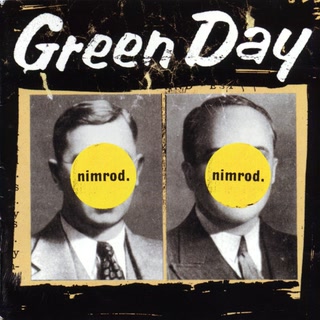
Main tuning: E Standard, about 8 ¢ sharp (A ≈ 442), measured on the CD.
Nimrod is where Green Day returned to standard tuning, and they stayed there. Every Songsterr tab of the album is in E Standard, Hitchin' a Ride and the acoustic Good Riddance (Time of Your Life) included, and the audio check agrees on fifteen of the eighteen songs. Nice Guys Finish Last, Scattered and Last Ride In are clear cases, with the open low E ringing out again and again.
The exceptions are worth knowing. Uptight, in B, sounds like an E♭ low string to the audio check, but no tab says so, and Take Back leans the same way without a firm answer; both stay in E. Haushinka sits in D and never plays the open E, which is why the check guesses wrong there. The measured pitch is steady, 7 to 12 cents sharp across the album; Hitchin' a Ride reads higher, about 18 cents, but not clearly enough to set it apart.
With TuneLit: E Standard about 8 cents sharp (A 442) for the whole album.
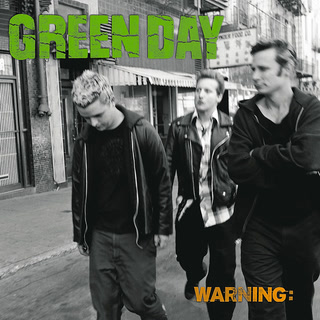
Main tuning: E Standard, about 4 ¢ sharp (A ≈ 441.1), measured on the CD.
The folk-tinged Warning, produced by the band itself at Studio 880 in Oakland, is tabbed in E Standard, and the audio check agrees on Minority, Warning, Castaway, Macy's Day Parade and most of the rest. Two songs are a half step down:
Misery, with its accordions and horns, is tabbed in E♭ on Songsterr and Ultimate Guitar, and the audio check agrees.
Waiting, which sits in a flat key, is in E Standard on Songsterr's most-viewed tab but in E♭ on its three-guitar version, and TuneLit's audio check hears an E♭ low string. It is listed in E♭. If you use the E Standard tab, stay in E: the notes are the same.
The songs drift more than on Nimrod: the title track sits about 20 cents sharp and Church on Sunday 17, while Castaway is about 9 cents flat and Jackass 15. Each of those has its own setting.
With TuneLit: E Standard a few cents sharp for most songs; E♭ for Misery and Waiting; use the song buttons for the four that stray.
Main tuning: E Standard at concert pitch (+1.7 ¢), measured on the CD.
The rock opera is the album where tabs disagree most. From Are We the Waiting to Homecoming, the songs sit in D, A, E and G, the tabs say E Standard, and the audio check agrees on every one; Wake Me Up When September Ends and Give Me Novacaine are textbook cases. Whatsername is in Drop D, on Songsterr and Ultimate Guitar alike, and the audio hears the low D.
The first four songs are different. American Idiot and Jesus of Suburbia sit in A♭, Holiday and Boulevard of Broken Dreams in F minor, keys that fall under A and F♯m shapes a half step down. Songsterr's most-viewed tabs put all four in E Standard, but one of its three big American Idiot tabs, with more than 130,000 views, is a half-step-down version, and smaller E♭ tabs exist for Jesus of Suburbia and Holiday too. TuneLit's audio check hears an E♭ low string on American Idiot (with a confidence of 0.994) and on Jesus of Suburbia, so those two are listed in E♭ Standard, with the tabs' E Standard named beside them. On Holiday and Boulevard of Broken Dreams the check cannot decide, so they stay in E Standard with the main tabs. Remember that for these four songs both tunings give the record's notes: match the tuning to whichever tab you use.
With TuneLit: concert pitch throughout. E Standard for most of the album, Drop D for Whatsername; for the first four songs, E♭ or E depending on your tab.
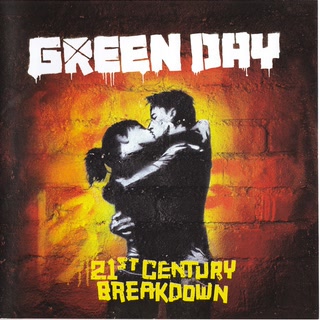
Main tuning: E Standard at concert pitch (−1.1 ¢), measured on the CD.
Produced by Butch Vig, and as close to A 440 as Green Day get. Most songs are tabbed and heard in E Standard: 21 Guns, Know Your Enemy, Last Night on Earth, East Jesus Nowhere and Last of the American Girls among them. Three songs differ:
21st Century Breakdown, the title track, is tabbed in E♭ on every Songsterr version, and the audio check agrees.
Restless Heart Syndrome is a whole step down, in D Standard, on the one Songsterr tab, guitars and bass, and the audio check hears the low D.
Before the Lobotomy is tabbed in E♭ on Songsterr's main tab, but in E Standard in its whole-album transcription. The audio check hears the open low E clearly, so it is listed in E Standard.
Murder City sounds like an E♭ low string to the audio check, but no tab agrees, so it stays in E. See the Light reads about 9 cents sharp and has its own button.
With TuneLit: E Standard at A 440, with the three exceptions above.
Main tuning: E Standard, about 3 cents flat on all three CDs, which counts as concert pitch.
Recorded together at Jingletown in Oakland and released between September and December 2012, the trilogy is the most uniform stretch of the catalogue: every Songsterr tab is in E Standard, and the audio check agrees on almost every song. ¡Tré! is the most even Green Day record TuneLit measured, every song within a few cents of the album.
A few songs are less clear. On ¡Dos!, See You Tonight, the short opener, reads about 34 cents sharp, and Makeout Party about 12 cents flat; both have their own settings. Amy (¡Dos!) and Brutal Love (¡Tré!) sit in flat keys and sound like an E♭ low string to the audio check, but the only tabs say E Standard, so they stay there; Oh Love (¡Uno!) is in the same situation without a firm answer. Drama Queen and 99 Revolutions never use the open low E much, so the check cannot confirm them; the tabs say E Standard.
With TuneLit: E Standard at A 440 for all three albums.
Main tuning: E Standard at concert pitch (−1.4 ¢), measured on the CD.
Self-produced at OTIS in Oakland. Bang Bang, the title track and Still Breathing are tabbed in E Standard, and the audio check agrees on Bang Bang and the title track; Still Breathing, in a flat key, leaves it unsure. Two songs are tabbed a half step down, Say Goodbye and Youngblood, and the audio check hears E♭ on both. Ordinary World, the quiet closer, sits about 11 cents sharp. Outlaws sits in B♭ and never plays the open low E, so the check's guess of F there means nothing.
With TuneLit: E Standard at A 440; E♭ for Say Goodbye and Youngblood.
Main tuning: E Standard, about 7 ¢ flat (A ≈ 438.3), measured on the CD.
The short, glam-flavoured album produced by Butch Walker (its cover shortens the title to Father of All...) is tabbed in E Standard except I Was a Teenage Teenager, a half step down; the audio check agrees with both. It is the flattest Green Day record since Kerplunk, about 7 cents under concert pitch, with I Was a Teenage Teenager and Take the Money and Crawl reading closer to A 440.
With TuneLit: E Standard about 7 cents flat; E♭ for I Was a Teenage Teenager.
Main tuning: E Standard at concert pitch (+1.7 ¢), measured on the CD.
Back with Rob Cavallo, recorded in London and Los Angeles. Most songs are tabbed and heard in E Standard: Look Ma, No Brains!, Bobby Sox, One Eyed Bastard, Goodnight Adeline and the title track among them. Three differ, and the audio check agrees with the tabs on all three:
The American Dream Is Killing Me and Corvette Summer are a half step down, in E♭ Standard.
Dilemma is in Drop D, guitars and bass. On the 2024 tour the bass for it went down to C♯, a half step below the record.
Living in the '20s sits in a flat key and leaves the check undecided; the tab says E Standard.
With TuneLit: E Standard at A 440, with E♭ and Drop D for the three exceptions.
Mike Dirnt playing bass at Rock im Park, Nuremberg, Germany, 8 June 2013.
The story
The semitone check
TuneLit's audio check listens for the lowest open string: a note heard often in the low octaves, with nothing a half step below it. On Green Day's records it agrees with the database on 156 of 185 songs. It is a strong confirmation where it agrees, and only a hint where it does not, because a song that never plays its open low string can fool it. Four songs were moved because the check and another source agreed: American Idiot, Jesus of Suburbia and Waiting (to E♭) and Before the Lobotomy (to E). Nine songs still disagree without a second source, and stay where the tabs put them:
Probably the check's mistake: I Was There, Haushinka, Drama Queen and Outlaws. Each sits in a key that never uses the open low E, which makes the check guess a half step high.
Worth a listen: One for the Razorbacks (heard as E, listed in E♭), and Uptight, Murder City, Amy and Brutal Love (heard as E♭, listed in E). For the last four, both tunings give the record's notes; only the tab's shapes change.
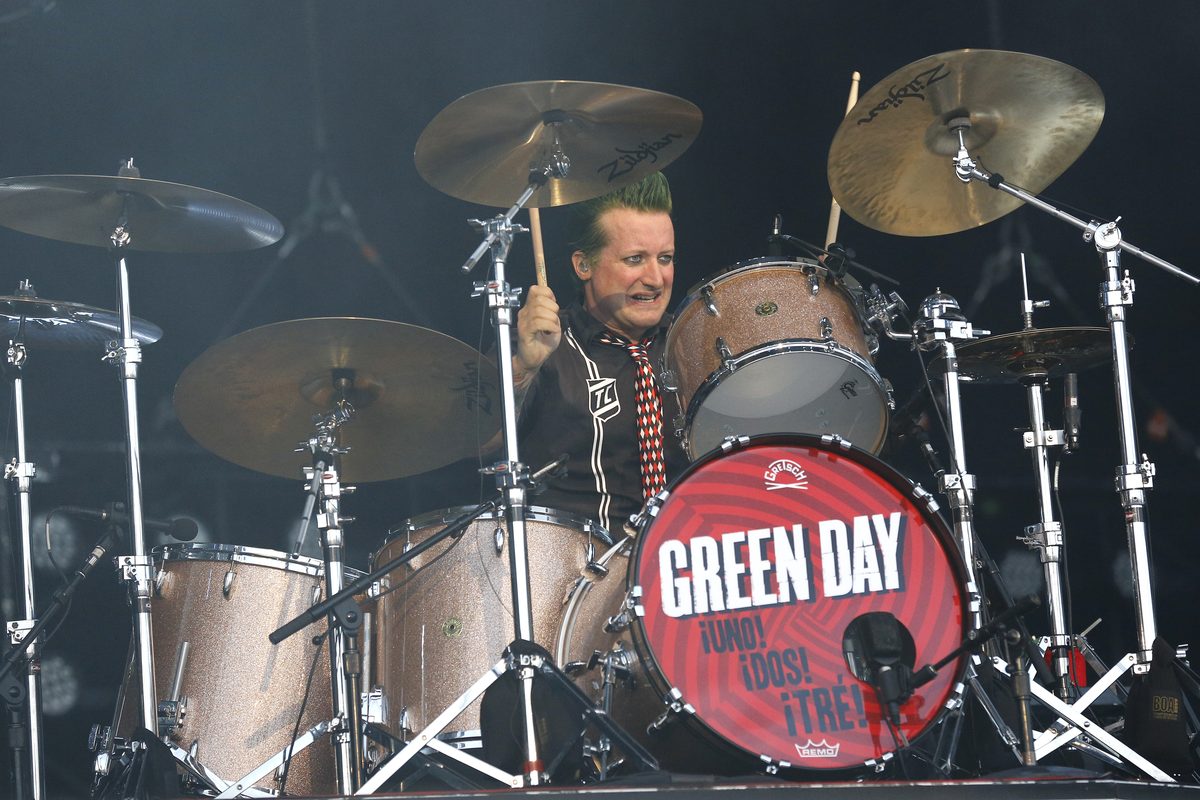
Tré Cool at the drums, the bass drum head painted for ¡Uno! ¡Dos! ¡Tré!, at Rock im Park, Nuremberg, Germany, 8 June 2013.
The story
Playing along
For Kerplunk, Dookie and Insomniac, tune every string down a half step: E♭ A♭ D♭ G♭ B♭ E♭. Then nudge the reference: about A 436 for Kerplunk, A 444 for Dookie, A 445 for Insomniac. The Tune buttons do both at once.
For everything from Nimrod on, start in E Standard. Nimrod wants A 442; the rest is at or near A 440.
For a half-step-down song on a standard album, you can retune, or keep the guitar in E Standard and use the E Standard tab if there is one: in a flat key the notes are the same.
Strings: a half step down only loosens the strings slightly. Billie Joe's E♭ guitar was strung with ordinary .010 sets, the same as his standard ones, so there is no need to change gauge.
Tuning down without an E♭ tuner: put a capo on the first fret, tune the strings to ordinary E Standard, then take the capo off. The open strings are now E♭ A♭ D♭ G♭ B♭ E♭.
Live recordings: if a concert video sounds a semitone off, try E♭ Standard first.
Questions
What tuning does Green Day use?
Mostly E Standard: 11 of 14 albums. Kerplunk, Dookie and Insomniac are in E♭ Standard. Many albums also have songs in other tunings, and the album pages list them song by song.
Why does Green Day sound out of tune when I play along?
Some records are not at concert pitch. Insomniac sits about 18 cents sharp (A ≈ 445); Kerplunk sits about 17 cents flat (A ≈ 436); Dookie sits about 15 cents sharp (A ≈ 444). A guitar tuned to A 440 clashes with them. Every Tune button on these pages sets the measured pitch for you.
How did TuneLit measure Green Day's records?
We played original CDs and LPs through TuneLit's pitch analysis: the strongest notes of each song are compared with the A 440 grid, which gives the offset in cents. That cannot tell the semitone, so the tuning name comes from interviews, the press and tabs, and for 4 songs from TuneLit's semitone check from the audio, backed by a tab or source. The audio is never stored or published.
Colors and font
Font
Colors
Menu
Install the app
Android (Chrome): menu ⋮ → Install app or Add to Home screen.
Computer (Chrome, Edge): the install icon at the right end of the address bar.
iPhone: Safari → Share → Add to Home Screen.
It opens full screen and keeps tuning with no connection.