Lead guitarist Richard Kruspe with a white guitar at the Zénith de Nantes, France, 16 November 2009, on the Liebe ist für alle da tour.
In short
How Rammstein tunes
Rammstein never kept to one tuning. The tabs put the first two albums, Herzeleid (1995) and Sehnsucht (1997), in a mix of E Standard and Drop D, with Weisses Fleisch in E♭ Standard.
Read more
Mutter (2001) is mostly Drop D and opens with the band's first Drop C song, Mein Herz brennt. Reise, Reise (2004) and Rosenrot (2005) are the Drop C albums, Liebe ist für alle da (2009) goes back to Drop D, the untitled 2019 album splits between Drop D and Drop C, and Zeit (2022) adds three songs in Drop B. The guitarists sometimes tune differently on the same song. TuneLit measured all eight studio albums: each sits within 5 cents of A 440, so a normal tuner is enough once the tuning name is right, but nine single songs sit 7 to 23 cents off their album, most of them on Rosenrot. TuneLit's semitone check from the audio agrees with the tabs on 79 of 88 songs.
If you have ever tuned down to Drop C because "Rammstein is in Drop C", then pressed play on Du hast or Sonne and found your riffs a whole step or more too low, you have met the most common Rammstein tuning myth. Rammstein never settled on one tuning. Across eight studio albums the guitars move between E Standard, Drop D and Drop C, with one song in E♭ Standard and three late songs down in Drop B. Drop C really is the sound of Reise, Reise and Rosenrot, and of the big singles Mein Herz brennt, Amerika and Deutschland, but Drop D is used more often overall, and the first two albums lean on plain E Standard.
The good news is the pitch. Unlike many heavy bands, Rammstein record at concert pitch. TuneLit measured all eight studio albums, and every one of them sits within about 5 cents of A 440. Once you have the right tuning name, a normal tuner set to 440 Hz is all you need, apart from a handful of songs listed below that sit 7 to 23 cents away from their album.
This page goes through every studio album, from Herzeleid (1995) to Zeit (2022): the tuning the tabs give for each song, what TuneLit measured on the records, what the audio itself says about the low string, and how to set everything up. The album list above opens each album, where every song has a Tune button that opens the tuner in exactly that tuning.
Popular songs
How to tune for Rammstein's best-known songs
Each song has its own page: the exact tuning, the record's pitch, how to get there string by string, and how to move the record into your own tuning.
Rammstein have had the same six members since 1994: Till Lindemann on vocals, Richard Z. Kruspe on lead guitar, Paul Landers on rhythm guitar, Oliver Riedel on bass, Christoph Schneider on drums and Christian "Flake" Lorenz on keyboards. The two guitarists double each other most of the time, often panned hard left and right, so the tuning of a song is usually the tuning of both. Not always, though, and that is worth knowing before you trust a single tab:
On Mutter (the song), the tabs give the lead guitar in E Standard and the rhythm guitar in Drop D.
On Deutschland, one Songsterr transcription puts Kruspe's part in Drop C and Landers' part in Drop D. The German guitar site bonedo, in its lesson on the riff, writes that the band tunes to Drop C.
Gear notes back the idea of different guitars for different tunings. Equipboard writes that from 1997 Kruspe used one ESP model for Drop D songs and his older ESP for standard tuning, and later brought the older guitar back for alternate tunings such as Mein Herz brennt. Paul Landers' Wikipedia gear list has guitars kept in Drop C, Drop D and standard tuning, with a Les Paul kept in standard tuning just for the song Rammstein.
None of this comes from an interview in which the band lists its tunings; we found no such interview. The tunings on this page come from the tabs (mostly Songsterr, whose Rammstein tabs are detailed and widely used, checked against Ultimate Guitar), and TuneLit's own measurements and audio checks are layered on top.
The three tunings you need:
E Standard (E A D G B E): the early songs such as Du hast, Asche zu Asche, Links 2 3 4 and Mutter, plus a few acoustic songs.
Drop D (D A D G B E): the most common Rammstein tuning, from Sonne and Engel to Haifisch, Ausländer and most of Zeit.
Drop C (C G C F A D): the whole step lower drop tuning, starting with Mein Herz brennt and covering almost all of Reise, Reise and Rosenrot.
Add E♭ Standard for Weisses Fleisch and Drop B (B F♯ B E G♯ C♯) for three songs on Zeit, and you can play the whole studio catalogue.
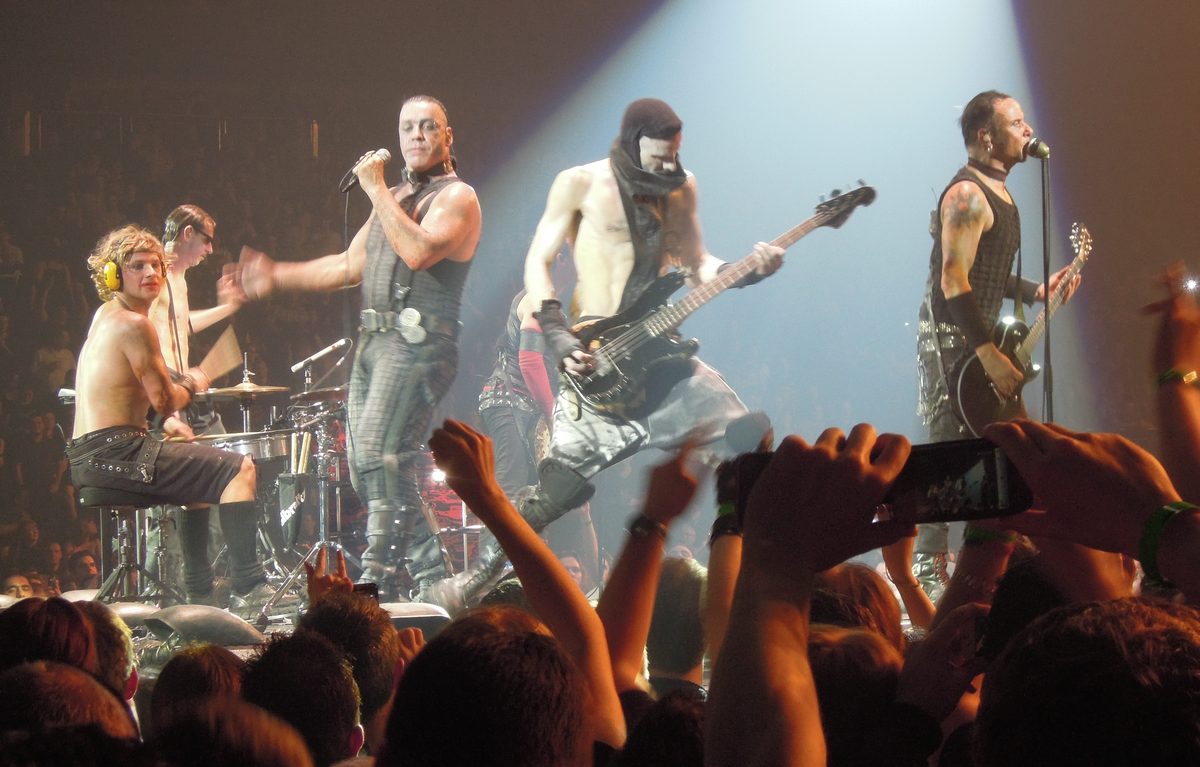
Rammstein on the small stage at the O2 Arena, London, 24 February 2012, playing Bück dich: Till Lindemann in the centre, bassist Oliver Riedel and guitarist Paul Landers to the right.
The story
Era by era
1995–1997: E Standard and Drop D. Herzeleid and Sehnsucht mix the two freely, sometimes from one song to the next. On Herzeleid six songs are tabbed in E Standard, four in Drop D and one, Weisses Fleisch, in E♭ Standard. On Sehnsucht the balance flips: seven Drop D songs against four in E Standard, Du hast among them. The bass often goes below the guitars on these records, so the deepest notes you hear are not always on the guitar.
2001: Drop D, and the first Drop C. Mutter is mostly a Drop D album (Sonne, Ich will, Feuer frei!), with two E Standard songs (Links 2 3 4 and the title track) and one big change at the very start: Mein Herz brennt is in Drop C, a whole step below anything on the first two records.
2004–2005: the Drop C years. Reise, Reise is a Drop C album from start to finish, with Moskau the one song tabbed in Drop D. Rosenrot, which collects six songs written for Reise, Reise, follows it: nine songs in Drop C, one duet in E Standard and one song in Drop D.
2009: back to Drop D. Liebe ist für alle da returns to Drop D for nearly everything. Pussy is the only Drop C song and Roter Sand is an acoustic song in E Standard.
2019–2022: Drop D and Drop C side by side, then Drop B. The untitled 2019 album splits down the middle: Deutschland, Radio, Zeig dich and Sex in Drop C, six songs in Drop D, and the acoustic Diamant in E Standard. Zeit (2022) is mostly Drop D again, with Zick Zack in Drop C and, for the first time, three songs in Drop B: Meine Tränen, Angst and Dicke Titten.
Main tuning: E Standard at concert pitch (measured +1 ¢, A ≈ 440.3).
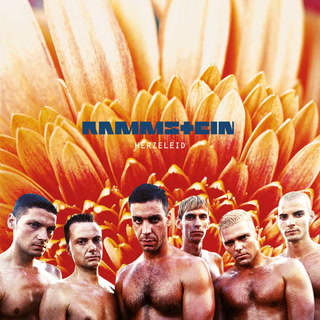
The debut, produced by Jacob Hellner, is the most mixed album in the catalogue. Six songs are tabbed in E Standard: Asche zu Asche, Seemann, Das alte Leid, Heirate mich, Herzeleid and Rammstein. Wollt ihr das Bett in Flammen sehen, Der Meister, Du riechst so gut and Laichzeit are in Drop D, and Weisses Fleisch is a half step down in E♭ Standard. Ultimate Guitar has Drop D versions of Das alte Leid and Heirate mich, but TuneLit's semitone check from the audio hears E as their lowest open string, and the low D hardly ever sounds on either record.
The album measures within a cent or two of A 440. Seemann is the exception: it sits about 16 cents flat (A ≈ 436) through most of the song, so it gets its own setting. Two more songs read oddly. Laichzeit measures about 47 cents flat, halfway between two notes, but only at low confidence; the note heard most is E (on that flat grid), and the open D the tabs tune to never sounds. Wollt ihr das Bett in Flammen sehen reads about 43 cents flat at very low confidence, while its bass line reads close to the album's pitch. Neither reading is strong enough to change the setting, so both songs stay at the album pitch for now. If one of them sounds out of tune against you, these are the songs to check by ear first.
With TuneLit: E Standard for most songs, Drop D for tracks 1, 2, 6 and 10, E♭ Standard for Weisses Fleisch, and E Standard at A 436 for Seemann. The low end of Seemann goes down to a low C♯ and A, far below the guitar, which is why it sounds deeper than an E Standard guitar can reach.
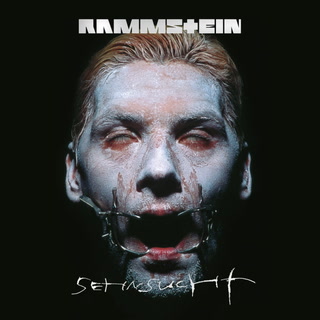
Sehnsucht made Rammstein famous abroad, and its best-known song is not in Drop D at all. Du hast is tabbed in E Standard, and its riff never uses the open low string, so a Drop D guitar plays it just as well. Sehnsucht, Spiel mit mir and Klavier are in E Standard too. Engel, Tier, Bestrafe mich, Bück dich, Alter Mann, Eifersucht and Küss mich (Fellfrosch) are in Drop D. The check from the audio agrees with the tabs on ten of the eleven songs; on Alter Mann it is unsure, because the bass part goes down to a low B, below the guitar.
The whole record sits about 5 cents sharp, a small but real offset that every Tune button on the album includes. It is the sharpest Rammstein album, which still only means A ≈ 441.
With TuneLit: Drop D at +5 ¢ for the album, E Standard at +5 ¢ for Sehnsucht, Du hast, Spiel mit mir and Klavier. If you play straight through, you retune String 6 between D and E four times.
Main tuning: Drop D at concert pitch (measured +2 ¢, A ≈ 440.6).
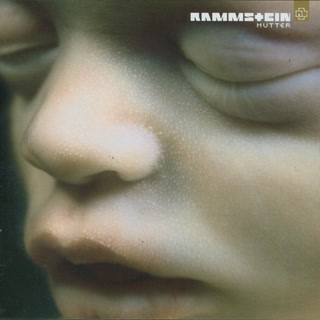
Mutter opens with the band's first Drop C song. Mein Herz brennt is tabbed in Drop C on Songsterr, and the audio check confirms C as its lowest open string, with the low C sounding in both the bass and the guitar range. Most of the album is in Drop D: Sonne, Ich will, Feuer frei!, Spieluhr, Zwitter, Rein raus, Adios and Nebel. Links 2 3 4 is in E Standard. The title track splits: the tabs give the lead guitar in E Standard and the rhythm guitar in Drop D, and the database lists E Standard, the lead part and by far the more used tab.
The check from the audio agrees with the tabs on all eleven songs. Sonne's bass tab uses a 5-string bass, and the record does go down to a low B, but the guitars stay in Drop D. Nebel, the closing ballad, measures about 7 cents flat (A ≈ 438.3) and drifts upwards through the song, so treat its setting as a middle value.
With TuneLit: Drop C for track 1, E Standard for tracks 2 and 6, Drop D for the rest, Nebel at A 438.
Main tuning: Drop C at concert pitch (measured +1 ¢, A ≈ 440.2).
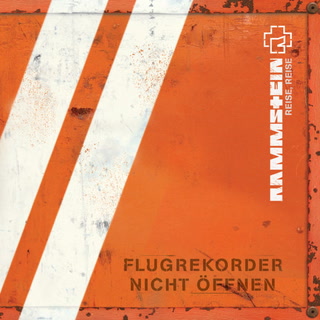
This is the album that earned Rammstein their Drop C reputation. Every song except Moskau is tabbed in Drop C on Songsterr, including Mein Teil, Keine Lust, Amerika and Ohne dich, and a fan equipment page says Kruspe's signature guitar was set to Drop C for the tour. The check from the audio confirms C on nine songs. It is unsure on the title track, whose low notes lean on C♯, a fret above the open string. Moskau is tabbed in Drop D; on the record its open D is rare and E is the note you hear most, so the check cannot settle it, and Ultimate Guitar also has versions in E Standard and Drop C.
The album sits at concert pitch, with two songs higher: Amerika about 10 cents sharp (A ≈ 442.5) and Stein um Stein about 15 cents sharp (A ≈ 443.7). Neither is a big step, but both are enough to hear when you play along with a 440 tuning.
With TuneLit: Drop C everywhere except Moskau (Drop D). Amerika and Stein um Stein open with their own sharper reference.
Main tuning: Drop C at concert pitch (measured +2 ¢, A ≈ 440.6).
Rosenrot includes six songs written for Reise, Reise, and it keeps that album's tuning. Benzin, Mann gegen Mann, Rosenrot, Spring, Wo bist du, Zerstören, Hilf mir, Te quiero puta! and Feuer und Wasser are all tabbed in Drop C. Two songs differ: Stirb nicht vor mir (Don't Die Before I Do), the duet with Sharleen Spiteri, is in E Standard, and the closer Ein Lied is in Drop D.
This is the album with the most songs away from the album pitch. Stirb nicht vor mir sits about 8 cents flat (A ≈ 437.9) and Hilf mir about 15 cents flat (A ≈ 436.3), while Ein Lied is about 15 cents sharp (A ≈ 443.8) and Te quiero puta! about 23 cents sharp (A ≈ 445.8). Stirb nicht vor mir and Ein Lied read the same through most of the song; Hilf mir and Te quiero puta! change from section to section, so use their settings as a starting point. The check from the audio confirms the tabs on ten songs. On Hilf mir it prefers a low B, a note that most likely comes from the bass or keyboards going below the guitars; no tab points to B, so the song stays in Drop C.
With TuneLit: Drop C for the album, E Standard at A 438 for Stirb nicht vor mir, Drop D at A 444 for Ein Lied, and the own settings for Hilf mir and Te quiero puta!.
Main tuning: Drop D at concert pitch (measured 0 ¢, A 440).
After two Drop C albums, Rammstein went back to Drop D. Songsterr tabs nine songs in Drop D, from Rammlied and Ich tu dir weh to Haifisch and Mehr. Pussy is the only Drop C song, and Roter Sand is an acoustic song in E Standard. Rammlied also has a Drop C tab, but the more used one is in Drop D and the audio check agrees with D. Frühling in Paris has a C♯ Standard tab on Ultimate Guitar; the check agrees with Drop D. On Haifisch and Wiener Blut the check is unsure: both songs sit on E and the open D is hardly heard, so they can be played in Drop D or in E Standard with the same notes (Songsterr's bass tab of Haifisch is in E Standard).
The whole album measures right on A 440, with no song far enough away to need its own setting.
With TuneLit: Drop D for the album, Drop C for Pussy, E Standard for Roter Sand. The standard edition's eleven songs are listed; the bonus disc of the special edition is not part of this page.
Main tuning: Drop D at concert pitch (measured +2 ¢, A ≈ 440.5).
The untitled 2019 album, the first not produced by Jacob Hellner, is split almost evenly. The opening singles Deutschland and Radio, plus Zeig dich and Sex, are tabbed in Drop C. Ausländer, Puppe, Was ich liebe, Weit weg, Tattoo and Hallomann are in Drop D. Diamant is a short acoustic song in E Standard. Ultimate Guitar has Drop C tabs of Ausländer and Was ich liebe; the audio check agrees with Drop D for both. For Deutschland, bonedo's word and the tabs say Drop C and the check agrees, although the bass never goes below D.
Weit weg sits about 16 cents sharp (A ≈ 444) from start to finish; the rest of the album is at concert pitch. Diamant's check points a semitone up, the known mistake on a song that never plays its open low string, so it stays in E Standard. Tattoo is another song that sits on E: its open low D is not heard on the record.
With TuneLit: Drop C for tracks 1, 2, 3 and 5, Drop D for the rest, E Standard for Diamant and A 444 for Weit weg.
Main tuning: Drop D at concert pitch (measured 0 ¢, A 440).
Zeit is mostly a Drop D album: Armee der Tristen, Zeit, Schwarz, Giftig, OK, Lügen and Adieu. Zick Zack is in Drop C, and three songs go lower than anything before them: Meine Tränen, Angst and Dicke Titten are tabbed in Drop B, B F♯ B E G♯ C♯. The audio check agrees with every song on the album, including the low B on all three.
The album measures right on A 440 with almost no spread between songs, the most even record in the catalogue.
With TuneLit: Drop D for the album, Drop C for Zick Zack, Drop B for tracks 7, 8 and 9. Drop B is two and a half steps below standard on String 6, so a heavier set of strings, or a guitar kept for that tuning, makes a big difference.
TuneLit lab
What TuneLit measured
TuneLit's recording estimator takes 90 seconds of each song, finds the strongest notes and compares them with the equal-tempered grid. That gives the record's offset from A 440 to within a few cents, but only within one semitone; the tuning name itself comes from the tabs. We measured one digital copy of each studio album from our own library. The audio is never uploaded or published; only the numbers appear here.
Album
Tabs say
TuneLit measured
Equivalent A
Songs with their own value
Herzeleid (1995)
E Standard, Drop D, E♭
+1 ¢
A ≈ 440.3
Seemann −16 ¢
Sehnsucht (1997)
Drop D, E Standard
+5 ¢
A ≈ 441.3
–
Mutter (2001)
Drop D, Drop C, E Standard
+2 ¢
A ≈ 440.6
Nebel −7 ¢
Reise, Reise (2004)
Drop C
+1 ¢
A ≈ 440.2
Amerika +10 ¢, Stein um Stein +15 ¢
Rosenrot (2005)
Drop C
+2 ¢
A ≈ 440.6
Stirb nicht vor mir −8 ¢, Hilf mir −15 ¢, Te quiero puta! +23 ¢, Ein Lied +15 ¢
Liebe ist für alle da (2009)
Drop D
0 ¢
A 440
–
Rammstein (2019)
Drop D, Drop C
+2 ¢
A ≈ 440.5
Weit weg +16 ¢
Zeit (2022)
Drop D, Drop C, Drop B
0 ¢
A 440
–
The headline is how unremarkable the album values are. Every album lands between 0 and +5 ¢; offsets of 4 cents or less count as concert pitch, so only Sehnsucht carries an album offset at all. The surprises are single songs: nine of them sit 7 to 23 cents away from their album, most of them on Rosenrot. A few cents is hard to hear on a single note, but 15 to 20 cents makes a sustained chord against the record sound sour.
Which string is the low one? A second check listens for the lowest open string in the audio. It agrees with the tabs on 79 of the 88 songs. It is unsure on seven: Laichzeit, Alter Mann, Reise, Reise, Moskau, Haifisch, Wiener Blut and Hallomann, mostly songs whose riffs sit a step above the open string or whose bass goes lower than the guitars. It disagrees on two, Hilf mir and Diamant, and in both cases the cause is a known weak spot (a bass below the guitars, a song that never plays its open low string), with no tab pointing the same way, so neither song was moved. This check only compares neighbouring semitones. It can confirm that a Drop C song is not in Drop B or Drop C♯, but on its own it cannot tell Drop C from Drop D, which is a whole step apart. Where the low C clearly sounds on a record (Mein Herz brennt, most of Reise, Reise and Rosenrot, Radio, Sex, Zick Zack), the measurement backs the Drop C tabs.
Keep the limits in mind. Dense, distorted mixes are harder to read than clean ones, so single songs scatter by a few cents; only clear outliers get their own value. A measurement hears the result, not the cause, so it cannot tell a guitar tuned sharp from a tape running fast.
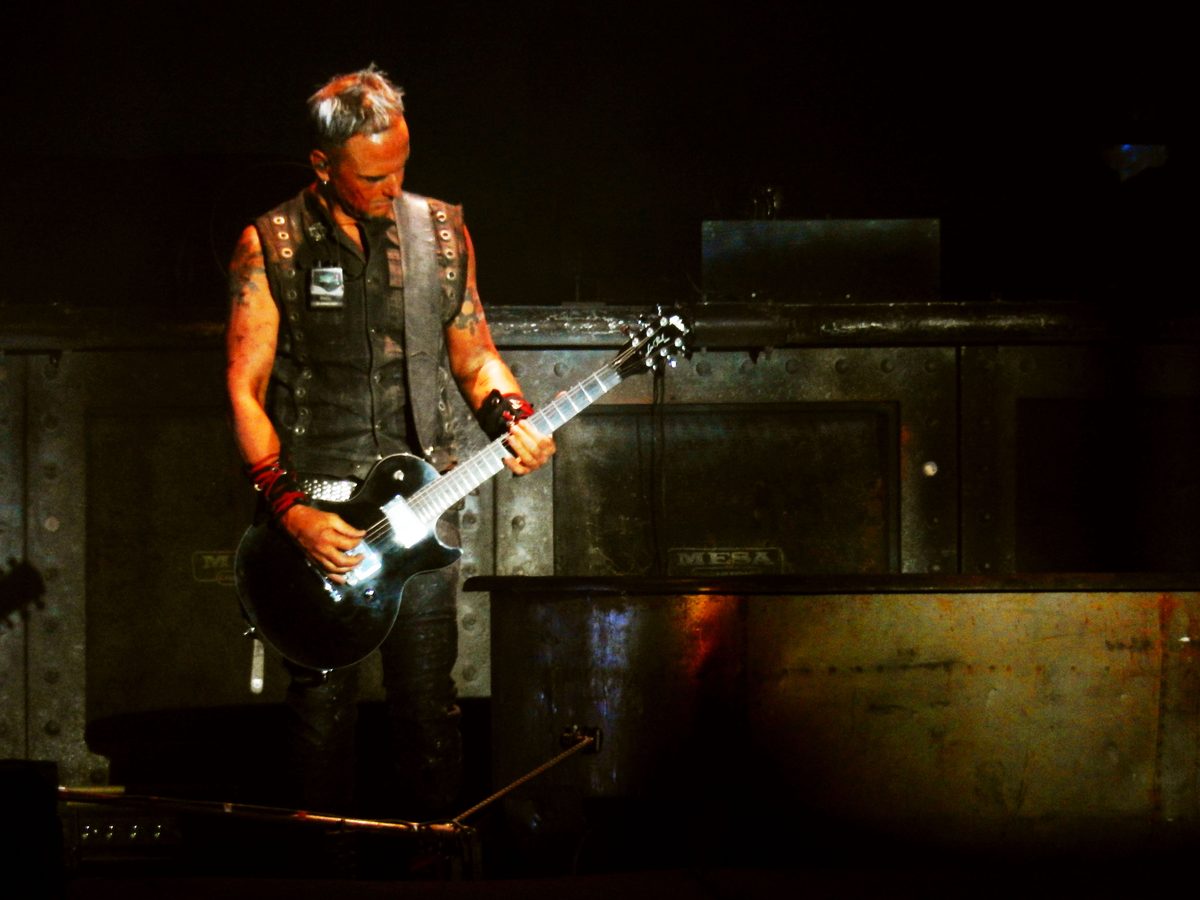
Rhythm guitarist Paul Landers playing a black single-cutaway guitar in the Arena of Nîmes, France, 13 July 2017.
Evidence
How sure are these numbers?
Every tuning on the album pages carries a status label. Every entry for Rammstein now reads Measured by TuneLit, because its offset comes from our own analysis of the record. The tuning name underneath rests on other evidence:
Widely reported: a guitar publication names the tuning. For Rammstein that is bonedo's Drop C for Deutschland.
Community: community transcriptions, mostly Songsterr, checked against Ultimate Guitar. This covers nearly every Rammstein song. Where the tabs disagree, the song's notes say so.
Measured by TuneLit: our pitch analysis of the record, which gives the offset in cents. The audio check of the low string backs most of the tab names.
If a song still sounds a touch off, nudge the reference by a hertz or two; near 440 Hz, one hertz is about 4 cents.
The story
Practical tips
Check the song, not the album. Five of the eight albums mix two or more tunings. The Tune button on each song is the quickest way to get it right.
Drop D and Drop C use the same shapes. Both drop the low string a whole step below String 5, so one-finger power chords work the same way. Only the pitch differs: Drop C is every string a whole step below Drop D.
Strings for the low tunings. A light set that feels fine in E Standard flaps in Drop C and gets very loose in Drop B. Heavier strings, or a guitar kept for the low tunings, keep the riffs tight and in tune when you pick hard.
Palm mutes and timing matter more than the tuning. Rammstein riffs are simple on paper and hard to play as tightly as the record. Practise with the record at its real pitch, and the timing is the only thing left to work on.
Bassist Oliver Riedel and Richard Kruspe on stage at the BBK Live festival in Bilbao, Spain, 8 July 2010.
Cheat sheet
Quick reference
Herzeleid (1995): E Standard at A 440. Drop D: Wollt ihr das Bett in Flammen sehen, Der Meister, Du riechst so gut, Laichzeit. E♭ Standard: Weisses Fleisch. Seemann at A 436.
Sehnsucht (1997): Drop D at +5 ¢. E Standard at +5 ¢: Sehnsucht, Du hast, Spiel mit mir, Klavier.
Mutter (2001): Drop D at A 440. Drop C: Mein Herz brennt. E Standard: Links 2 3 4, Mutter. Nebel at A 438.
Reise, Reise (2004): Drop C at A 440. Drop D: Moskau. Amerika at A 442.5, Stein um Stein at A 443.7.
Rosenrot (2005): Drop C at A 440. E Standard at A 438: Stirb nicht vor mir. Drop D at A 444: Ein Lied. Hilf mir at A 436, Te quiero puta! at A 446.
Liebe ist für alle da (2009): Drop D at A 440. Drop C: Pussy. E Standard: Roter Sand.
Rammstein (2019): Drop D at A 440. Drop C: Deutschland, Radio, Zeig dich, Sex. E Standard: Diamant. Weit weg at A 444.
Zeit (2022): Drop D at A 440. Drop C: Zick Zack. Drop B: Meine Tränen, Angst, Dicke Titten.
Golden rule: the reference is almost always 440 Hz; the tuning name is what changes, sometimes from one track to the next.
Questions
What tuning does Rammstein use?
Mostly Drop D: 5 of 8 albums. Reise, Reise and Rosenrot are in Drop C; Herzeleid is in E Standard. Many albums also have songs in other tunings, and the album pages list them song by song.
How did TuneLit measure Rammstein's records?
We played original CDs and LPs through TuneLit's pitch analysis: the strongest notes of each song are compared with the A 440 grid, which gives the offset in cents. That cannot tell the semitone, so the tuning name comes from interviews, the press and tabs. The audio is never stored or published.
Colors and font
Font
Colors
Menu
Install the app
Android (Chrome): menu ⋮ → Install app or Add to Home screen.
Computer (Chrome, Edge): the install icon at the right end of the address bar.
iPhone: Safari → Share → Add to Home Screen.
It opens full screen and keeps tuning with no connection.