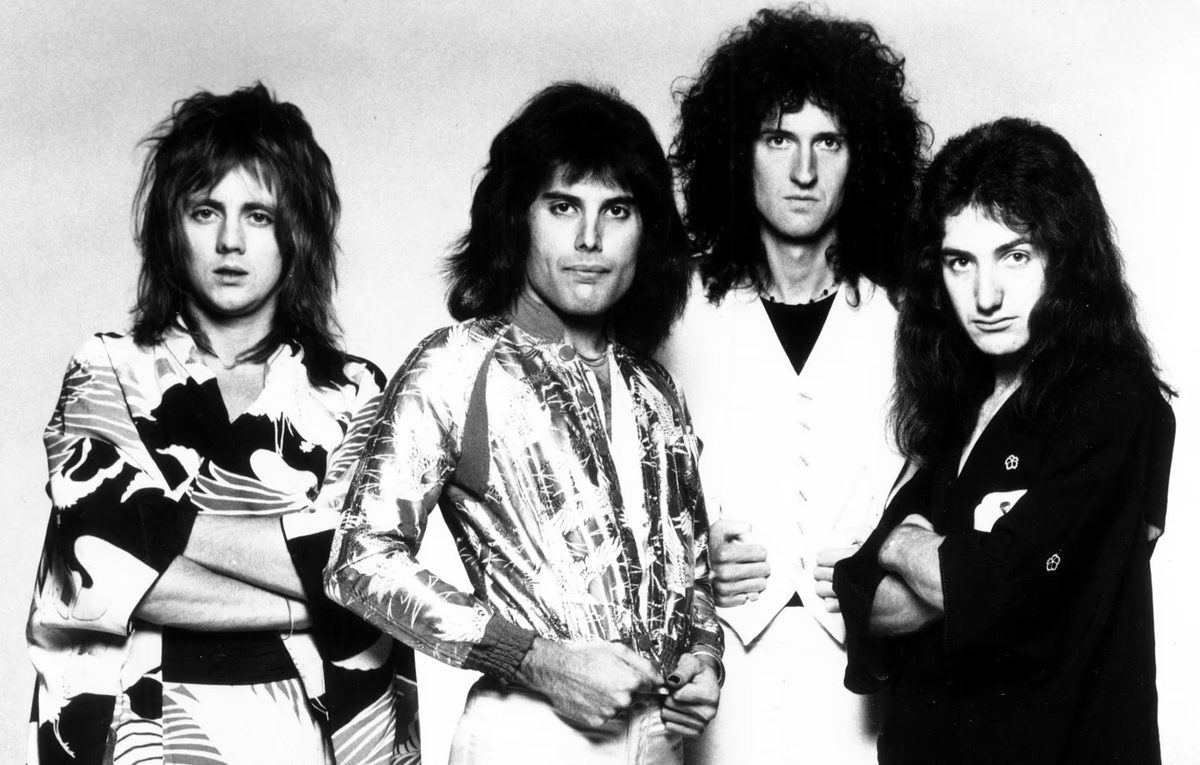
Queen in a 1975 Elektra Records publicity photo for A Night at the Opera: Roger Taylor, Freddie Mercury, Brian May and John Deacon (left to right).
In short
How Queen tunes
Brian May tuned his home-built Red Special to E Standard for almost every Queen song. Fat Bottomed Girls is in Drop D by his own account, The Prophet's Song, White Man and Headlong drop string 6 to D as well, and Is This the World We Created...? is tabbed in E♭ Standard.
Read more
TuneLit measured all fifteen studio albums from CD, and the pitch is the surprise. A Night at the Opera, Bohemian Rhapsody included, sits about 15 cents flat (A ≈ 436), A Day at the Races about 21 cents flat (A ≈ 435), while the debut and Jazz run 11 and 16 cents sharp. From The Game on, every album is within 4 cents of A 440, yet single songs keep wandering: Hammer to Fall is 33 cents flat, Staying Power 35 cents sharp, Scandal 27 cents sharp, and Long Away, Khashoggi's Ship, Coming Soon and The Hitman sit close to half a semitone off. Another One Bites the Dust sits so far up that its riff sounds closer to F than to E. Japanese remasters and Mobile Fidelity gold CDs read the same within a few cents, so the offsets are on the master tapes. Every Tune button carries the song's own measured offset.
Queen look like an easy band to tune for. Brian May built his guitar, the Red Special, with his father Harold in the early 1960s, and he kept it in plain E Standard for almost everything the band recorded: no baritones, no open tunings, no riffs tuned down low. When Total Guitar filmed a lesson with him in 2011 about Fat Bottomed Girls, the magazine introduced him as a player not usually associated with alternative tunings, and that song's Drop D is the exception the whole catalogue is known for.
The difficulty is in the records. Queen's 1970s albums do not sit at A 440. A Night at the Opera plays about 15 cents flat, A Day at the Races about 21 cents flat, the debut and Jazz 11 and 16 cents sharp. Inside an album, single songs sit a quarter or almost half a semitone away from their neighbours, and a guitar tuned to an ordinary 440 tuner sounds sour against many of them. This page collects what the tabs and sources say about every studio album from Queen (1973) to Made in Heaven (1995), what TuneLit measured on the CDs, and how to tune along. The album pages list every song with a Tune button that opens the tuner in exactly that tuning, measured offset included.
Popular songs
How to tune for Queen's best-known songs
Each song has its own page: the exact tuning, the record's pitch, how to get there string by string, and how to move the record into your own tuning.
TuneLit measured all fifteen studio albums, the Flash Gordon soundtrack included, from the owner's CDs, taking the earliest CD edition in the library as the source for each album:
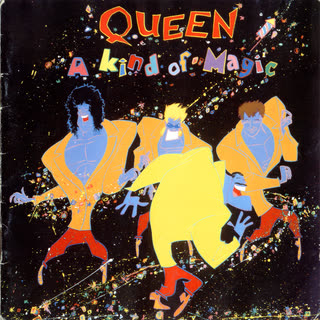
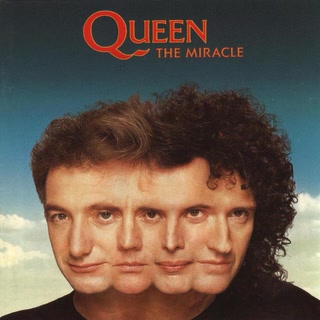
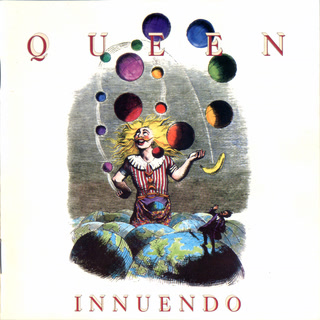
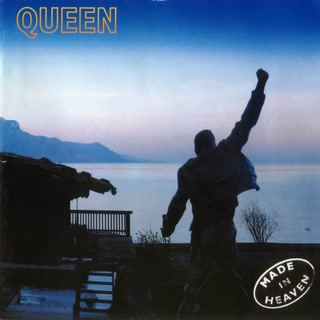
First CD issues: A Kind of Magic (EMI CDP 7 46267 2, 1986), The Miracle (Parlophone CDP 7 92357 2, 1989), Innuendo (Parlophone CDP 7 95887 2, 1991) and Made in Heaven (Parlophone, 1995). Their CD bonus tracks are left out.
Hollywood Records, 1991: Sheer Heart Attack, from the American reissue; its bonus remix of Stone Cold Crazy is left out.
Mobile Fidelity gold CD, 1992: A Night at the Opera (UDCD 568).
EMI's Digital Master Series, 1993 and 1994: Queen, Queen II, A Day at the Races, News of the World, Jazz, The Game, Flash Gordon, Hot Space and The Works (Parlophone CDPCSD 131 to 140). Several of these rips also carry the bonus tracks of the 1991 Hollywood CDs, which we left out.
Every album is in the library more than once: Toshiba-EMI's Japanese remasters of 2001 and 2004 for all fifteen, Mobile Fidelity gold CDs of A Day at the Races, News of the World and The Game, and a 2000 remaster of A Night at the Opera. We measured those too, as a cross-check, song by song. On eleven albums they agree with the primary CD within about a cent, so the offsets on this page are on Queen's master tapes, not in one transfer. The exceptions are small. The 1994 EMI CDs of The Game and Flash Gordon read about 4 cents lower than the Japanese remasters, and The Game's Mobile Fidelity disc agrees with the Japanese one. News of the World's 1993 CD reads 2 to 3 cents below both of its other editions, and A Day at the Races' Japanese remaster 2 cents below the other two. If you play along with one of those other editions, add those few cents.
The method is the one behind every TuneLit band page. The estimator reads 90 seconds of each song, from 0:45, compares the strongest notes with the equal-tempered grid and gives the record's offset from A 440, known only within one semitone. Which semitone the strings sit on comes from the tabs and sources. A song gets its own value when it differs from its album by 8 cents or more with good confidence; anything within ±4 cents counts as concert pitch.
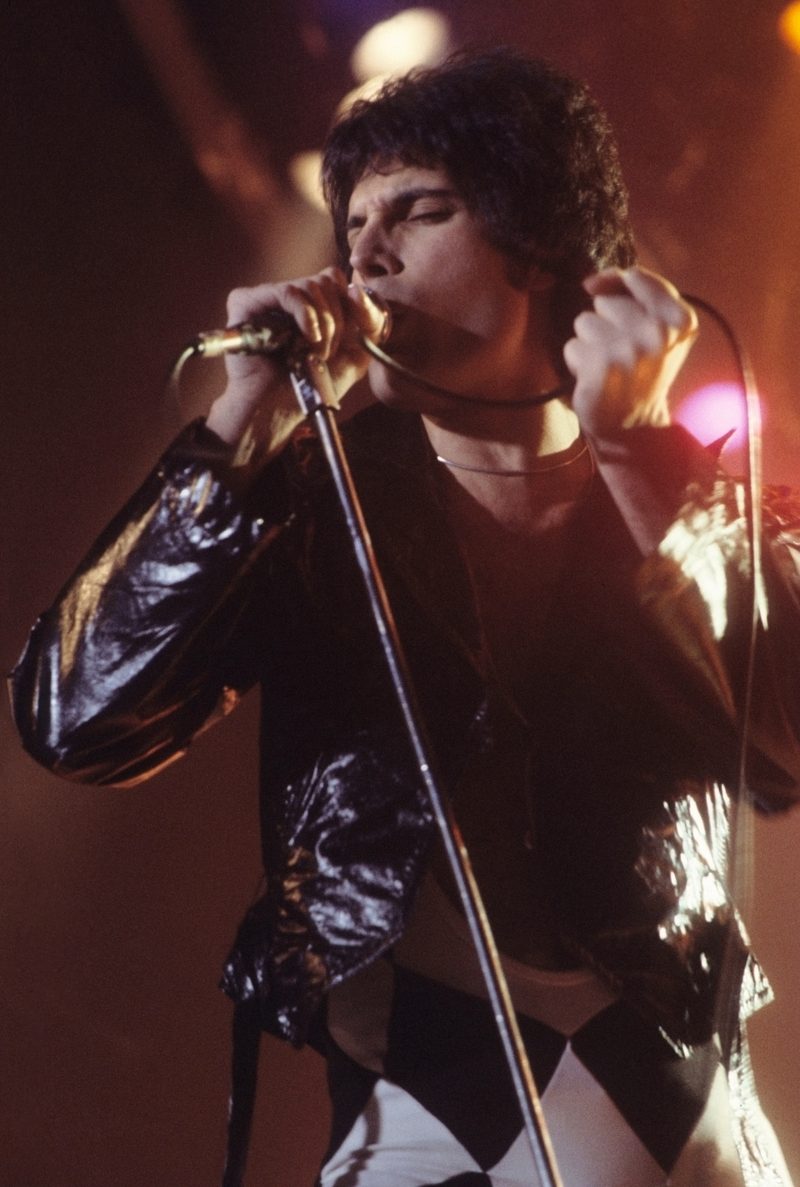
Freddie Mercury singing at the New Haven Coliseum, Connecticut, in November 1977.
The story
Brian May's tunings in one place
Tuning
Strings, low to high
Songs
E Standard
E A D G B E
almost every song
Drop D
D A D G B E
Fat Bottomed Girls, The Prophet's Song, White Man, Headlong
E♭ Standard
E♭ A♭ D♭ G♭ B♭ E♭
Is This the World We Created...? (tab)
F Standard, 43 ¢ flat
F B♭ E♭ A♭ C F
Another One Bites the Dust (the record, see The Game)
Drop D is the one alternative tuning May has talked about. Fat Bottomed Girls was written in it, he told Total Guitar, and on stage he plays it on a separate copy of the Red Special, a green guitar by Andrew Guyton kept in Drop D for that song. The Prophet's Song is the other documented case: May lowered string 6 to D for it. White Man and Headlong are in Drop D on the community tabs. On all four records TuneLit's audio check hears D as the lowest open string, which the tabs alone could not prove.
E♭ Standard turns up once, on the community tab of Is This the World We Created...?, an acoustic ballad played on an Ovation. The song is usually written out in B minor, and the record sounds a semitone lower; the tab gets there by tuning down a half step.
Everything else is standard tuning, but not always on the Red Special:
12-string guitars: May plays a 12-string acoustic on '39 and Las Palabras de Amor, and a Burns Double Six 12-string electric for the rhythm parts of Long Away. All in standard tuning, so a six-string covers them.
Ukuleles: Good Company, which May wrote on his father's banjo ukulele and recorded on a regular ukulele, and a short ukulele-banjo part on Bring Back That Leroy Brown. TuneLit's tuner has a ukulele, but no source gives the tuning May used.
Harp and toy koto: May's harp glissandos on Love of My Life, a toy koto on The Prophet's Song.
Spanish guitars: John Deacon and May on Who Needs You, and Steve Howe's flamenco interlude in Innuendo.
Slide: May plays slide on Tie Your Mother Down and Drowse, and a glass slide for the solo of Radio Ga Ga.
Other hands: Deacon plays all the guitars on Cool Cat and most of them on Misfire, and rhythm guitar on Back Chat and Pain Is So Close to Pleasure. Roger Taylor plays rhythm guitar on Sheer Heart Attack, Fight from the Inside and Drowse. Freddie Mercury plays the acoustic rhythm guitar of Crazy Little Thing Called Love.
The story
Flat keys on standard guitars
Many Queen songs began on Mercury's piano, in keys guitarists rarely meet: Bohemian Rhapsody moves through B♭, E♭, A and F major, and Somebody to Love is in A♭ major. That is not a tuning. The guitars stay in E Standard and play barre shapes, and the tabs assume the same, so do not tune down to make a flat key easier.
It matters for one more reason. TuneLit's audio check listens for the open low string, and in these songs the open E is rarely played. It then tends to answer "one semitone higher", a known error of the method, which is why fifteen Queen songs that rarely touch the open E show that answer in the measurement report while their tuning stays in E.
The story
The pitch of the records
The albums fall into two groups. The 1970s records each have a pitch of their own: Queen +11 ¢ (A ≈ 442.7), Queen II +7 ¢, Sheer Heart Attack −4 ¢, A Night at the Opera −15 ¢ (A ≈ 436.3), A Day at the Races −21 ¢ (A ≈ 434.8), News of the World −4 ¢, Jazz +16 ¢ (A ≈ 444). From The Game (1980), the first album the band made with the producer Mack in Munich, to Made in Heaven (1995), every album sits within 4 cents of A 440.
Single songs are another story. More than a quarter of the songs differ from their album enough to get a value of their own, and a dozen sit 25 cents or more from A 440: Seven Seas of Rhye on Queen II (−41 ¢), Long Away (−45 ¢), Fight from the Inside (half a semitone), Who Needs You (−26 ¢), Dreamer's Ball (−31 ¢), Another One Bites the Dust, Coming Soon (+42 ¢), Staying Power (+35 ¢), Hammer to Fall (−33 ¢), Khashoggi's Ship (−47 ¢), Scandal (+27 ¢) and The Hitman (+47 ¢). Read in 30-second windows, each of them holds its pitch from start to end, and the other CD editions show the same values, so these are properties of the finished masters. How each song got there, through tape speed during recording or mixing or otherwise, a measurement cannot tell. What it can tell is where to tune.
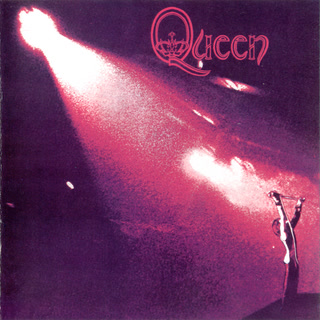
Main tuning: E Standard +11 ¢ (A ≈ 442.7), measured by TuneLit on EMI's 1994 CD.
The debut is a guitar record in E Standard, from Keep Yourself Alive to Liar and Son and Daughter, with May's Hallfredh acoustic on Doing All Right. Its songs do not share one pitch. Six of them sit 8 to 17 cents sharp, which gives the album its +11 ¢, but Keep Yourself Alive and Jesus are about 9 cents flat, and The Night Comes Down, the one song the band kept from its earlier demo session, sits at concert pitch. So does the short instrumental Seven Seas of Rhye... that closes the album.
With TuneLit: E Standard everywhere; use each song's button, because the spread from Jesus to Modern Times Rock 'n' Roll is 26 cents.
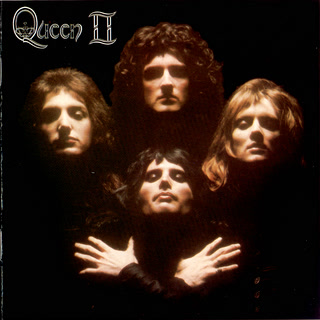
Main tuning: E Standard +7 ¢ (A ≈ 441.8), measured on EMI's 1994 CD.
The white side and the black side are both E Standard guitar records, with May's multi-tracked guitar orchestras on Procession and Father to Son. Two of the seven guitar lines in the Procession tab, and two parts of the Father to Son tab, drop string 6 to D; the main parts stay in standard tuning. The March of the Black Queen (+18 ¢) and Funny How Love Is (+17 ¢) run sharp, White Queen and The Loser in the End sit near concert pitch, and the single Seven Seas of Rhye is the outlier: about 41 cents flat (A ≈ 429.7), steady through the song and the same on the Japanese remaster.
With TuneLit: E Standard; for Seven Seas of Rhye use its own button, almost half a semitone down.
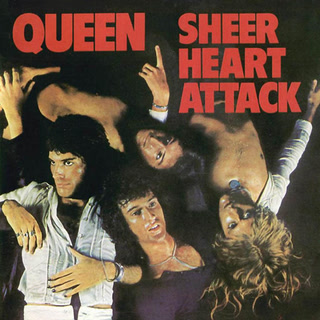
Main tuning: E Standard −4 ¢ (A ≈ 438.9), measured on Hollywood Records' 1991 CD.
The steadiest of the early albums: most songs sit within a few cents of the album value. Brighton Rock, with May's delay solo, Killer Queen and Stone Cold Crazy are all tabbed in E Standard. Now I'm Here (+7 ¢) and Stone Cold Crazy (+5 ¢) sit a little higher, In the Lap of the Gods (−13 ¢) lower. Deacon plays acoustic guitar on Tenement Funster and almost all the guitars on Misfire, May a short ukulele-banjo part on Bring Back That Leroy Brown.
With TuneLit: E Standard at −4 ¢ for most of the album; the three songs above have their own buttons.
Main tuning: E Standard −15 ¢ (A ≈ 436.3), measured on Mobile Fidelity's 1992 gold CD.
The flattest album but one, and the most consistent: nine of the twelve songs sit between 10 and 17 cents flat, including Bohemian Rhapsody (−15 ¢, steady from the a cappella opening to the gong) and Love of My Life. The Mobile Fidelity disc, the 2000 remaster and the 2001 Japanese CD agree within half a cent. A guitar tuned to A 440 is 15 cents sharp against this album, enough to hear in the guitar harmonies.
The Prophet's Song is the tuning change: May lowered string 6 to D for it, and the tab has the bass in Drop D as well. '39, with May's 12-string acoustic and Deacon's double bass, is the exception in pitch: it sits at concert pitch, 15 cents above everything around it. Death on Two Legs is about 7 cents flat, and God Save the Queen reads 23 cents sharp at moderate confidence. Seaside Rendezvous has no guitar at all.
With TuneLit: E Standard −15 ¢ (A ≈ 436.3) for the album; Drop D −15 ¢ for The Prophet's Song; '39 at A 440.
Main tuning: E Standard −21 ¢ (A ≈ 434.8), measured on EMI's 1993 CD.
The flattest Queen album: Tie Your Mother Down, Somebody to Love, Teo Torriatte and most of the rest sit 15 to 23 cents below A 440. Somebody to Love is in A♭ major on E Standard guitars. Long Away goes further, about 45 cents flat (A ≈ 428.7), almost halfway to E♭, with May on a Burns Double Six 12-string. Drowse, Taylor's song with May on slide, sits higher at about 10 cents flat. The opening of the album, the multi-tracked guitar introduction before Tie Your Mother Down, reads close to concert pitch, while the song itself sits with the album.
White Man is in Drop D on both guitar parts of its community tab, and an Ultimate Guitar transcriber says the same; the audio check hears D as the lowest string. You and I has two Drop D parts in its tab among four in standard tuning, and stays listed in E Standard.
With TuneLit: E Standard −21 ¢ (A ≈ 434.8); Drop D for White Man; Long Away and Drowse on their own buttons.
Main tuning: E Standard −4 ¢ (A ≈ 438.9), measured on EMI's 1993 CD.
The album value hides the widest spread in the catalogue. We Are the Champions and Spread Your Wings sit near it, but Taylor's Sheer Heart Attack is 18 cents flat, Deacon's Who Needs You, with its Spanish guitars, 26 cents flat, May's Sleeping on the Sidewalk 14 cents sharp and It's Late 11 cents sharp. Fight from the Inside, which Taylor recorded almost alone on drums, guitar and Deacon's bass, sits right between two notes: about 50 cents from E either way (see below). We Will Rock You is mostly stamps, claps and voices; its overall reading came with low confidence, so it uses the album value, but May's closing solo reads about 19 cents flat, and the other two CD editions give the same low reading for the song.
With TuneLit: E Standard, song by song: the spread from Who Needs You to Sleeping on the Sidewalk is 40 cents.
Main tuning: E Standard +16 ¢ (A ≈ 444), measured on EMI's 1994 CD.
The sharpest Queen album: ten of its thirteen songs sit 10 to 21 cents above A 440, and the Japanese remaster reads the same within a cent. Fat Bottomed Girls is the famous tuning change, Drop D on guitar and bass, written that way according to May, and it sits even higher at about 24 cents sharp (A ≈ 446.2). Don't Stop Me Now reads about 11 cents sharp, close enough to share the album's value. Two songs break away: Dreamer's Ball, May's tribute to Elvis Presley, sits 31 cents flat, and Taylor's Fun It reads about 40 cents sharp, though at too low a confidence for a value of its own. Jealousy has May's Hallfredh acoustic with its buzzing fret-wire bridge, in standard tuning.
With TuneLit: E Standard +16 ¢ (A ≈ 444); Drop D +24 ¢ for Fat Bottomed Girls; Dreamer's Ball on its own button.
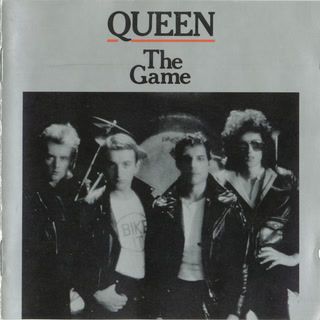
Main tuning: E Standard at concert pitch (+3 ¢), measured on EMI's 1994 CD.
The first album with Mack, and the start of Queen's steadier pitch: Crazy Little Thing Called Love and Save Me sit at A 440, Play the Game 7 cents above. On Crazy Little Thing Called Love, Mercury plays the acoustic rhythm guitar and May his solo on Taylor's Fender Esquire. Rock It is about 12 cents sharp, and Coming Soon about 42 cents sharp, between two notes; the audio check hears E for it.
Another One Bites the Dust is the big surprise. The record sits about 43 cents away from the A 440 grid, and the notes TuneLit hears in Deacon's riff are F, G♯ and B♭ of that grid, where an E-tuned bass would give E, G and A. So the open string is not E 43 cents flat but a pitch 57 cents above E, closer to F. Two Ultimate Guitar tabs say the same: the recording is a half step up. TuneLit lists the song as F Standard 43 cents flat (the same as E Standard 57 cents sharp). The 1994 EMI CD reads about 4 cents below the Japanese and Mobile Fidelity editions on every song of this album.
With TuneLit: E Standard at concert pitch for most of the album; F Standard −43 ¢ for Another One Bites the Dust.
Main tuning: E Standard at concert pitch (−3 ¢), measured on EMI's 1994 CD.
A soundtrack of short cues, many of them synthesiser and dialogue with little guitar, which makes several readings weak. The guitar pieces are clear: Flash's Theme, Football Fight and The Hero are in E Standard, The Hero about 8 cents sharp, Battle Theme 17 cents flat. Escape from the Swamp (−22 ¢), Marriage of Dale and Ming (−15 ¢) and Flash's Theme Reprise (−14 ¢) also have their own values. The Japanese remaster reads about 4 cents higher than this CD throughout.
With TuneLit: E Standard; use the song buttons for The Hero and Battle Theme.
Main tuning: E Standard at concert pitch (+1 ¢), measured on EMI's 1994 CD.
Queen's dance record has little guitar on its first side: Body Language is driven by its bassline, Staying Power by horns, and Deacon plays rhythm guitar on Back Chat and every guitar on Cool Cat. The pitch is all over the place on that side: Staying Power sits about 35 cents sharp (A ≈ 448.9), Back Chat 14 cents and Body Language 19 cents flat. The rock side is steady at concert pitch, with Put Out the Fire about 11 cents sharp. Under Pressure, built on the bass riff Wikipedia credits to Deacon, sits at A 440. Las Palabras de Amor adds May's 12-string acoustic.
With TuneLit: E Standard at concert pitch; Staying Power, Back Chat, Body Language and Put Out the Fire on their own buttons.
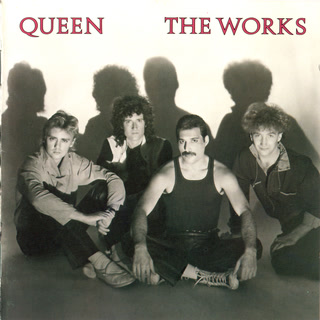
Main tuning: E Standard at concert pitch (+2 ¢), measured on EMI's 1994 CD.
Radio Ga Ga, I Want to Break Free and It's a Hard Life sit at A 440. Hammer to Fall, May's song built on a hard, angular riff, is the exception: about 33 cents flat (A ≈ 431.7) from start to end. Man on the Prowl, with May's solo on a Telecaster, is 12 cents sharp. Is This the World We Created...? is tabbed in E♭ Standard on the acoustic guitar, and the record sits about 17 cents below that (A ≈ 435.6).
With TuneLit: E Standard; Hammer to Fall at −33 ¢; E♭ Standard −17 ¢ for Is This the World We Created...?.
Main tuning: E Standard at concert pitch (−2 ¢), measured on the first CD, EMI CDP 7 46267 2.
The Highlander album sits close to A 440 throughout. Gimme the Prize is the one song with its own value, about 15 cents sharp. One Vision reads about 11 cents sharp at low confidence, so it keeps the album value; Friends Will Be Friends is in G major on the record. Deacon plays rhythm guitar on Pain Is So Close to Pleasure, and May does not play on One Year of Love.
With TuneLit: E Standard at concert pitch; Gimme the Prize at +15 ¢.
Main tuning: E Standard at concert pitch (+1 ¢), measured on the first CD, Parlophone CDP 7 92357 2.
Most of the album is at A 440, but four songs are not. Khashoggi's Ship sits about 47 cents flat, almost halfway to E♭, and the audio check hears E for it. I Want It All is 13 cents sharp, Scandal 27 cents sharp and Was It All Worth It 10 cents sharp. The Miracle, The Invisible Man and Breakthru stay at concert pitch.
With TuneLit: E Standard; the four songs above on their own buttons.
Main tuning: E Standard at concert pitch (+4 ¢), measured on the first CD, Parlophone CDP 7 95887 2.
The title song, with Steve Howe's flamenco guitar, These Are the Days of Our Lives, Bijou and The Show Must Go On all sit within a few cents of A 440. Headlong is in Drop D on its community tab, with the bass in Drop D too, and the audio check hears D as the lowest string. I'm Going Slightly Mad reads about 24 cents sharp, but at low confidence. The Hitman sits about 47 cents sharp, right between two notes: it is listed as E Standard +47 ¢, and the low notes TuneLit hears fit the other reading at least as well (E Standard about 53 cents flat).
With TuneLit: E Standard at concert pitch; Drop D for Headlong; both readings of The Hitman.
Main tuning: E Standard at concert pitch (+3 ¢), measured on the first CD (Parlophone, 1995).
Built after Mercury's death from his last vocals and older recordings, and steady at A 440. It's a Beautiful Day sits about 16 cents sharp and A Winter's Tale about 12 cents flat; Too Much Love Will Kill You, You Don't Fool Me and the title song are at concert pitch. Yeah, four seconds long, is too short to measure, and the long untitled closing track has no steady pitch.
With TuneLit: E Standard at concert pitch; It's a Beautiful Day and A Winter's Tale on their own buttons.
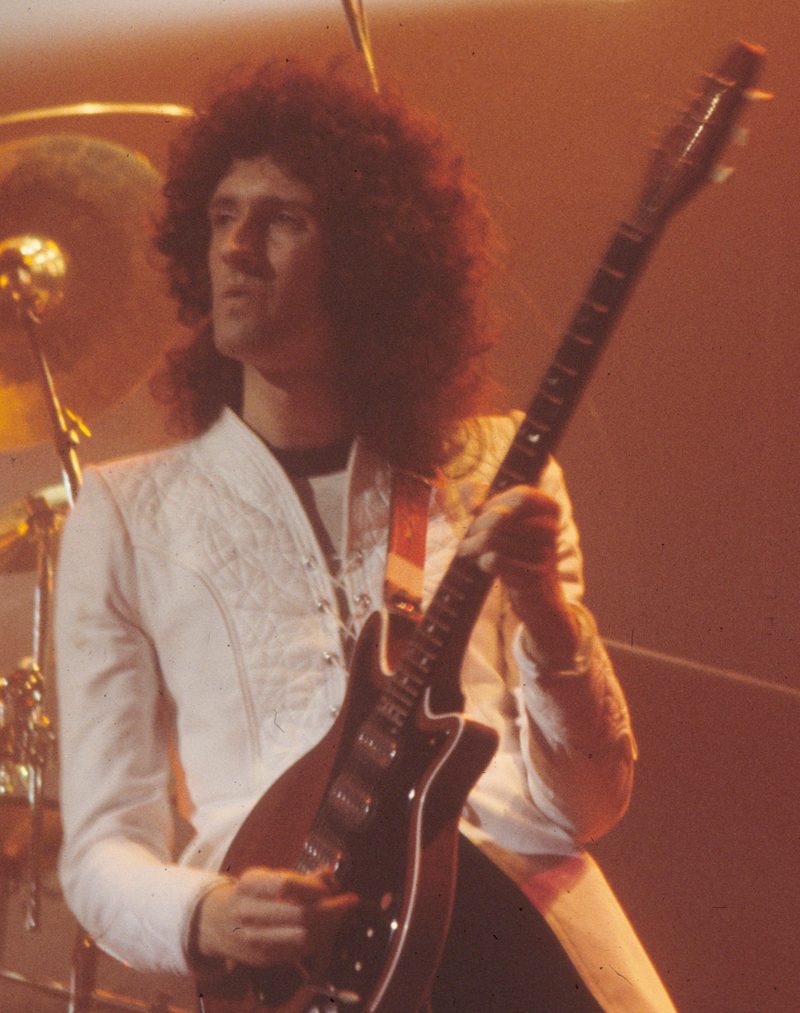
Brian May playing his home-built Red Special at the New Haven Coliseum, Connecticut, on 16 November 1977.
The story
Songs halfway between two notes
Seven songs sit 40 to 50 cents from A 440, close to the middle between two notes, where a tuner can name either:
Another One Bites the Dust: listed as F Standard 43 cents flat, from the audio check and two tabs (see The Game). The page also offers E Standard 43 cents flat.
Coming Soon: E Standard +42 ¢; the audio check agrees with E. The page offers E♭ Standard +42 ¢ as the other reading.
The Hitman: E Standard +47 ¢; the low notes fit E Standard 53 cents flat (A ≈ 427) as well, offered as the other reading.
Fight from the Inside: listed as E Standard at A 427, 51 cents flat. Its bass sits on an open string that reads closer to E 49 cents sharp, so if the button sounds a half step low, tune E Standard 49 cents sharp (A ≈ 452.7).
Long Away, Khashoggi's Ship and Seven Seas of Rhye: 41 to 47 cents flat, close to the edge but on the E side; the audio check agrees with E for all three.
Tune to the button, play the song's main riff or chord with the record, and switch to the other reading if it sounds a half step away.
The story
How to tune along
Tap the song's button, not the album's. On most Queen albums the songs differ by 10 to 30 cents, enough to sound sour.
Ignore the key. B♭, E♭ and A♭ songs are played on a standard-tuned guitar with barre shapes.
Retune for four songs: Fat Bottomed Girls, The Prophet's Song, White Man and Headlong drop string 6 to D; Is This the World We Created...? is tabbed a half step down.
Check the low-confidence songs by ear. We Will Rock You (its solo reads about 19 cents flat), Fun It (about 40 cents sharp), I'm Going Slightly Mad (about 24 cents sharp) and One Vision (about 11 cents sharp) use their album values; their notes say which way to move if the button sounds off.
Or move the record instead. TuneLit's Play along can shift a song to your own tuning, which is easier than retuning between every song of A Day at the Races and Jazz.
Evidence
How sure are these numbers?
Every guitar entry on these pages carries Measured by TuneLit, because its offset comes from our own analysis of a CD. The tuning name rests on other evidence:
Official: May said it himself. Fat Bottomed Girls is in Drop D, written that way, in his Total Guitar lesson, and his stage rig keeps a guitar in Drop D for it.
Widely reported: reference works agree. The Prophet's Song's Drop D, and E Standard as May's tuning across the catalogue.
Community: from tabs. White Man and Headlong in Drop D, Is This the World We Created...? in E♭ Standard, and the half step up of Another One Bites the Dust.
Keep a few limits in mind. Nine albums were measured from EMI's 1993 and 1994 remasters, one from Hollywood's 1991 reissue and one from a Mobile Fidelity disc, not from the first CDs of the 1980s; the cross-checks above suggest another edition sits within a few cents. Synthesiser-heavy songs, the Flash Gordon cues and the stamps of We Will Rock You give the estimator little to work with. And a measurement hears the result, not the cause: it cannot say whether a song is off because of a tape machine or a deliberate speed change.
Cheat sheet
Quick reference
Queen (1973): E Standard +11 ¢; Keep Yourself Alive −8 ¢, Jesus −9 ¢, The Night Comes Down and Seven Seas of Rhye... at concert pitch.
Queen II (1974): E Standard +7 ¢; The March of the Black Queen +18 ¢, Funny How Love Is +17 ¢, White Queen −4 ¢, The Loser in the End at concert pitch, Seven Seas of Rhye −41 ¢.
Sheer Heart Attack (1974): E Standard −4 ¢; Now I'm Here +7 ¢, Stone Cold Crazy +5 ¢, In the Lap of the Gods −13 ¢.
A Night at the Opera (1975): E Standard −15 ¢; '39 at concert pitch, Death on Two Legs −7 ¢, God Save the Queen +23 ¢. Drop D: The Prophet's Song.
A Day at the Races (1976): E Standard −21 ¢; Long Away −45 ¢, Drowse −10 ¢. Drop D: White Man.
News of the World (1977): E Standard −4 ¢; Sheer Heart Attack −18 ¢, Who Needs You −26 ¢, Sleeping on the Sidewalk +14 ¢, It's Late +11 ¢, Fight from the Inside half a semitone off.
Jazz (1978): E Standard +16 ¢; Dreamer's Ball −31 ¢. Drop D +24 ¢: Fat Bottomed Girls.
The Game (1980): E Standard at concert pitch; Rock It +12 ¢, Coming Soon +42 ¢. F Standard −43 ¢: Another One Bites the Dust.
Flash Gordon (1980): E Standard at concert pitch; The Hero +8 ¢, Battle Theme −17 ¢ and four cues with their own values.
Hot Space (1982): E Standard at concert pitch; Staying Power +35 ¢, Put Out the Fire +11 ¢, Back Chat −14 ¢, Body Language −19 ¢.
The Works (1984): E Standard at concert pitch; Man on the Prowl +12 ¢, Hammer to Fall −33 ¢. E♭ Standard −17 ¢: Is This the World We Created...?.
A Kind of Magic (1986): E Standard at concert pitch; Gimme the Prize +15 ¢.
The Miracle (1989): E Standard at concert pitch; I Want It All +13 ¢, Scandal +27 ¢, Was It All Worth It +10 ¢, Khashoggi's Ship −47 ¢.
Innuendo (1991): E Standard at concert pitch; The Hitman +47 ¢, between two notes. Drop D: Headlong.
Made in Heaven (1995): E Standard at concert pitch; It's a Beautiful Day +16 ¢, A Winter's Tale −12 ¢.
Golden rule: May's tuning is E Standard; the record's pitch is what changes. Tap the song's button.
Questions
What tuning does Queen use?
Mostly E Standard: 15 of 15 albums. Many albums also have songs in other tunings, and the album pages list them song by song.
Why does Queen sound out of tune when I play along?
Some records are not at concert pitch. A Day at the Races sits about 21 cents flat (A ≈ 435); Jazz sits about 16 cents sharp (A ≈ 444); A Night at the Opera sits about 15 cents flat (A ≈ 436). A guitar tuned to A 440 clashes with them. Every Tune button on these pages sets the measured pitch for you.
How did TuneLit measure Queen's records?
We played original CDs and LPs through TuneLit's pitch analysis: the strongest notes of each song are compared with the A 440 grid, which gives the offset in cents. That cannot tell the semitone, so the tuning name comes from interviews, the press and tabs, and for 1 song from TuneLit's semitone check from the audio, backed by a tab or source. The audio is never stored or published.
Colors and font
Font
Colors
Menu
Install the app
Android (Chrome): menu ⋮ → Install app or Add to Home screen.
Computer (Chrome, Edge): the install icon at the right end of the address bar.
iPhone: Safari → Share → Add to Home Screen.
It opens full screen and keeps tuning with no connection.