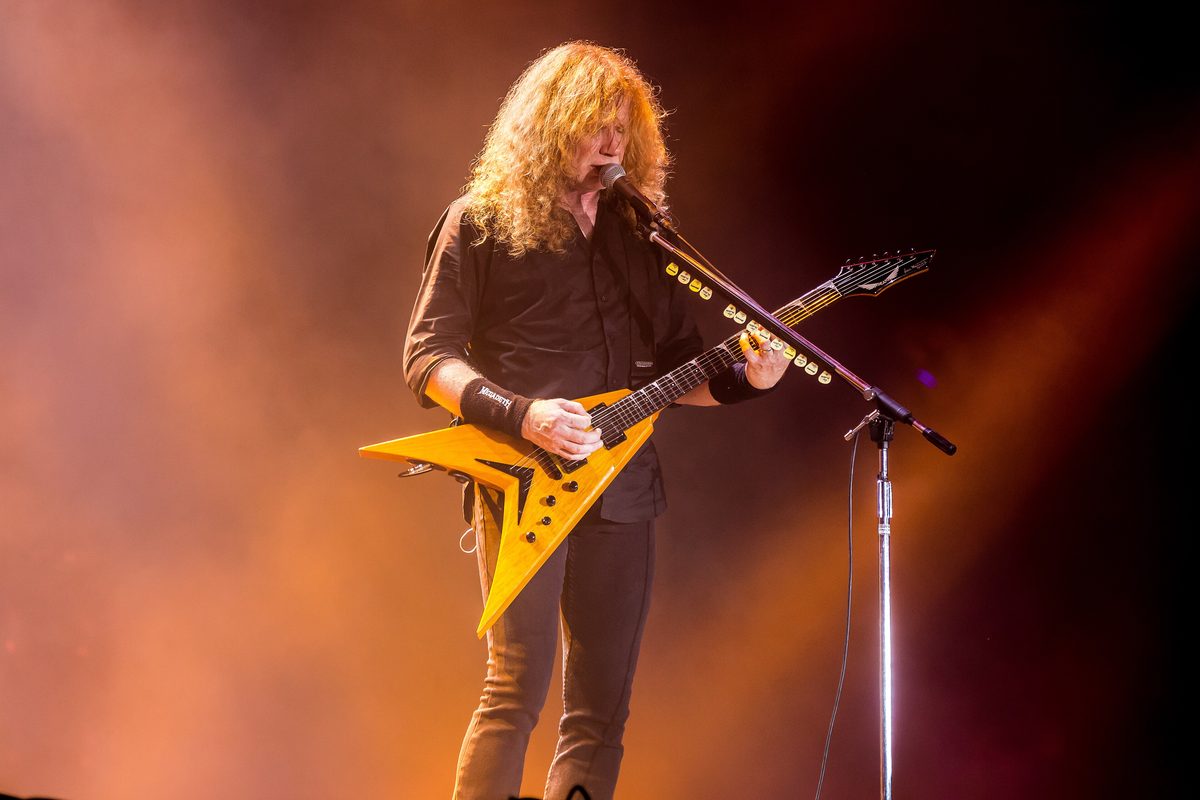
Dave Mustaine singing and playing a yellow V-shaped guitar with Megadeth at the Summer Breeze Open Air festival in Dinkelsbühl, Germany, on 17 August 2017.
In short
How Megadeth tunes
Megadeth recorded most of its albums in E Standard: Dave Mustaine has said he avoided detuning on purpose. The exceptions start with the first two records, which TuneLit measured well below concert pitch: Killing Is My Business... and Business Is Good! (1985) about 37 cents flat and Peace Sells... but Who's Buying? (1986) about 42 cents flat, so the right tuning is a flattened E Standard, not the E♭ some tabs use.
Read more
Youthanasia (1994) is the band's only E♭ Standard album, and Risk (1999) adds a D Standard song and a Drop D song. After the neck injury Mustaine dates to 2012, the band moved to D Standard, on stage from 2013 and on every album from Super Collider (2013) to the final self-titled album (2026). Every album from So Far, So Good... So What! on sits within about 9 cents of A 440, and the audio check confirmed the tabs on 146 of 173 songs and moved Crush 'Em from E♭ to E Standard.
Megadeth stayed in standard tuning for most of its career, and on purpose. Tune a guitar to plain E Standard (E A D G B E) and you can play along with everything from So Far, So Good... So What! (1988) to Th1rt3en (2011), apart from one album and a handful of songs. From Super Collider (2013) to the final self-titled album (2026) the band played a whole step down in D Standard (D G C F A D), and so did its live shows.
The exceptions are where it gets interesting. The first two albums are not at concert pitch at all: TuneLit measured Killing Is My Business... and Business Is Good! about 37 cents flat and Peace Sells... but Who's Buying? about 42 cents flat, almost halfway down to E♭. Youthanasia (1994) is the band's only album half a step down in E♭. And a few songs drop the low string to D, or the whole guitar a whole step, years before D Standard became the rule.
This page goes through all seventeen studio albums: what the tabs and the band say, what TuneLit measured from the owner's CDs, the songs that break the pattern and how to tune along. Every album in the list above opens a page where each song has a Tune button that sets the tuner to exactly that tuning, offset included.
Popular songs
How to tune for Megadeth's best-known songs
Each song has its own page: the exact tuning, the record's pitch, how to get there string by string, and how to move the record into your own tuning.
So Far, So Good... So What! to Countdown to Extinction
E Standard
none
1994
Youthanasia
E♭ Standard
none
1997–2011
Cryptic Writings to Th1rt3en
E Standard
Prince of Darkness (D Standard), Wanderlust and Promises (Drop D)
2013–2026
Super Collider to Megadeth
D Standard
none
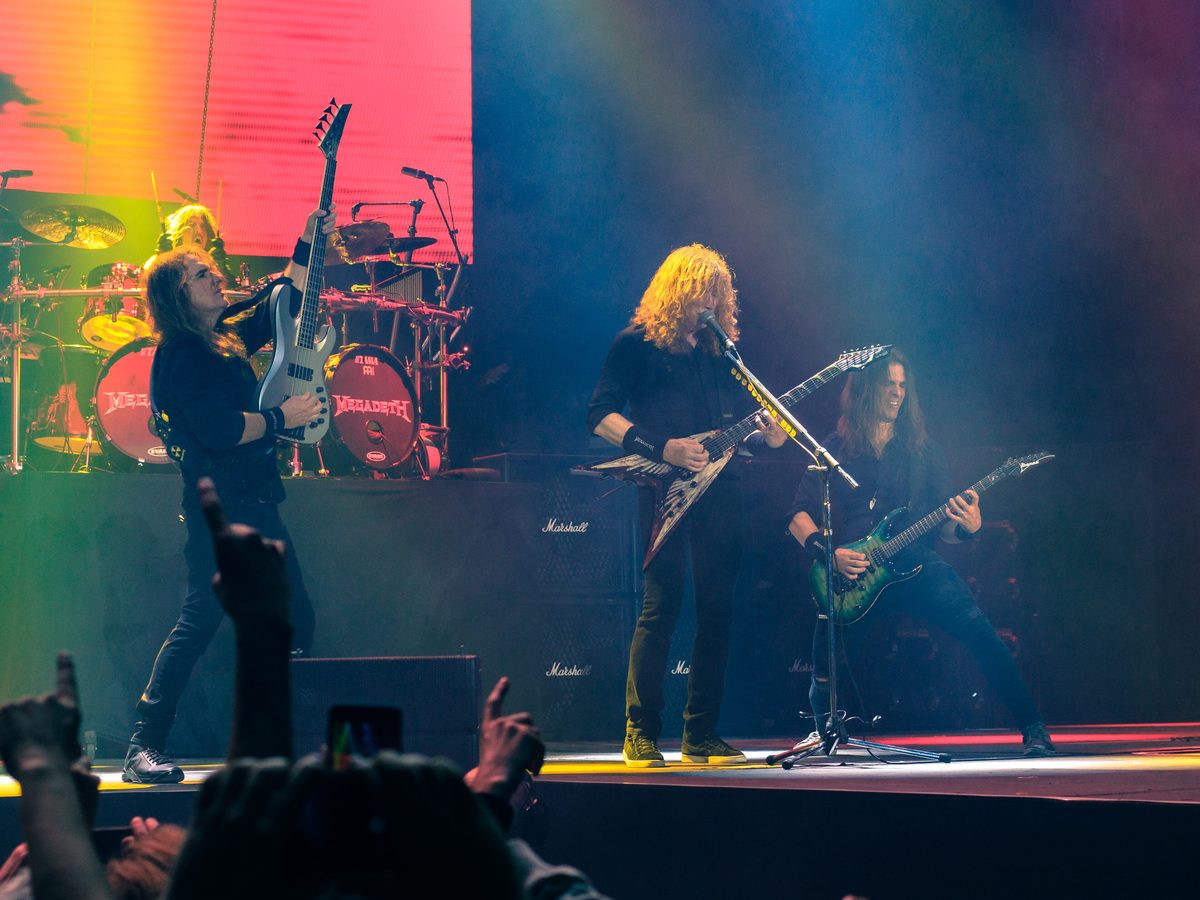
Megadeth at The O2 in London on 16 June 2018: David Ellefson on bass (left), Dirk Verbeuren on drums, Dave Mustaine and Kiko Loureiro (right).
The story
Standard tuning on principle, D Standard by necessity
In a 2022 Premier Guitar interview Dave Mustaine said he had kept to standard tuning deliberately, as a jab at bands that detuned to sound heavier. What changed it was physical. He dates a broken neck to 2012; the vertebrae were fused, and the plate left in his throat affects his voice. That, he said, is why the band tuned down to D. David Ellefson described the move in 2017 in the same practical terms: rather than stop, the band found a way around it by lowering the guitars.
The stage went first. By the summer of 2013 Megadeth was playing its whole set a whole step down, old songs included, and it stayed there. So a live Megadeth recording from 2013 on sits two semitones below the album the song comes from, Holy Wars and Peace Sells included. Mustaine's strings follow the tuning: Premier Guitar lists .010–.052 sets for standard tuning and .011–.054 for D.
Two things to know before you read any Megadeth tab:
"D Standard" is every string a whole step down, D G C F A D. It is not Drop D, where only the low string goes down (D A D G B E). Megadeth used both, D Standard for the late albums and Drop D for a couple of songs from 1999 and 2001.
Many popular tabs are re-tuned on purpose. Songsterr carries "E Standard" versions of the D Standard songs, "D Standard" versions of the old ones (to play along with the live band after 2013) and "E♭" versions of the first two albums. The album pages list the tuning of the record itself.
The story
Where the records actually sit
TuneLit measures how far a record sits from the A 440 grid, but only within one semitone: which note the strings are on comes from the tabs and sources. A second check listens for the lowest open string and for the note just under it (how we measure recordings). On Megadeth it agreed with the database on 146 of the 173 songs it was asked about. Most of the rest are songs whose riffs avoid the open low string, or where a 5-string bass goes below the guitars, and there it simply could not tell. It moved one song, Crush 'Em, and it confirms the D Standard of Super Collider.
From So Far, So Good... So What! on, nearly every album sits within a few cents of concert pitch, which an A 440 tuner handles fine. Five are clearly off:
Killing Is My Business... and Business Is Good! (1985): about 37 cents flat (A ≈ 431). Every song with a clear reading sits between 34 and 43 cents low.
Peace Sells... but Who's Buying? (1986): about 42 cents flat (A ≈ 429.5). Every song with a clear reading sits between 31 and 52 cents low.
So Far, So Good... So What! (1988): about 7 cents sharp (A ≈ 442).
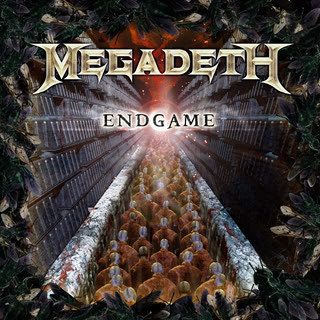
Endgame (2009): about 9 cents flat (A ≈ 438).
Super Collider (2013): about 7 cents sharp (A ≈ 442).
The first two are the ones that matter. A guitar in plain E Standard sits about 40 cents sharp of them, which is close to a quarter tone and easy to hear. That is why both "tune down a quarter step" and "E♭" versions of these songs circulate. The audio check settles which note the strings are on: it hears the flattened E on every song it could judge, not E♭. So the right tuning is E Standard, lowered by about 40 cents. An E♭ tuning at A 440 lands about 60 cents under these records, even further off than plain E.
No source explains the offset. On Peace Sells it was on the tapes before anyone remixed them: the original Capitol mix sits about 42 cents flat, the 2004 remix about 40, and the four Randy Burns mixes released as bonus tracks on the 2004 reissue between 29 and 38. A measurement cannot tell a guitar tuned low from a tape running slow; it only hears the result.
Main tuning: E Standard −37 ¢ (A ≈ 431), measured by TuneLit on the Combat CD.
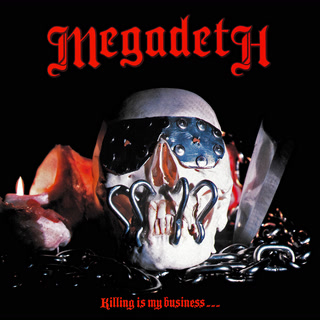
The debut was made for Combat Records on a budget of $8,000, plus a further $4,000 when that ran out, with Mustaine and Chris Poland on guitars, Ellefson on bass and Gar Samuelson on drums. Every tab plays it in E Standard shapes, and two transcribers add that the record sits about a quarter step flat. TuneLit confirms the direction and puts a number on it: the CD sits about 37 cents below A 440, with the songs between 34 and 43 cents low. A quarter step would be 50. The audio check hears the flattened E on six songs and cannot decide on the other two. Last Rites/Loved to Deth opens with a piano version of Bach's Toccata and Fugue in D minor, which gives no usable reading.
These Boots, the cover of Nancy Sinatra's hit with Mustaine's rewritten lyrics, is left off pressings after 1995 and came back on later reissues. The owner's copy of The Final Kill (2018), with Mark Lewis's remix and a new version of These Boots, sits at the same pitch as the original, about 35 cents flat.
With TuneLit: every Tune button opens E Standard −37 ¢. By hand, choose E Standard and set the reference A to 431 Hz.
Main tuning: E Standard −42 ¢ (A ≈ 429.5), measured on the 1986 Capitol CD.
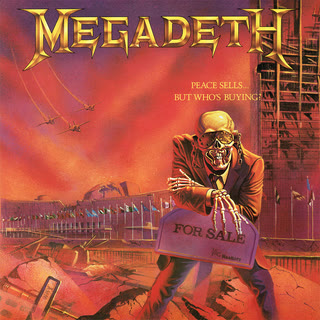
Recorded on a $25,000 budget from Combat; Capitol bought the album and had Paul Lani remix it. Every main tab is in E Standard, and one transcriber writes that all the songs are tuned down about a quarter step. TuneLit measured the CD about 42 cents flat. Most songs sit between 38 and 46 cents low. Devils Island is the highest, about 31 cents flat, and I Ain't Superstitious, the Willie Dixon cover, the lowest at about 52 cents flat, almost exactly halfway between E and E♭. Both get their own settings. Ellefson's famous bass intro to Peace Sells is in standard tuning like the guitars, so the bass needs the same −42 ¢.
The audio check hears the flattened E on seven songs. On I Ain't Superstitious it points a half step lower, but no tab agrees, so the song stays in E; see the list of songs in doubt below. Wake Up Dead's own reading is too unsure to use, so it keeps the album value.
With TuneLit: E Standard −42 ¢, −31 ¢ for Devils Island and A 427 for I Ain't Superstitious. The popular E♭ versions are about 58 cents under the record; do not use them to play along.
Main tuning: E Standard +7 ¢ (A ≈ 442), measured on the 1988 Capitol CD.
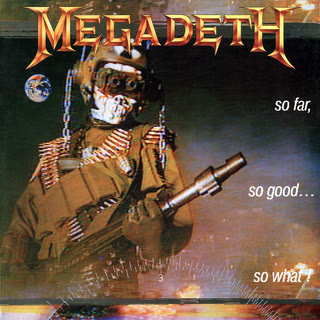
The only album with Jeff Young on guitar and Chuck Behler on drums, and the first one at concert pitch, or a little above it. Every song is tabbed in E Standard, and the audio check agrees on six of the eight. The record sits about 7 cents sharp, with two songs lower: the instrumental Into the Lungs of Hell measures right at concert pitch, and Anarchy in the U.K., the Sex Pistols cover, about 6 cents flat. Both get their own settings. The 2004 remix sits within a few cents of the original.
With TuneLit: E Standard +7 ¢; plain E Standard for Into the Lungs of Hell, and −6 ¢ for Anarchy in the U.K.
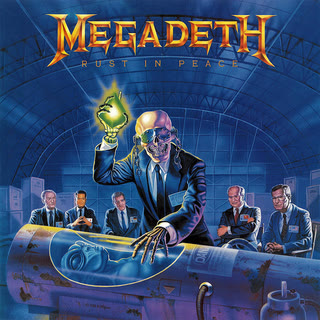
Main tuning: E Standard, measured at concert pitch (−2 ¢) on the 1990 Capitol CD.
Marty Friedman's and Nick Menza's first album, and plain E Standard throughout: Holy Wars... The Punishment Due, Hangar 18, Tornado of Souls and the rest are all tabbed that way, and the audio check agrees on seven of the nine songs. One song is clearly lower: Take No Prisoners measures about 16 cents flat (A ≈ 436), and the 2004 remix has it well below the other songs too, so it gets its own setting.
Hangar 18 has a twist for bass players. Songsterr's bass part drops the low string to D (D A D G), and the record backs it up: a low D, below anything the guitars can reach, is by far the most common bass note. That bass note is also why the audio check cannot decide on the guitars' E. The guitars stay in E Standard.
The 2004 remix sits about 7 cents higher than the original CD. If you play along with the remix, nudge Fine-tune up a little.
With TuneLit: E Standard for every song, −16 ¢ for Take No Prisoners; Hangar 18's button includes the Drop D bass.
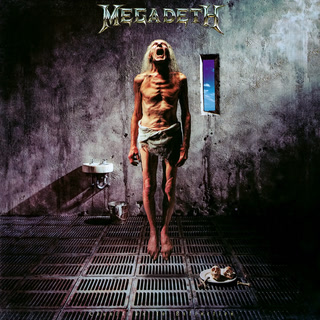
Main tuning: E Standard, measured at concert pitch (+3 ¢) on the 1992 Capitol CD.
The band's most commercially successful album is also its tidiest: every song tabbed in E Standard, every song within about 10 cents of A 440, and the audio check agreeing on all but one, where it could not decide. Symphony of Destruction, Sweating Bullets and the title track all sit within 5 cents of concert pitch. The 2004 remix reads about 2 cents higher.
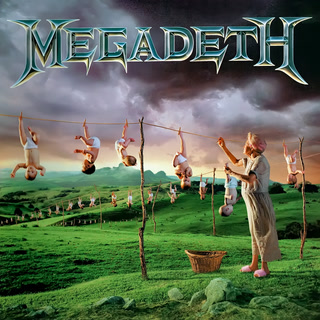
Main tuning: E♭ Standard +4 ¢ (A ≈ 441), measured on the 1994 Japanese CD.
The one Megadeth album half a step down (E♭ A♭ D♭ G♭ B♭ E♭). Every song is tabbed that way, Wikipedia notes that the whole original album was recorded in E♭, and the audio check hears E♭ as the lowest open string on all twelve songs. That is why A Tout le Monde sounds in F minor; the 2007 remake on United Abominations is in E Standard, a half step higher. No source we found explains why the band tuned down for this album. The record sits about 5 cents sharp, every song within a few cents of that.
The 2004 remix is a different story. Several songs read well above the original: A Tout le Monde, Train of Consequences and the title track about 12 to 14 cents higher, Victory and I Thought I Knew It All about 20, The Killing Road about 33 and Blood of Heroes about half a semitone away. The tuning is still E♭; only the pitch moved. The Tune buttons follow the original CD, so with the remix, tune by ear.
With TuneLit: E♭ Standard +5 ¢ for every song. By hand, E♭ Standard at A 441 is close enough.
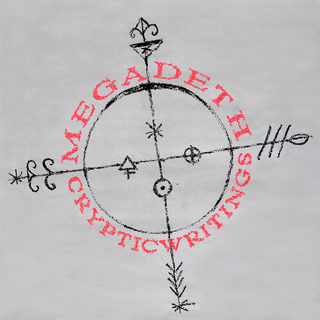
Main tuning: E Standard, measured at concert pitch (+1 ¢) on the 1997 Japanese CD.
Back to standard tuning after Youthanasia: Trust, Almost Honest, Use the Man, She-Wolf and the rest are tabbed in E Standard, and the audio check agrees on ten of the twelve songs. A Secret Place is the odd one: the record has a low D and E♭ in the bass octave and no open E at all, and a little-viewed Songsterr tab puts the song in Drop D. With a 5-string bass that can happen in E Standard too, so the song keeps the main tab's tuning; it is on the list of songs to check by ear. In the 2004 remix, I'll Get Even sits about 36 cents above the original; the other songs match within 2 cents.
Main tuning: E Standard, measured at concert pitch (+1.5 ¢) on the 1999 Japanese CD.
Friedman's last album with the band, with Jimmy DeGrasso on drums, and the one with the most tunings before 2013:
Prince of Darkness is a whole step down in D Standard, guitars and bass, fourteen years before that became the band's default. The audio check hears D as the lowest open string.
Wanderlust drops Mustaine's low string to D (Drop D), while Friedman's part stays in E Standard. The check hears the low D.
Crush 'Em is the song the check moved. The most-viewed Songsterr tab is in E♭, two others are in E Standard, and the check hears E as the lowest open string, about six times as often as the E♭ under it. It is listed in E Standard, like the rest of the album.
Enter the Arena, the 52-second piece before Crush 'Em, is tabbed in E Standard, but the check hears E♭ as its lowest note. Its own measurement is weak and no tab says E♭, so it stays in E; check it by ear.
The whole album sits within a few cents of A 440. In the 2004 remix, The Doctor Is Calling and Wanderlust read about 24 and 34 cents above the original.
With TuneLit: E Standard for most songs, D Standard for Prince of Darkness and Drop D for Wanderlust, all at concert pitch.
Main tuning: E Standard, measured at concert pitch (0 ¢) on the 2001 Japanese CD.
Al Pitrelli's only studio album with the band. Everything is in E Standard except Promises, where the distorted rhythm part and the bass drop the low string to D, while the clean guitar and the solo stay in standard; the audio check hears the low D. Two songs sit clearly below the rest of the album: Recipe for Hate... Warhorse about 11 cents flat and Losing My Senses about 9 cents flat. Each gets its own setting. Return to Hangar, the sequel to Hangar 18, is in E Standard like the original.
With TuneLit: E Standard, Drop D for Promises, −11 ¢ for Recipe for Hate... Warhorse and −9 ¢ for Losing My Senses.
Main tuning: E Standard, measured at concert pitch (+1 ¢) on the 2004 Sanctuary CD.
Recorded after Mustaine's arm injury had stopped the band in 2002, with Chris Poland back on lead guitar for the sessions. Every song is tabbed in E Standard, the record sits within a few cents of A 440, and the audio check agrees on eleven of twelve songs.
Main tuning: E Standard, measured at concert pitch (+1 ¢) on the 2007 Japanese CD.
Glen Drover on guitar, James LoMenzo on bass and Shawn Drover on drums; E Standard throughout, and the audio check agrees on every song. À Tout le Monde (Set Me Free), the remake with Cristina Scabbia, is in standard tuning, a half step above the 1994 original, so the two versions need different tunings. One song is lower: Never Walk Alone... A Call to Arms measures about 11 cents flat and gets its own setting.
With TuneLit: E Standard, −11 ¢ for Never Walk Alone... A Call to Arms.
Main tuning: E Standard −9 ¢ (A ≈ 438), measured on the 2009 Japanese CD.
Chris Broderick's first album, in E Standard like its neighbours, but the one late album that sits clearly below concert pitch: about 9 cents flat. The songs spread from about 3 cents flat (The Hardest Part of Letting Go... Sealed with a Kiss) to about 16 cents flat (Bite the Hand and Bodies), but none clearly enough apart from the rest to get its own setting. The audio check agrees on eight songs. On the opening instrumental, Dialectic Chaos, it points a half step up, the usual sign of a riff that avoids the open string; the bass there goes below the guitars.
Main tuning: E Standard, measured at concert pitch (−4 ¢) on the 2011 digital release.
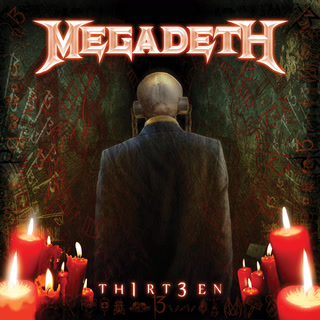
Ellefson's return, and the last Megadeth album in standard tuning. It mixes new songs with reworked older ones such as New World Order and Millennium of the Blind. Every song is tabbed in E Standard, all of them sit 0 to 7 cents flat, and the audio check agrees on twelve of thirteen.
Main tuning: D Standard +7 ¢ (A ≈ 442), measured on the 2013 digital release.
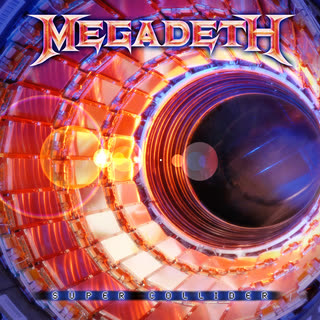
Recorded from late 2012 into early 2013, after Mustaine's neck injury, and the first album a whole step down. Every Songsterr tab is in D Standard. Premier Guitar's 2022 feature calls The Sick, the Dying... and the Dead! the band's first album in D, but the record says otherwise: the audio check hears D as the lowest open string on eight of the eleven songs, and none of its answers points to E. On Forget to Remember it points to E♭, but the song's riffs never touch the open D, which is when the check guesses high; it stays in D.
The record sits about 7 cents sharp, the songs between 3 and 14 cents high.
Main tuning: D Standard, measured at concert pitch (+3 ¢) on the 2016 CD.
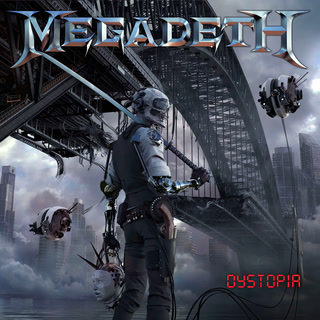
Kiko Loureiro's first album, with Chris Adler on drums. The title track won the 2017 Grammy for Best Metal Performance. Every song is tabbed in D Standard, Premier Guitar's 2016 rundown lists Mustaine's .011–.054 strings for D tuning, and the audio check agrees on nine of the eleven songs. Death from Within measures about 13 cents sharp and gets its own setting. Songsterr also carries "E tuning" versions of several songs, re-tuned for players who do not want to retune.
With TuneLit: D Standard, +13 ¢ for Death from Within.
Main tuning: D Standard, measured at concert pitch (+2 ¢) on the 2022 Japanese CD.
The album Mustaine and Loureiro both describe as D Standard in Premier Guitar, with Dirk Verbeuren on drums and Steve Di Giorgio on bass. The audio check agrees on ten of the twelve songs. On Mission to Mars it points to E♭: the open D never sounds there, while a low C from the bass does, so the song stays in D.
Main tuning: D Standard, measured at concert pitch (+2 ¢) on the 2026 CD.
The final album, with Teemu Mäntysaari on guitar, James LoMenzo back on bass and Verbeuren on drums. Every song is tabbed in D Standard, guitars and bass, and the audio check agrees on eight of eleven. I Am War measures about 10 cents sharp and gets its own setting. Some tabs of I Don't Care use Drop C instead; the record has hardly any low C, so D Standard fits better.
The standard edition ends with Ride the Lightning, labelled a bonus track: the Metallica song Mustaine co-wrote, played a whole step below Metallica's 1984 recording in E Standard.
With TuneLit: D Standard, +10 ¢ for I Am War.
The story
Tabs that turned out wrong, and songs still in doubt
The tabs held up well. Where they did not:
The E♭ versions of Killing Is My Business... and Peace Sells... songs. The records are E Standard about 40 cents flat; E♭ at A 440 is about 60 cents under them.
Crush 'Em (Risk): the most-viewed Songsterr tab is in E♭; the record and two other tabs say E Standard.
"First album in D": Premier Guitar gave that title to The Sick, the Dying... and the Dead!, but Super Collider (2013) and Dystopia (2016) are already in D Standard.
Songs worth checking by ear before you trust a Tune button:
I Ain't Superstitious (Peace Sells): the audio check points a half step below the tabs' E, and the song measures right between two notes. Its button keeps the tabs' E at A 427.
Enter the Arena (Risk): tabbed in E Standard, but E♭ is the lowest note the check hears.
A Secret Place (Cryptic Writings): E Standard or Drop D? Low D and E♭ are heard, open E never.
Songs where the check points a half step up because the riff avoids the open low string: Anarchy in the U.K., Ecstasy, Dialectic Chaos, Forget to Remember and Mission to Mars. The tabs' tunings stay.
Songs where the check could not decide, usually because a 5-string bass goes below the guitars: Last Rites/Loved to Deth, Chosen Ones, Into the Lungs of Hell, Hangar 18, Poison Was the Cure, Foreclosure of a Dream, She-Wolf, Moto Psycho, Back in the Day, 1,320', The Right to Go Insane, We the People, Super Collider, Off the Edge, The Emperor, Foreign Policy, The Sick, the Dying... and the Dead!, Tipping Point, I Don't Care and Let There Be Shred.
The story
Other versions: remixes, live albums, soundtrack songs
The 2004 remixes of the Capitol albums are not always at the original's pitch. Peace Sells, So Far, So Good... So What! and Countdown to Extinction stay within a few cents, Rust in Peace reads about 7 cents higher, and Youthanasia, plus single songs on Cryptic Writings and Risk, moved by 10 to 50 cents. The Tune buttons are set for the original CDs.
Live albums from 2013 on, and the band's shows since then, are a whole step down, so the old songs are in D Standard there. TuneLit has not measured any live Megadeth release.
Hidden Treasures (1995), the EP of soundtrack songs, is not in the album list. Its Angry Again (1993) and Diadems (1995) are tabbed in E♭ like Youthanasia, while 99 Ways to Die is in E Standard.
The story
Practical advice
Start from E Standard. Ten of the seventeen albums, from So Far, So Good... So What! to Th1rt3en apart from Youthanasia, are E Standard within 10 cents of A 440.
For the first two albums, tune flat, not to E♭. Set the reference A to about 431 Hz for Killing Is My Business... and 429.5 Hz for Peace Sells..., or use the Tune buttons. A 427 for I Ain't Superstitious.
Keep a second guitar a whole step down for Super Collider, Dystopia, The Sick, the Dying... and the Dead!, the 2026 album and Prince of Darkness. Mustaine's heavier .011–.054 set keeps the D strings from going slack.
Youthanasia is the one E♭ album. A guitar in E Standard is a half step sharp of every song on it, A Tout le Monde included.
Drop D is a one-string change. For Wanderlust and Promises, lower only the low E to D.
Match the version you play along with. A live recording from 2013 on is a whole step below the album, and the 2004 remixes of Youthanasia and Rust in Peace sit above the original CDs.
Questions
What tuning does Megadeth use?
Mostly E Standard: 12 of 17 albums. Super Collider, Dystopia, The Sick, the Dying... and the Dead! and Megadeth are in D Standard; Youthanasia is in E♭ Standard. Many albums also have songs in other tunings, and the album pages list them song by song.
Why does Megadeth sound out of tune when I play along?
Some records are not at concert pitch. Peace Sells... but Who's Buying? sits about 42 cents flat (A ≈ 429); Killing Is My Business... and Business Is Good! sits about 37 cents flat (A ≈ 431). A guitar tuned to A 440 clashes with them. Every Tune button on these pages sets the measured pitch for you.
How did TuneLit measure Megadeth's records?
We played original CDs and LPs through TuneLit's pitch analysis: the strongest notes of each song are compared with the A 440 grid, which gives the offset in cents. That cannot tell the semitone, so the tuning name comes from interviews, the press and tabs, and for 1 song from TuneLit's semitone check from the audio, backed by a tab or source. The audio is never stored or published.
Colors and font
Font
Colors
Menu
Install the app
Android (Chrome): menu ⋮ → Install app or Add to Home screen.
Computer (Chrome, Edge): the install icon at the right end of the address bar.
iPhone: Safari → Share → Add to Home Screen.
It opens full screen and keeps tuning with no connection.