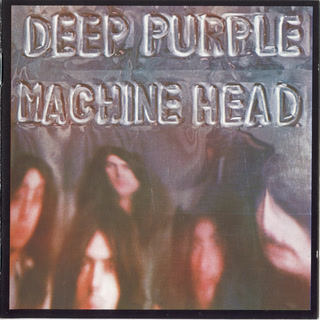
Deep Purple · 1972 · Studio album
Machine Head tuning.
E Standard, about 6 cents sharp (A ≈ 442), measured on the CD. 2 of 7 songs are tuned differently.
Album tuning
E Standard +6 ¢
About 6 cents sharp (A ≈ 442), measured on the CD.
MeasuredFrom tabs
Measured by TuneLit
6 ¢ sharp
| Source | Offset | Equivalent A | Songs | Spread | Confidence |
|---|---|---|---|---|---|
| CD, EMI CDP 7 46242 2 | +6.3 ¢ | A 441.6 | 7 | +2.3 to +8.1 ¢ | High |
Before we measured, sources said: E Standard, with no pitch given (community).
Recorded on 6–21 December 1971 in Montreux with the Rolling Stones Mobile Studio, after the casino fire that Smoke on the Water tells about. E Standard throughout. The EMI CD sits about 6 ¢ sharp (A ≈ 441.6), but the songs spread out: Highway Star reads close to concert pitch (+1 ¢), Smoke on the Water +8 ¢, Lazy about +14 ¢ at low confidence, and Maybe I'm a Leo and Space Truckin' 19 to 20 ¢ sharp, each of those two with its own Tune button.
7 songs · 2 tuned differently
Every song, ready to tune
Tune opens the tuner in that song's tuning, pitch included. Play along opens the song player set to that tuning, so the track plays in yours. What the labels mean
-
1. Highway Star
E Standard +6 ¢Measured
Notes
The opener, and a staple of the band's concerts ever since. On this CD it reads about +1 ¢, near concert pitch, while the album as a whole sits about 6 ¢ sharp; the difference is too small for its own value.
-
2. Maybe I'm a Leo
Different pitch
E Standard +19 ¢Measured
Notes
About 19 ¢ sharp on this CD (A ≈ 444.8), the second-highest song of the album.
Ritchie Blackmore in standard tuning: every tab of the album (Songsterr, the main ones credited to his parts) has the guitar and Roger Glover's bass in E Standard. TuneLit measured this song on its own about 19 ¢ sharp (A ≈ 444.8), 13 ¢ above the album value.
-
3. Pictures of Home
E Standard +6 ¢Measured
-
4. Never Before
E Standard +6 ¢Measured
-
5. Smoke on the Water
E Standard +6 ¢Measured
Notes
The riff is a G minor blues line in parallel fourths, plucked with the fingers. On this CD the song reads +8 ¢, close to the album's +6 ¢.
-
6. Lazy
E Standard +6 ¢Measured
Notes
A G blues with long organ and guitar solos; it reads about +14 ¢ at low confidence, so it keeps the album's value.
-
Notes
About 20 ¢ sharp on this CD (A ≈ 445).
Ritchie Blackmore in standard tuning: every tab of the album (Songsterr, the main ones credited to his parts) has the guitar and Roger Glover's bass in E Standard. TuneLit measured this song on its own about 20 ¢ sharp (A ≈ 445), 13 ¢ above the album value.
What the labels mean
- Measured
- TuneLit measured the pitch on an original CD or LP. The tuning name still comes from the sources.
- Official
- The band, a member, their producer or their guitar tech said it.
- Widely reported
- Trusted outlets, guides and tabs agree, but the band did not say it directly.
- From tabs
- From community tabs, or from players who tune along with the record.
- Disputed
- Sources disagree. The likeliest setting is shown; the notes name the other one.
Each song shows one label, the strongest it has, in this order. How we measure recordings →
Questions
What tuning is Machine Head in?
Deep Purple recorded Machine Head (1972) in E Standard, about 6 cents sharp (A ≈ 442), measured by TuneLit on the CD. Maybe I'm a Leo uses E Standard +19 ¢; Space Truckin' uses E Standard +20 ¢.
Why does Machine Head sound out of tune with my guitar?
Maybe I'm a Leo sits about 19 cents sharp (A ≈ 445), so a guitar tuned to A 440 clashes with it. The Tune buttons on this page set the tuner's reference to match the record, song by song, so you only tune the strings.