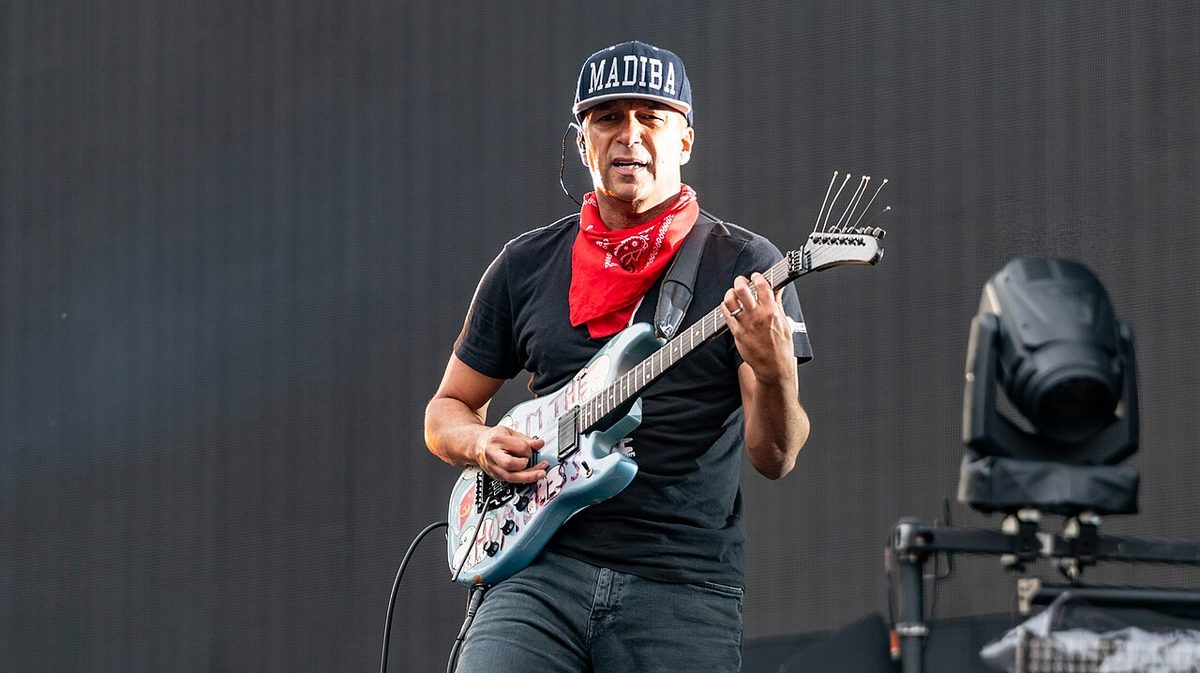
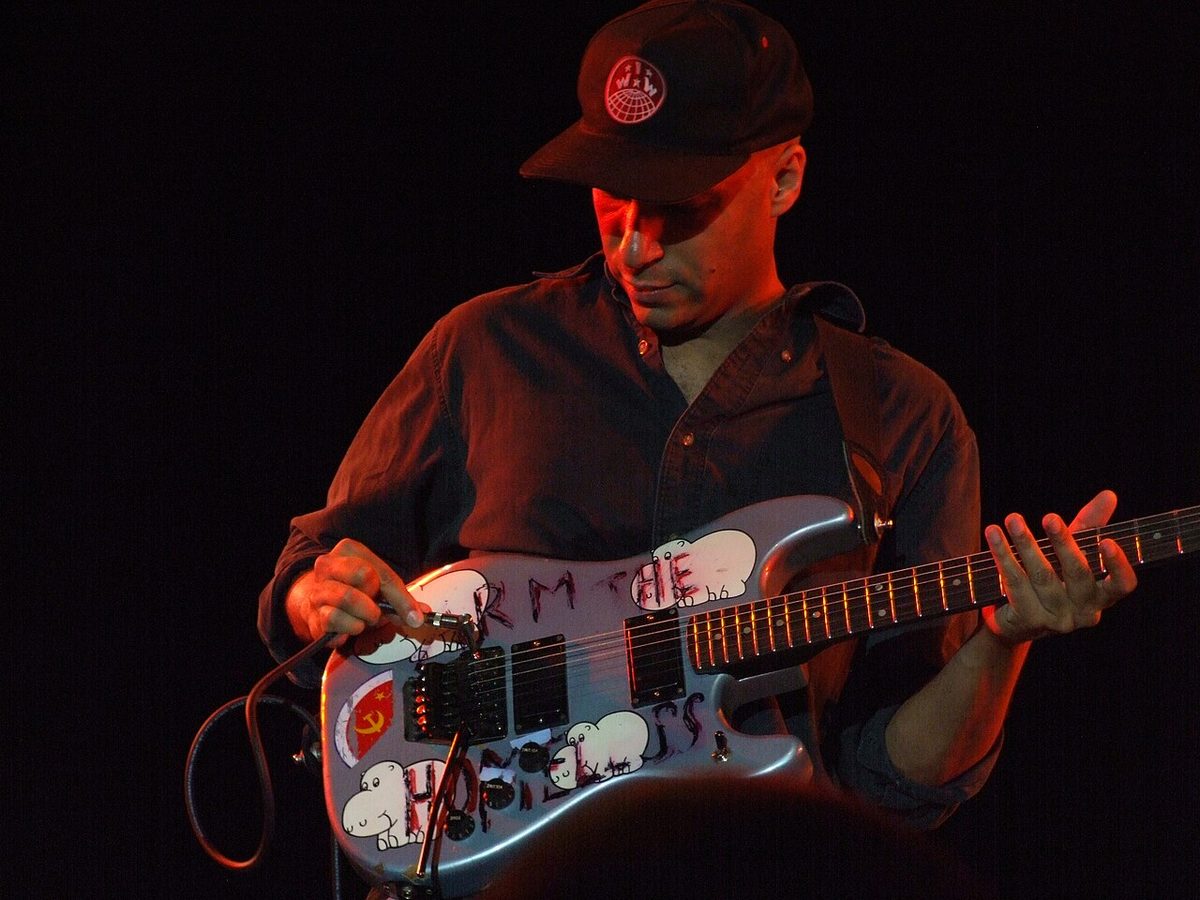
Tom Morello playing as the opening act at Muse's concert in Bristol, England, on 5 June 2019.
In short
How Rage Against the Machine tunes
Tom Morello has always kept it simple: one guitar for the songs in E, in normal tuning, and a Telecaster for the songs in Drop D. He names Killing in the Name, Freedom and Testify among the Drop D songs himself.
Read more
For the rest, TuneLit listened to the bass: Tim Commerford tunes down with the guitar, so a Drop D song has a low D under it, a whole step below a normal bass's lowest note. That puts 17 of the 45 album songs in Drop D. Two songs go elsewhere: Calm Like a Bomb lowers string 6 to B, and Bulls on Parade sounds a half step down. TuneLit measured the four studio albums. The debut and Evil Empire sit about 10 cents sharp (A ≈ 442.5), The Battle of Los Angeles about 4 cents sharp and Renegades at concert pitch. A few songs stand apart: Take the Power Back is about 42 cents sharp, almost halfway to the next note, Wind Below 28 cents sharp and Roll Right 33 cents flat.
Rage Against the Machine made four studio albums with one guitarist, and he has explained his tunings more plainly than most. Tom Morello told MusicRadar that his home-built "Arm the Homeless" guitar is for the songs in E and his Telecaster is for the songs in Drop D. The first has a locking nut, so it cannot be retuned quickly; the Telecaster was bought, by trading an amplifier head, for exactly that job. He also said who showed him Drop D: Maynard James Keenan of Tool.
So every Rage song is in one of two tunings, with two exceptions, and the question for anyone playing along is only: which songs are which? Morello names three Drop D songs in interviews. For the others TuneLit measured the owner's CDs and listened to the low notes. This page explains how, goes through the four albums and shows what the measurements found. The album list above opens each record, where every song has a Tune button that sets the tuner exactly as listed, offset included.
Popular songs
How to tune for Rage Against the Machine's best-known songs
Each song has its own page: the exact tuning, the record's pitch, how to get there string by string, and how to move the record into your own tuning.
Normal tuning (E A D G B E) is where most of the catalogue sits: Bombtrack, Bullet in the Head, Know Your Enemy, Guerrilla Radio, Sleep Now in the Fire.
Drop D (D A D G B E) lowers string 6 a whole step. Lower it until it sounds an octave below the open string 4. The three low strings then make a power chord under one finger, which is how the riffs of Killing in the Name, Freedom and Testify are played.
Tim Commerford's bass follows the guitar: E A D G for the songs in E, and string 4 down to D for the Drop D songs.
Tom Morello at the Nokia Theatre, New York, on 17 April 2008.
The story
How TuneLit told them apart
A bass in normal tuning cannot play lower than its open E. A bass in Drop D can, and in these songs it does, all the time: the riff sits on the open low D. So TuneLit counted the lowest notes of each song. In Killing in the Name, which Morello names as Drop D, a low D is the commonest bass note and the low E hardly sounds. In Bullet in the Head, a song in E, it is the other way round: the low E is the commonest note and there is no D under it.
Every song falls clearly on one side or the other, apart from a few listed below. The songs Morello names come out as Drop D, which is a good sign that the method works here. The result:
Rage Against the Machine: Killing in the Name, Take the Power Back, Wake Up, Township Rebellion and Freedom are in Drop D; the other five in normal tuning.
Evil Empire: People of the Sun, Revolver, Snakecharmer and Tire Me are in Drop D; Bulls on Parade is a half step down; the other six in normal tuning.
The Battle of Los Angeles: Testify, Born of a Broken Man, Voice of the Voiceless and Ashes in the Fall are in Drop D; Calm Like a Bomb has its low B; the other seven in normal tuning.
Renegades: Renegades of Funk, How I Could Just Kill a Man, The Ghost of Tom Joad and Street Fighting Man are in Drop D; the other eight in normal tuning.
Three songs are left in doubt. Settle for Nothing and Beautiful World have too few low notes to say. War Within a Breath has a bass note lower than either tuning explains; it is listed in normal tuning until someone checks it by ear.
The story
The two exceptions
Calm Like a Bomb: B A D G B E. Reverb's article on Morello's sound says the song is tuned down to B, and tabs lower string 6 alone, five semitones, leaving the other strings as they are. TuneLit's check from the audio hears the lowest string on B. A string lowered that far is slack on a normal set: pick it lightly, or keep a heavier string 6 (a .056 or more) on a guitar for this song.
Bulls on Parade: a half step down. The riff is fingered as F♯, on fret 2 of string 6, but on the record it sounds as F, and F is by far the commonest low note TuneLit hears in the song. So the guitar and bass are a half step down: E♭ A♭ D♭ G♭ B♭ E♭. It is the only song on the four albums tuned that way.
TuneLit lab
What TuneLit measured
Album
Sources said
Measured
Reference A
Songs with their own value
Rage Against the Machine (1992)
E Standard and Drop D
+10 ¢
A ≈ 442.5
Take the Power Back +42 ¢, Freedom 0 ¢
Evil Empire (1996)
E Standard and Drop D
+10 ¢
A ≈ 442.5
Wind Below +28 ¢, Roll Right −33 ¢
The Battle of Los Angeles (1999)
E Standard and Drop D
+4 ¢
A ≈ 441.1
none
Renegades (2000)
E Standard and Drop D
0 ¢
A ≈ 440.1
Down on the Street +9 ¢, Street Fighting Man +10 ¢
The first two albums sit about 10 cents sharp, the third a little sharp and the fourth at concert pitch. For the first two albums the library holds two different CD editions each, a 2008 Japanese reissue and a 2016 audiophile one, and they agree with each other within about 2 cents on every song, so the offsets belong to the recordings and not to one pressing.
One caution about this band in particular. Morello bends pitch with a Whammy pedal, a toggle switch and a wah in almost every song, and the vocals are rapped. There is less steady, pitched sound to measure than on most rock records, and the confidence figures are lower than usual. Treat single-song differences of a few cents as noise.
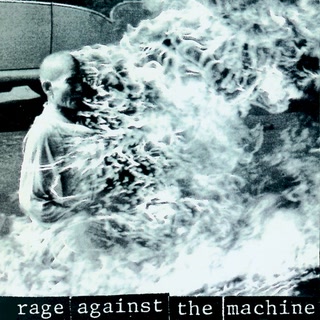
The debut, produced by Garth Richardson. TuneLit measured it about 10 cents sharp (A ≈ 442.5). Freedom, the closing song, sits at concert pitch and has its own setting.
Take the Power Back is the odd one: about 42 cents sharp, almost halfway between two notes. An ordinary tuner would call such a record either note, so the song's page offers both readings: Drop D raised 42 cents, or a half step higher lowered 58 cents. They are the same pitch. Start with the first.
With TuneLit: E Standard +10 ¢ for the songs in E, Drop D +10 ¢ for the Drop D songs, Freedom at A 440.
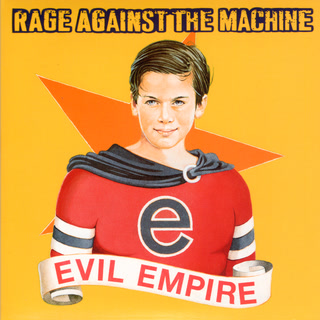
Produced by Brendan O'Brien, with Bulls on Parade, People of the Sun and Vietnow. The album again sits about 10 cents sharp. Two songs near the end are far from the rest and have their own settings: Wind Below, about 28 cents sharp (A ≈ 447.2), and Roll Right, about 33 cents flat (A ≈ 431.7). That is a spread of 60 cents between two neighbouring songs, far more than a guitar drifts by itself.
With TuneLit: E Standard +10 ¢, Drop D +10 ¢ for its four songs, and Bulls on Parade a half step down at +10 ¢.
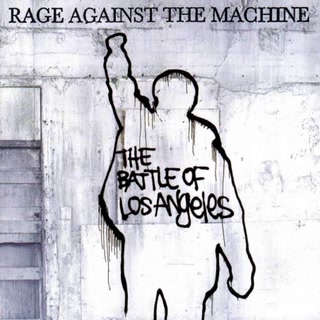
Again with Brendan O'Brien: Testify, Guerrilla Radio, Calm Like a Bomb and Sleep Now in the Fire. TuneLit measured an original Japanese CD about 4 cents sharp (A ≈ 441.0), and no song is far enough from that to need its own value.
With TuneLit: E Standard +4 ¢, Drop D +4 ¢ for its four songs, and Calm Like a Bomb with its low B at +4 ¢.
The last album, twelve cover versions produced by Rick Rubin, from Bob Dylan and the Rolling Stones to Cypress Hill and Minor Threat. It sits at concert pitch. Two songs next to each other, Down on the Street and Street Fighting Man, are about 10 cents sharp. Pistol Grip Pump reads almost exactly between two notes, but with too little confidence to act on; if it sounds off, tune by ear against its riff.
With TuneLit: E Standard at A 440, Drop D at A 440 for its songs.
The story
Playing along
Two guitars, as Morello does it, save a lot of retuning. With one guitar, group the songs: play the songs in E together, then lower string 6 and play the Drop D songs.
On the first two albums use the Tune button; 10 cents is enough to make the unison riffs with the bass sound sour.
Morello's pitch tricks are effects, not tunings. The Whammy pedal in Killing in the Name or Know Your Enemy moves the guitar's pitch by fixed steps; the strings stay where they are.
How the figures on this page were found, and how far to trust them, is on How we measure recordings.
Questions
What tuning does Rage Against the Machine use?
Mostly E Standard: 4 of 4 albums. Many albums also have songs in other tunings, and the album pages list them song by song.
How did TuneLit measure Rage Against the Machine's records?
We played original CDs and LPs through TuneLit's pitch analysis: the strongest notes of each song are compared with the A 440 grid, which gives the offset in cents. That cannot tell the semitone, so the tuning name comes from interviews, the press and tabs. The audio is never stored or published.
Menu
Theme
Language
This page is in English for now. Each language opens its home page.
Install the app
Android (Chrome): menu ⋮ → Install app or Add to Home screen.
Computer (Chrome, Edge): the install icon at the right end of the address bar.
iPhone: Safari → Share → Add to Home Screen.
It opens full screen and keeps tuning with no connection.